Month: March 2009

  • How to be Lucky

    Although it’s hard to believe, luck is actually something that can be learned. Richard Wiseman, a psychologist, known for studying quirky topics, decided to spend a few years using science to learn what luck actually is, and how people can get it. His book The Luck Factor describes his findings, which I’ll review here. Luck seems like a strange thing to study scientifically, but as you’ll see, it can be done.

    The common sense notion of ‘luck’ is that it’s what you get when you mix chance with benefit; and both have to be present. For example, accidentally leaving your science experiment out overnight is probably quite a rare occurrence, but it’s not lucky, because it’s not beneficial. Unless your name is Alexander Fleming, that is, and a piece of mould falls into your petri dish leading you to discover penicillin. That’s lucky!

    So you’d think that being lucky, by definition, is something you can’t control. Because once you start to control it, you’re taking chance out of the equation. You’re moving away from the concept of luck, and into something else; ‘strategy’, maybe. But isn’t it interesting, that when we talk about luck as a trait – when we say someone is a ‘lucky’ person – we don’t seem to worry about chance? We don’t investigate what they did to improve their odds, we just see some beneficial things and say “they’re lucky.”

    “From one point of view, nothing is based purely on luck – just better or worse odds.”

    From one point of view, luck exists, and is random. From another point of view, nothing is based purely on luck – just better or worse odds. From that perspective, there are things you can do to improve your luck. This doesn’t involve influencing the outcome of completely random events, like lottery draws; it means increasing the chance of certain outcomes happening, like buying more tickets.

    This, in part, is what ‘lucky’ people do – buy more ‘tickets’ in all areas of their lives. They think and act in different ways to unlucky people. The end result of these thoughts and actions is more ‘wins’; but as it’s not apparent that they are doing anything different, it seems like pure luck.

    Wiseman spent years researching luck, by studying exceptionally lucky and unlucky people, and noticing the differences between them. From this work he devised a system that people can use to become luckier. The system boils down to the following four principles:

    1) Maximise Your Chance Opportunities

    You’re more likely to win the lottery if you buy more tickets. There are many similar things you can do to increase your chance of having a ‘lucky’ experience. Networking is the main one. The more people you know and are open to knowing, the more likely you are to meet someone who knows of a job vacancy. or has a single friend you’d get on with. This explains why extraverts tend to be luckier than introverts.

    But you also need to keep a relaxed attitude. Lucky people buy more tickets, but they are also good at noticing ticket stands when they see them. I’ve mentioned in a previous article that positive emotions have the effect of broadening your attention, while negative emotions tend to narrow it. It stands to reason then, that the more relaxed and happy you are, the more opportunities you’re likely notice. This explains why lucky people also tend to be less neurotic than unlucky people.

    The final way that lucky people buy more tickets is by being open to new experiences. They are more likely to try new things, and as a result expose themselves to more potential opportunities – if you do the same things all the time, you’re limiting your chances of having a lucky event happen to you. Of course, the same holds true of having unlucky things happen to you, which is why you need to employ the other principles too!

    2) Listen to your Lucky Hunches

    Intuition is an interesting thing. Put very simply, intuition works like this: We take in a lot of information as we go through our lives. A a lot this gets stored in our brains. Our brains make links between this information. When we’re in a situation similar to one we’ve experienced before, our brains look to see what that similar thing links up to. Then we get a feeling about it, based on that stored information.

    “Lucky people trust their intuitions, and are better at hearing them.”

    We get a feeling because it’s a fast way to get information to us. Our brain could just as easily flash a string of words into our minds – and that might be fine if we’re choosing between red and green pesto. But our brains evolved in the wild, where decisions are more important. By the time we’ve thought out “better watch out, there’s probably a dangerous animal in that bush ahead of you!”, we might be dead. So we get hunches instead.

    Lucky people trust these intuitions, and are better at ‘hearing’ them. They have strategies to help them tune into their intuitions more; things like meditation, and ways of clearing their heads. Unlucky people, in contrast, tend to ignore their hunches, and miss out on some useful information their brains have stored up.

    3) Expect Good Fortune

    Positive thinking can be quite an annoying thing. At least, reading about it can. It gets thrown around the internet ad nauseum, you can’t read anything about it without getting the predictable picture of a rainbow, and the language used to describe it is always so…cheesy. But believe it or not, that’s not actually why it’s annoying. What’s annoying, is that all those hippies are actually right: expecting good things to happen does tend to make good things happen.

    Lucky people, unsurprisingly, are very optimistic. They expect things to go well, so they don’t give up as easily – even when the odds are slim and they’ve already encountered setbacks. They expect to meet good, friendly people, and this attitude is reflected back by the people they meet. Unlucky people are the exact opposite. They expect to fail, so they give up at the first setback, and they expect interactions to go badly – making them nervous.

    4) Turn Bad Luck into Good

    As well as being optimistic about the future, lucky people are also optimistic about past setbacks. They are well trained in finding a positive spin on a situation, and don’t see setbacks as an opportunity to indulge in negative emotions. An example Wiseman used is this – say you’re in a queue at a bank when all of a sudden a robbery occurs, during which you get shot in the arm. Was this lucky or unlucky?

    Unlucky people say things like “Duh, it’s unlucky, unless you like being shot!” Lucky people say things like “Wow! You’re lucky you weren’t shot in the head! Plus you can sell the story to the newspapers and make some money!”

    Whether a situation is absolutely positive or negative isn’t the issue here. The relevant point is just the way lucky people think. They find the good fortune in the bad, are convinced things will work out for the best, and don’t sit around dwelling on their ill fortune.

    Being Lucky

    The risk with correlational research is that the findings might be reversed – maybe luck creates good intuition, sociability, and positive thinking, not the other way around. The only way to find out is to do experiments – teach people these principles, and see if they become luckier. Wiseman did exactly this, creating his very own ‘Luck School’.

    He explains what happened on graduation day in detail in his book, but essentially he found that luck was the end result of these principles, not the cause. After luck school, unlucky people got lucky, and lucky people got even luckier.

    The overview I’ve given here of the principles should be enough to get you started, but if you really want to improve your luck I highly recommend getting a copy of Wiseman’s book, The Luck Factor. It’s very readable and has several laugh-out-loud moments, as well as questionnaires and exercises you can use to measure and improve your luck. And unlike most self-help books, this one is based on years of research – so it might actually work!

  • The Self-Help Book Reader’s Guide

    “…question any claim to truth, asking for clarity in definition, consistency in logic, and adequacy of evidence.”
    – Paul Kurtz

    There are thousands of self-help books available for sale, and they can’t all be good. In fact, good ones are probably the minority. If you are a buyer of self-help literature, what strategy do you use to separate the good from the bad and the ugly? Do you exert any kind of conscious effort to find the good ones? Or is your buying decision based purely on what the book claims it can give you?

    That’s not good enough, you know. More thought should go into your purchase. This type of book is a big investment – financially speaking, it’s not much – it’s about the same price as a meal out. But you’re putting a lot of other stuff on the line: your time, your world view, what/how you think, your beliefs, what actions you’ll take over the coming weeks and months, and so on. That’s a big investment.

    If you’re not planning to invest these things, why are you buying this type of book? You’d be better off going out for a nice meal. If you are, you should be as sure possible you’ll get a return on your investment. So you need more than a quick flick through at the bookshop!

    This is a list of a few ways to evaluate a book before buying it. I wrote this with self-help books in mind, so the examples lean in that direction, but the general methods apply to books, newspapers, blogs; anything really.

    Critical Thinking

    Critical thinking, the buzzword of universities, is exactly what it sounds like: being critical of an idea, and looking into it’s truth before accepting it. Critical thinking doesn’t mean to be a critic. The point isn’t to search for faults and flaws until you find them; it’s to put ideas through fair but tough testing.

    “The point isn’t to search for faults and flaws until you find them; it’s to put ideas through fair but tough testing.”

    It’s very easy for emotions to sway you into accepting or denying an argument. Marketers and the media know this well. And when you throw your pre-existing biases into the mix as well, you can sometimes end up even further from a logical response. So if you’re reading a self-help book, and it’s making claims that you want to be true, and using emotional language to get you pumped up, you might end up getting swept along in the moment. If you apply critical thinking to the same book, you may end up going through, saying “this point is not supported…that’s a circular argument….that evidence is not sufficient”. You might be surprised at how much is not up to scratch.

    Instead of buying the next self-help book you plan to get, get a text on critical thinking (like this one, for instance). It still counts as self-help, and fits in perfectly with your plans to improve yourself. It’s a mental skill that you’ll be able to apply to everything you read from then on. You’ll have a better idea of what is good and bad, and your future efforts will be more streamlined.

    I must warn you though, after learning this skill, you’ll find newspapers and other forms of media very, very frustrating. You’ll see exactly how they are intended to sway opinion, how there is no substance to the arguments, how emotion is used rather than reason. It will frustrate you even more when you hear people repeat these things back to you, people who haven’t looked any deeper into the issue than what they have been told to think. You have been warned!

    Unless a sufficient explanation is given for a claim, don’t believe it! Don’t accept things because they sound clever or the author sounds authoritative. Things will always sound clever. The author will always sound authoritative. As such, these things alone are not good enough. Feel free to disagree with things you read; it’s better to find the 10% of a book that’s good than believe the other 90% that’s incorrect.

    Bad Evidence

    Keep an eye out for the evidence given for an argument. Some self-help authors are very clever about using ‘evidence’. They use methods of illustrating points that are very touching, but do not actually support their arguments.  Your critical thinking book will give you more detail, but here are three commonly used tactics that are NOT to be regarded as sufficient evidence for an argument:

    Personal experiences, testimonials or anecdotes

    Very often, you’ll find a story about someone’s experience, that seems to back up a point. However, one person’s experience can only illustrate a point, not support it. Here’s an example:

    “The healing power of brown rice was highlighted to me over 7 years ago. I was suffering from migranes. I saw every kind of doctor I could, they ran all sorts of tests but all were baffled; no one could find the cause or the cure. Every night I found myself in incredible pain. Most nights I didn’t sleep a wink. It was only when I learned to direct the energy frequency of food that I saw the answer. I was vibrating at too low a frequency, and the low-frequency energy was being stored in the head, causing the migranes. I started eating brown rice twice a day, and I could feel the energy frequency of my body start to rise every day. Within a week, the migraines were gone. The doctors couldn’t explain it.”

    Does this format sound familiar? The author claims to have had some ailment, applied his method, and cured it. This is NOT evidence for the method! It explains why the author thinks what he does, but does not prove whether what he thinks is correct. Again, there are many unanswered questions: How does he know the migraines did not stop spontaneously? What is energy frequency? How does he know his energy frequency was raised? And so on.

    Even if the author gave 10 anecdotes, even that would not be enough. If I looked hard enough, I could probably find 10 people whose migranes disappeared soon after they added brown rice to their diet. It means nothing if I ignore the 1000 people whose migraines didn’t disappear after eating brown rice.

    “Because you can support anything with a testimonial, a testimonial can support nothing.”

    In The Last Self-Help Book You’ll Ever Need, Paul Pearsall recounts a story of a self-help obsessed couple who came to him for marriage counselling, after the husband unexpectedly hit his wife. The reason for the attack was a tumor in the area of the brain involved with motivational control. The signs had been there all along, but had been missed by leaders of the self-help groups they went to. They misinterpreted his symptoms, saying he had been suppressing his hidden rage, which itself was caused by his wife’s low self-esteem. Tumours of the type he had can be removed safely if found early enough. Unfortunately, by the time Pearsall referred the man for neurological assessment, it was too late. He died two months later.

    It would be a fairly simple matter to find 10 or so disasters of self-help such as this, fill a book with them, write it in an authoritative tone, and make a huge argument against self-help. But this would be no more valid than the self-help books that use this technique themselves. In both cases, the examples are pre-selected to support the argument in question. Because there is an example for everything, you can support anything with a testimonial. Because you can support anything with a testimonial, a testimonial can support nothing.

    An analogy for testimonials would be this: if I threw a dart at a wall, then drew a bull’s eye and the rest of the dart board around it, it would seem I had a perfect aim. In reality, you have no idea how good my aim is.

    Clinical experience

    This is something that can seem convincing. The reports of a professional doing his job must be a reliable source of information, right? Quite possibly, but the real question is how relevant is it to you, as the reader of a book?

    It’s just one person’s perspective. The only source of data are the people that go in and out of the clinic. If you go to a counsellor for some problem, and see an improvement after six weeks, what do you do? Probably go back for another six weeks. If someone else goes to the same counsellor and doesn’t see an improvement, what do they do? Probably go somewhere else. But that counsellor only deals with the people coming back, the successes. So maybe there’s a bit of bias there.

    Also, we don’t process all experiences the same way. One striking incident will take precedence over many non-emotional experiences. If you’re reading a book by some professional, are they giving you the statistics for all their clinical experiences? Or do they just give a few special examples? What about the experiences of their peers?

    Remember also that if you go to see a professional, they will talk to you and pick the best treatment for you. If they sense that you won’t benefit or might even be harmed by a particular treatment, they will refer you to someone else, as Pearsall did in the example above. If you’re just reading a book by that professional, he might well have many pearls of wisdom, but you are missing out on that expert diagnosis.

    A book is far removed from a one-to-one clinical setting, and the same treatment might not carry over to the written word. The therapist’s presence might be essential. If tests had been done to ensure that the treatments are effective in writing as well as in person, evidence of that should be given in the book. I like to think most one-to-one professionals are good people and highly skilled at what they do – the point here is how well that skill translates into book format.

    Circular Arguments

    Self-help books are full of these. A circular argument is where the evidence given to support an argument assumes that the original argument is true. For example:

    “Vanilla is the nicest flavour of ice-cream. Why? Because the other flavours don’t taste as nice!”

    In order for the reason to support the premise, the premise has to already be true. Remember the brown rice/migraine example above? Circular reasoning might go something like this: “Brown rice increases energy frequency, which improves health. How do I know this? I once had migraines. After I ate brown rice, they disappeared. Brown rice must have increased my energy frequency, because my health improved.”

    Circular arguments might seem persuasive, but when you break them down you see they don’t tell you anything useful.

    It All Makes Perfect Sense! (Or does it…)

    Take a look at the following fairly obvious findings from social psychology, which came out of studies of soldiers in the 1940s:

    1. Better-educated soldiers suffered more adjustment problems than did less-educated soldiers. (Intellectuals were less prepared for battle stresses than street-smart people).

    2. Southern soldiers coped better with the hot South Sea Island climate than did Northern soldiers. (Southerners were accustomed to hot weather).

    3. White privates were more eager for promotion than were Black privates. (Years of oppression take a toll on achievement motivation).

    4. Southern Blacks preferred Southern to Northern officers (because Southern officers were more experienced and skilled in interacting with Blacks).

    What university did these come from? The University of the Blatantly Obvious? Is this really what academics get paid for? Well, I’m assuming that you’re fairly intelligent, and given the topic of this article, you may have guessed that in each case, the actual finding was the complete opposite of the above statements.

    If that might was quite obvious to you right now, it wasn’t to the participants of Paul Lazarsfeld’s 1949 study, in which these statements were used. Most of the participants of that study said the findings were “obvious”. It just demonstrates that presentation and authority can trigger that ‘makes sense’ intuition in you – regardless of accuracy – this is what self-help must rely on, being largely a non-evidence based field.(1)

    Its important to keep this in mind, because not only do self-help authors have authority, and a snappy, persuasive writing style to throw at you, but they are also saying a lot of things that you want to be true. So can become difficult to resist the temptation of blind acceptance. Resist it!

    Look for References

    A good rule of thumb: no references, no purchase. Self-help books aren’t peer-reviewed, so there are no restrictions on what the author can write. References do not guarantee quality, and lack of references doesn’t necessarily mean a book is bad. But, if the references are there, at least you can see where authors are getting their ideas from, and you can see how much other work they are aware of in the same area. If you want to, you can look up the references.

    If there are references, take a look at them. Are they scientific journals or magazine articles? Or are they references to similar books, just there to give the illusion of research, or are they genuine attempts to back up the arguments?

    Author Credibility

    Always research the author of the book before buying. Google them, see if there are any major controversies or disputes that might be relevant to your purchase.

    What’s the authors claim to competence? Are they an expert in the field they are writing in? A celebrity cashing in on fame? A concerned citizen?

    Don’t assume that a ‘Dr’ in front of a name means something. Look into what field the authors doctorate is in, and look up their other qualifications. Check the other areas they have done work in. Some authors have a PhD in one area, but write in another. This isn’t necessarily a bad thing, of course – but something to keep in mind.

    Remember that celebrity doesn’t always equal credibility. If you’re looking at a book from a self-help celebrity, look at their previous works. If you find they’ve written 15 books that are all slight variations on a single theme, you can be pretty sure they are just cashing in on an idea!

    A good way to find credible authors in a particular area is to go to a library and flick through a psychology text book. Get one of those huge ones that cover almost every topic in psychology. Go to the section covering the area you want help with, and see who the ‘big names’ are in that field. Write them all down, and then search Amazon for them, see if they’ve written anything for the general reader.

    Ignore the Cover

    The cover is nearly useless in helping you decide whether or not to buy. It has the title, the name of the author and the price, but the rest is pretty much useless. The blurb will tell you what it’s about, but it won’t tell you how good it is. It’s not going to say “This book is mostly excellent but some parts are a bit sketchy, be careful while reading!” It’s always going glowing. Ignore the testimonials and celebrity quotes too. For the same reason, they are no use to you.

    Also, note that there’s no regulation or law governing the use of the term “best-seller”. It means nothing, and besides, popularity doesn’t always correlate with quality (you only need to look at boy bands for proof of that!).

    Final Thoughts

    Never buy on impulse. The thought and effort you put into buying books that offer you benefits, should be in proportion with the benefit that you want from it. So if you’re looking for advice on how to make a martini, a 5 minute flick through the books on the shelf is good enough. If you’re looking for advice on how to make your marriage work, put a bit more effort in than that!

    Being critical and skeptical does not mean being closed minded. You have to stay open to new ideas and perspectives, but the point is that some ideas are just plain wrong, and it helps to know which ones they are. As the saying goes, “be open-minded, but not so much that your brain falls out.”

    Recommended Reading:


    References
    (1) Lazarsfeld, P.F. (1949). The American Soldier: An Expository Review. Public Opinion Quarterly, 13(3), 377-404

  • The Self-Help Industry

    One sunny day when I was 19 or so, I came across a very intriguing book.  It was written by a tall man named Anthony Robbins, and it informed me that I had unlimited power.  Things that can be done by one human being, it said, could be done by any other.  It’s a mere matter of strategy; find someone who was once in the position you are in, but but got to where you want to be, and simply copy what they did.  This greatly interested me, for like many others I held fanciful dreams of the many incredible things I wanted to do.  At the time, I was greatly interested in becoming a famous rockstar.  I actually made a plan using this book, and started following the steps through.

    That plan didn’t quite work out (although I can still play a few Weezer songs fairly well on guitar).  But what’s interesting, as I look back on that experience, is how easily I bought into those ideas.  Without question, I accepted the idea that I could be whatever I wanted.  I read many self-help books after that one, all with a similar level of acceptance.

    My reaction did make sense; we all want to believe we can attain our loftiest desires.  If someone writes a book saying “I can get you those things”, it’s going to sell – no question.  People are going to believe it because they want to believe it.  Not to mention the fact that something in print carries an automatic air of authority.

    I’m obviously not alone in my reaction.  There are many books of this kind, all claiming the secret to success or the means to avail you of some malady or other.  In 2003, sales of self-improvement products reached $8.56 billion in all formats.  That’s in the US alone.  This industry is massive, which raises a very important question:

    Do self-help books work?  Do they deliver what they promise?

    (OK two questions)

    Unfortunately, this is pretty much impossible to say.  Do they work at what?  Each book makes a different claim.  The authors of individual books typically provide no support for their advice.  Sometimes, rarely, you’ll get references linking you to evidence behind the advice.  This usually happens because a psychologist has been studying an area for years and then decides to write a book about it (eg, The Luck Factor, Learned Optimism).  You don’t get people wanting to write a self-help book, but thinking “Wait!  Maybe I’d better test all this out first!”, and spending the next decade doing research.  They just write the book and people buy it.  

    “The overall impact of the self-help industry is unknown.”

    Buyers tend to be repeat customers too, and just like myself read several self-help books, which makes it even harder to measure any overall impact.  No studies have been done on the industry as a whole, and it’s impossible to know the impact it has.

    Some self-help critics (for example, Steve Salerno) try to use indirect evidence to make a case against self-help: things like increases in psychiatric drug use over the years.  The aim is to raise the question: why are these things so, if self-help books are having a positive impact on society?  This is thought provoking, but ultimately it’s impossible to link self-help to any other statistic without studying it directly.  It’s a (cleverly disguised) 100% complete guess.  

    Some self-help sub-fields have had attention in journals; mostly alternative therapies like homeopathy.  But the more general “self-improvement” variety of book is basically untested.  So we have to take a different approach to answer these questions, starting with another question…

    Is it possible for self-help books to work?

    Let’s start from the scratch: Is it possible for written advice to have a positive impact?  Obviously I think it is, or this website wouldn’t exist.  But to what extent is this true?

    It depends on the specific claim being made.  There are self-help books making big claims; the cure for depression, end to phobias, and remedies for all sorts of serious conditions.  For things like this, I would say no, it isn’t possible.  Or at least, it’s highly unlikely.  Even regular therapy sessions with trained and experienced professionals doesn’t get the results that some of these books claim.  

    There are many curable mental health issues, given the proper treatment.  However, a major factor in successful treatment is the relationship between the client and therapist.  Some studies even suggest this is more important than the style of therapy used.  In other words, the most important part of the treatment is exactly the part you miss in a book.

    “There’s no doubt written advice can be beneficial. There’s also no doubt it can be useless. How would you tell?”

    Whenever you see a big and unbelievable claim, be cautious.  Find out what the professionals in that area do, and what results they get for their clients.  If you see a book telling you it can get you millions from investments, look at what other investors do.  How much do professionals make?  Or the people they advise?  Don’t just look at the top 5% either!  If the book claims it can get you much more than the average that the pros get, ask yourself: why?  If someone who’s worked in the field for years gets a certain amount from investing, how could you get 20 times more from reading a book?  Is everyone really just missing out on this one vital piece of information?  It’d be unlikely, wouldn’t it?

    So larger claims you can safely ignore.  What about smaller claims, or books on general self-improvement, where the aim is just to take you up one step, rather than a whole flight of stairs in one leap?  Here there’s no doubt that written words can work – loads of studies are done by post or over the internet, and find positive results.  

    But that doesn’t help us much, because there’s also no doubt that written words can be useless, even detrimental.  And there isn’t a professional field to compare these claims against.

    Once again, we have been lead to another question…

    What is the quality of the self-help industry likely to be?

    Think about this:

    There are a LOT of self-help books out there.  Over 3000 new ones come out each year.  By the law of averages, there has to be some good ones, some bad ones, some average ones.  And because there are no entry requirements to write a self-help book – no credentials needed, no peer-review, no need to support advice with evidence, etc. – the variance in quality is likely to be quite large.  

    If quality isn’t controlled by an external body, then the only people who can control it are the buyers and sellers.  Either the authors employ some kind of quality control system, or the buyers discriminate when buying.  Let’s look at these:

    The authors – This is unlikely – I’ve already mentioned the lack of testing on the part of the authors.  Quality control just doesn’t seem to happen often.  Even simple backing ideas up with evidence doesn’t happen much.  Then there are examples of authors displaying unscrupulous practices in the creation and promotion of their work.  I won’t go into details of who and how, but the controversy is easy to find if you look for it.

    The buyers – Do buyers discriminate? This is hard to say.  It’s probably true to a point, but not to the point of having any effect on the industry overall.  Again there is no evidence, but I can’t imagine any conscious discrimination that could outweigh hype and mass-marketing.  Plus it’s easy to conceive a way that books that don’t produce the results they offer could do well; maybe they are just hope-inducing, with all the positive motivational statements in them, and that’s why people keep buying more books. 

    So it seems possible, even likely, that there are more bad self-help books than good ones.  But…

    Is that a problem?  It’s all just harmless fun isn’t it?

    Well, not really.  These aren’t cook books – they are not saying “put these ingredients in a pan, heat them up, and eat it”.  They are saying “this is how the world is, this is how you are, and this is how to live your life.”  If the author doesn’t have good reasons for saying things like this, they shouldn’t be saying them at all.  

    It’s unethical to use a position of authority to spread a certain model of the world, without sufficient evidence to back it up.  Your results in any particular area are only as good as your model; if your model’s wrong then your results will be bad.  When it comes to life in general, a bad model leads to bad decisions.  An author couldn’t know the accuracy of their model unless they test it.  Freedom of speech is  a great thing, but it doesn’t absolve responsibility for what you said!  

    I find it quite telling that few self-help books are based on huge research efforts.  In fact, you don’t need any idea of the research that has been done in an area!  That seems very strange.  If you’re an author writing about how some strange alternative therapy that develops, say, self-confidence, shouldn’t you at least be familiar with the science of that area?  Shouldn’t you address it, and present the reasons that your ideas are better?  Isn’t it irresponsible, arrogant, or negligent to simply ignore what’s already out there?  

    There are good and bad books.  If you can’t tell the difference, you’re in trouble – you’ll get swept along by hype and authority, and accept almost any information into your model of the world.  There needs to be a filter in place, before that information gets to your brain.  If you have a good filter, you’re potentially able to avoid the bad books, and even pull the one or two good paragraphs from them and ignore the rest.  

    If self-help authors are unwilling to control the quality of their products, it’s down to the readers to do it.  If Self-help buyers were all trained to evaluate arguments, and they all did research before buying, they would be able to separate the wheat from the chaff.  Weaker books would die off by natural selection, authors would be forced to up their game.  On the larger scale, this would be very hard, if not impossible to do.  On an individual level though, many readers would benefit from making their next purchase a book on critical thinking.  If you’re a self-help reader, seriously consider this.  It will give you a filter, and improve the purchases you make after that.

    Recommended Reading:

  • How to be Happier – 10 positive psychology interventions

    This is the practical part of this series on happiness. It’s quite long, and not necessary to read through it all. The only essential part is “The Happiness Formula” – after that feel free to bookmark or skim, if you prefer not to read the whole thing.

    This article is different to the other “how to be happier” articles I found on the internet. The other stuff seemed to be more inspirational and uplifting rather than practical. I found advice like ‘smile more’, ‘be myself’, and ‘get a cat’. This article differs because it’s not just 10 pieces of advice I made up as I went along. It’s a review of different methods that have been tested scientifically. They’re tested in the same way drugs are: measure happiness before, give the intervention, and measure happiness after.

    You’re not supposed to do everything at once! This is just a resource of ideas for you to try. If you want to be thorough, you can measure your happiness with a scale, try something out for a week or two, then measure again. You can find many scales here (Authentic Happiness Inventory is probably the best one to use; the site is free but requires registration).

    The Happiness Formula

    What your instincts tell you about how to be happier is probably wrong. Most people try to change their happiness by changing their circumstances. The logic is, by changing their life situation to one they are happier with – more money, better house, different gender, whatever – they’ll become happier because they like the new situation more.

    This idea is basically misguided, although true to an extent. The happiness you experience comes from three sources; your genetics, your life circumstances, and your intentional activities, split like this:
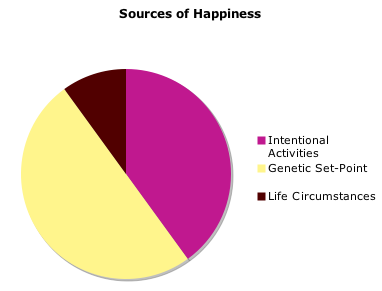
    So the ‘happiness formula’ is this:

    Happiness = Genetic Set Point + Life Circumstances + Intentional Activities

    We’re stuck with our own set of genes for life, so no luck there. Our life circumstances are only slightly relevant. This includes where you live, your gender, health, money, marital status, and so on. We can change all of these, but they only take up 10% of the happiness pie. Ten percent is not insignificant, but the most logical place to take action is ‘intentional activities’ – anything you deliberately think or do. (1)

    This might seem backwards, but it makes sense when you add in the concept of adaptation – many things give us a boost in happiness, but we adapt to them over time, and the happiness wears off. Circumstances are more long-standing. Intentional activities are short-term: no time to adapt.

    So take marriage. Marriage is long-term, and seems to make most people happier for a few years, before they adapt to it. But expressing gratitude to each other, having those awful picnic things where you feed each other food (yuck!), talking about all the other disgustingly romantic things you did together; these things boost happiness, but as they are episodic there’s no adaptation to them. You just have to keep doing different activities.

    The following are ideas all fit into the intentional activities slice of the pie.

    1) Expand your Social Network

    Social relationships are a bit of an exception to the above rule, because they’re something we don’t adapt to. If you have close relationships in your life, you’ve got a regular source of happiness (unless they are bad relationships, of course).

    It’s possible to live alone in this world – if you could get a job with no human contact, and afford a house and food you’d be able to survive. But ten thousand years or so ago, you’d be dead without relationships. No one in your tribe would help you out and you’d have no allies if some cave-criminal decided to steal your lunch. For that reason, we have a brain system that ‘rewards’ us with happiness if we make a new friend or even just have an interesting conversation with someone.

    Aha, you might say, I know a person who really likes their own company more than other people! Yes there are some people like that, but a group of mischievous researchers once took a group of introverted people, and forced them to talk and relate to people, and even they enjoyed it. (2)

    If you’re on a quest for success, like getting a load of money or building a strong business, some people will tell you that’s a bad idea. Don’t put all your time into it at the expense of your friends and family, they say. It’s not what’s really important, etc.

    But they are actually right. You’ll probably still want your success, but it would be useful to remember that you will adapt to success, you won’t adapt to relationships, and that wanting something and liking it are different things.

    How to get more social ties into your life is a whole other series of articles. Obvious ideas are find work that involves human contact or working in a team, join clubs, learn social skills, and generally just get out more.

    2) Change your Thinking

    Our actions can be broken down into three things – thoughts, emotions, and behaviours. Any one of these things will affect the other two. If you feel happy (emotion), you’ll tend to have happy thoughts too. If you furrow your brow and shout aggressively (behaviour), you’ll start to feel angry (emotion). And if you think that your life is terrible and there’s no way out for you, soon enough you’ll start feeling sadness and despair. Feeling sad will make you take the actions of a sad person, which will make you think more sad thoughts, and downward spirals like this can sometimes lead to depression.

    Cognitive Behavioural Therapy (CBT) is a form of psychotherapy intended to break people out of downward spirals of this kind. The main method used is to intervene at the ‘thought’ stage of the spiral, by teaching people how to logically challenge the thoughts that are leading to the negative feelings and behaviours. Negative thoughts have predictable structures, which have been identified and labelled. There are specific challenges for the different types of thought, clients are trained in them, and use them whenever such thoughts occur.

    So for example, as soon as the client thinks “I always do stupid things”, he recognises this as an over generalisation and challenges it with counter-questions like “is there a time I didn’t do a stupid thing?” His questions expose the logical flaws and weaken the negative feedback loop. There are also sometimes ‘homework’ assignments, addressing the ‘behaviour’ part of the spiral, such as exposure to gradually more anxiety producing situations.

    CBT doesn’t necessarily prevent the natural occurrences of negative thoughts, but can stop them turning into huge downward spirals, and also interrupts current spirals that are already spiralling. This doesn’t mean that it will only work for people who are unhappy to start with. Everyone experiences setbacks at various times, and this is where it can be useful to have a better way of dealing with them. It’s a tool you can use to take a more optimistic outlook on something.

    A good book with exercises based on CBT is Martin Seligman’s Learned Optimism. Most of the other books and websites I found on CBT were focused on treating specific problems like anxiety and depression. These are good for learning the techniques and methods of CBT, which you can then apply to your thoughts in general. Of course, if you believe you suffer from a serious condition, you should seek the advice of an expert rather than try to self-medicate.

    3) Meditation

    There’s a mystical image surrounding meditation. When I talked with people about it, I got the impression it’s seen as, new-agey, and a bit ‘out-there’, perhaps involving people in orange robes chanting “oohhmm.” In reality, it’s just a practical exercise for training the mind, just like you train the body. There are many different types, but the one I’m talking about here is called mindfulness meditation, and this itself is taught in various ways and known by different names. Vipassana is one form you might have heard of (as practiced by celebrities such as Madonna and Rivers Cuomo).

    Mindfulness meditation involves deliberately directing your attention to something, typically your breathing or an object, and not allowing any thoughts to enter your head as you do so. As soon as your mind wanders, you just become aware of it, acknowledge it, and bring your attention back to the breathing. You do this for 20 minutes a day or so, building up the time you do it for. Very simple, but not very easy.

    So it’s about learning to control your awareness so that you can place it wherever you want, which will usually be wherever you are at that particular time. You know all this “be in the moment!” spiel that you seem to hear everywhere these days? That might well be good advice, but without telling you how to control your attention, it’s a bit like saying “be physically strong!” without giving a weight-lifting program. Mindfulness is one way of controlling your attention.

    And it also makes you happier. In one study, participants were given an 8-week program in mindfulness meditation. After the program, EEG scans measured increased activation in the left side of the anterior cortical area of the brain, the area associated with positive emotions. Additionally, the participants were given the influenza vaccination at the end of the program, and the meditators actually had a stronger immune response to it than the control group. (3)

    Jon Kabat-Zinn’s book Wherever You Go, There You Are is a very good introduction to mindfulness, and you can also find a video of a speech he gave here, where he describes what mindfulness is and how to do it. (the instructions start at around 24mins). Finally, there’s a very thorough and free mindfulness resource at http://www.vipassanadhura.com/howto.htm.

    Beyond this, there are also courses around the world teaching mindfulness meditation. Many of the courses are free, like the Vipassana ones, which basically involve going to a retreat for 10 days and meditating for 18 hours a day. Sounds very intense. So investigate this further if you want more instruction.

    4) Positive Reminiscence

    In a way, this one is the opposite of the meditation I just mentioned. In meditation, you generally move your attention away from thoughts, and certainly don’t encourage them. In positive reminiscence, you deliberately think about your various happy memories. When people were asked to spend 15 minutes a day for 4 weeks reminiscing on happy memories, they ended up happier than groups asked to think about neutral or sad memories. (4)

    It’s important that you’re just reminiscing, and not analysing. In another study participants were asked to systematically analyse their happy memories – this actually caused a reduction in happiness. Any skilled meditator would probably predict this, as a big aspect of meditation is learning to think non-analytically. It seems that analytical thinking, and creating judgements around thinking, is not useful when happiness if the goal.

    So as long as you’re just reminiscing, and not evaluating the past, you’ll be OK. Remember; 15 minutes a day. Don’t sit there daydreaming and wasting your time away.

    5) Pursuing Goals

    Some scientists believe that happiness is a system built into our brains to help us reach goals. When we progress to our goals, we become happier, when we’re lagging behind, we get less happy, even anxious. That’s partly why humans like challenges. Well, most of us do; some prefer to simply sit down, eat and watch Prison Break. But for the rest of us, making progress towards a goal will bring happiness along with it.

    A study in the early 1990s found that the more committed to a goal you are, and the more attainable it seems, the happier you are when you reach it. Another in 2002 found that if you train people in how to set and reach goals, they experience more positive emotions, vitality, and wellbeing. So it seems that if you are committed and strategic about it, your goals will work better for you – probably because you have more chance of reaching them! (5)(6)

    But remember what I said earlier about adaptation – the happiness from a goal being reached won’t necessarily last, so setting one like earning more money is a lot like running on a treadmill – you’ll break a sweat but you’re not going to get anyway. You’re like the donkey trying to reach the carrot.

    There are resources to help you set and follow goals all over the net and in self-help books, so I won’t go into it here.

    6) Writing

    When I say ‘writing’ I’m referring specifically to things like journals and diaries. Although writing in the ‘Dear Diary’ sense is stereotyped as ‘for girls’, historically it’s been popular with both genders. You can buy the The Autobiography of Benjamin Franklin from Amazon very cheap. I did. It’s quite good, he was a very industrious and motivated chap, which I suppose you’d need to be if you wanted to help found a country.

    There are two types of writing you can do. I’ll call these disclosive writing, which refers to writing about negative or distressing events, and positive writing, which is writing about positive things you want to happen.

    Disclosive Writing

    A massive amount of research has been done on this – a review in 2005 analysed 146 experiments, and found it to be effective (7). Essentially, you write about negative or traumatic events, and the structured nature of written language causes you to create a narrative out of the event. When systematically structured like this, the event is more easily processed by your mind, and you get a better sense of understanding and closure. The more ‘insight’ words (eg, understand, realise) and ‘causal’ words (eg, because, reason) that end up in the narrative, the stronger the effect is. This shows that the benefits come when writing is used to help make sense of bad events.

    The book Writing to Heal has exercises on how to do this. It’s written by James Pennebaker, one of the major researchers in the area.

    Positive Writing

    With positive writing, you don’t write about happy memories. Breaking down a negative event can help remove negative feelings, but as we’ve already seen, you don’t want to be analysing or evaluating positive events – in your head or on paper. Why would you? If you want the feeling that they create, you can elicit that by reminiscing – there’s no need to structure a narrative around it.

    Instead, with positive writing you write about what is termed your ‘best possible self’. This is quite a self-helpey exercise, but there is research behind it. You imagine yourself as you’d like to be, on paper. It’s as simple as that, just write out in detail what your future is like after you’ve met all your life goals realised all your dreams, and so on. I’m not sure why this works, maybe it helps you to stay optimistic, or maybe it has a similar function as creating a goal, giving you something to aim for. Whatever the mechanism is, it does seem to work.(8)

    7) Expressing Gratitude

    Gratitude, if you didn’t know, is a sense of thankfulness and appreciation aimed towards something specific. It’s a positive emotion in itself, so it’s not too much of a surprise that feeling grateful more often will be good for your happiness; but there’s more to it than that.

    Gratitude can be used as a coping strategy, to reframe a negative experience in a positive way. You broke your leg, but you’re grateful you didn’t break both. When directed at experiences in the past, it serves to help savour them.

    Remember, we adapt to many events that make us happy, and they lose their magic after a time. If you get a new car, it makes you happy for a while because you can compare ‘new car’ with ‘old car’. A year down the line, you’re comparing ‘new car’ with ‘new car’ – you’re used to it. With gratitude, you are countering the effects of adaptation to an extent, by manually overriding what is being compared.

    A popular gratitude exercise is called ‘three good things’. It’s simple; every night you write down three good things that happened to you that day, and why they happened. In one study, happiness gradually and consistently increased over six months of doing this (9). In another ten-week trial, participants ended up happier, in better physical health, and strangely, were spending more time exercising. (10)

    This is a simple exercise, and doesn’t take up much time, so it’s certainly worth a try. But be aware that the results are modest initially, and it takes some months for the effects to build up.

    8 ) The Gratitude Letter

    If you scanned this page to look at the headers, you’d probably find some to your liking, and others you didn’t like the look of. The gratitude letter is one that is seriously not to my own liking! Maybe it’s a side effect of being British, but the thought of doing this makes me cringe greatly. However, it does actually work, and some people really like it, so if it sounds good to you then go for it. Here’s how to do it:

    You think of a person who really helped you out, that you never properly thanked. You write a letter to them, expressing your gratitude for all the lovely things they did for you. But you don’t post this letter off. Oh no. That would be too easy. What you actually do is go visit them in person, and read it out aloud to them. Then what happens, apparently, is you both get all emotional, and you might even both cry. But after this, your happiness gets a very large spike, which lasts a few weeks as you bask in the afterglow of appreciation. Then it gradually wears off, and you go back to normal. (8)

    9) Discover and Use Your Strengths

    People always tell you to ‘stick to your strengths’, and it’s actually pretty good advice. The more you work your strengths into your daily routine, the happier you get happier. I know because I did an experiment on this for my dissertation. But how do you know what your strengths are? In 2004, after a huge amount of research, a tome by the name of Character Strengths and Virtues: A Handbook and Classification was published. This volume classifies 24 character strengths, some of which you use a lot, while others you use very little.

    There’s a test you can take at authentichappiness.com, which will place the 24 strengths in rank order for you, so you’ll find which are your real strengths and which are more like weaknesses. It does take around 45 minutes though. After the test you’ll get some details on your top five strengths, which they call your signature strengths. Research has shown that if you deliberately make use of these strengths on a daily basis, you get happier. And it seems that the longer you do it for, the happier you get, although no research has been done past the 6 month mark. (8)

    The idea is to integrate the signature strengths into your daily lives. Find hobbies and interests that use them, rethink how you go about your work to use them more, and so on. There are some other ideas here (Click the strengths vs weaknesses link – it’s a Word document, scroll down to the appendix).

    10) Random Acts of Kindness

    Kindness, generosity, nurturance, altruism, or whatever you want to call it, is the cornerstone of most religious and ethical systems. For some reason, performing acts of kindness makes the giver as well as the receiver happier. Maybe it increases the sense of interdependence in the community, which is good for everyone. Maybe it’s because of the reciprocity principle – if you receive something, you are motivated to give back. This is why restaurants give you the mint instead of leaving it in a bowl – it makes people tip more!

    Again though, it works, whatever the reasons. College students who were asked to perform five acts of kindness, one a week for six weeks were significantly happier at the end of it. In another study, people were either asked to perform the same act of kindness, or varied acts of kindness for ten weeks. Interestingly the group performing the same act did not see an increase in happiness. Maybe it was the effect of adaptation, maybe just boredom; who knows? But it seems you must be a bit creative about your kindness for it to work for yourself. (10) (11)

    Two Final Thoughts…

    Mileage May Vary

    Well done if you’ve made it this far. There’s a lot to choose from, and now you might be wondering, what will work for me? In the experiments that these techniques were based on, there will undoubtedly be people for whom it didn’t work, and psychologists haven’t figured out yet which interventions are best for which people. Personally, I don’t like the idea of the gratitude letter, and writing about my best possible self. But other people will love them and benefit from them – there’s proof of this. Then again, maybe I would randomly find I love positive writing. Who knows? The point is, some trial and error may be required.

    Also, remember to give these techniques at least a full week, preferably a few, before you evaluate how good they are. And give them a fair try – you need to do them regularly and habitually for them to work in the longer-term. If you just want a bit of short-term happiness, go get a massage or something.

    Be Realistic

    The biggest block to happiness is not in the external world, but in our own psychology. The systems of happiness, pleasure and desire that we all possess are not there for our enjoyment; they are there to help the organism known as ‘the human’ function effectively. The body does not care if you are happy. If it can trick you into pursuing things that you think will make you happy, but actually are just helping you survive, then it will.

    If you become as materialistic as possible and do nothing but work and sleep, you’ll get pretty rich. With money comes security, you can buy a big house, good food, and enjoy high status. You can even get a gold digging wife or husband, and have some kids. Your body doesn’t care if you are unhappy all your life, as long as you survive and reproduce.

    That’s why you have to be a bit smarter when it comes to happiness. You have to know the system to work it. The above methods are the result of work people have done to that end. If any of them look appealing to you and you want to give them a try, by all means do it. It will probably work.

    But remember one thing; true and complete happiness is impossible to achieve. It’s not in the nature of happiness for it to be fully obtainable, nor is it possible for happiness to evolve so that it is fully obtainable. So don’t make happiness too big of a deal. It’s only one part of life. You’re not supposed to be happy all the time. There are other things in your life that you need to do, that require other emotional and mental states.

    Besides, if you focus on it too much, you’re not likely to get it. It’s often more effective to find engagement elsewhere, and let it come to you.

    Don’t think that you need some incredible life to be happy. Don’t think you need some spectacular level of happiness to be normal. We can use science to break happiness down into little pieces, and do experiments to see how to increase it, but experiments can’t tell you how happy you should be. Each individual person has to answer that themselves, and every answer will be different.

    Of course, if you don’t answer that question yourself, an answer will be provided for you. We’re inherent comparers, us humans. We’re always looking out for what other people have got. In a world with things like the internet, television and magazines, we’re constantly exposed to the most attractive, most talented, most charismatic of about 6 billion people: which can sometimes make us want too much.

    I found an interesting quote:

    “The world is full of people looking for spectacular happiness while they snub contentment”

    It doesn’t say who said it, but I think it’s worth keeping in mind.

    References

    In the first comment…