We’re in such a rush these days, aren’t we? Whatever we want, we want it yesterday. Unfortunately, things usually take a lot longer than that. To get any kind of good result, we usually have to take some kind of action regularly, over a long period of time. Especially if it involves learning a skill. This is where the idea of habits comes in – you make a habit of the action you need to take, and do it everyday automatically. Then, somewhere down the line, the result will just happen – if you can wait that long.
“Whatever we want, we want it yesterday.”
The standard self-help advice for installing a new habit is to do the activity on a daily basis, for 21 consecutive days. Thirty days is also popular. The idea seems to originate from Maxwell Maltz’s famous book, Psycho-Cybernetics. Maltz was a plastic surgeon, and noticed it took around 21 days for people to become accustomed to their new appearances, or for ‘phantom limb’ sensations to disappear. He later linked his observation into theories of self-image, and the 21 day rule came to be.
Despite its popularity, the 21 day rule has never been tested empirically, to my knowledge. I’ve even read sites claiming that 30 days is overkill when forming a habit. These are all sweeping generalisations, obviously. It would depend on exactly what you meant by ‘habit’, and the nature of the behaviour you’re trying to establish.
Repetition over a period of time seems like a sensible way to form a habit; but what if the habit involves lots of smaller behaviours and tasks? If the 21 day rule is accurate, would you need to multiple the amount of sub-tasks by 21, to get the true amount of time required?
Take something like healthy living. Within that, you’ve got exercise, healthy eating, not smoking, and so on. Within that, you’ve got stretching, weights, cardio, eating whole foods, vegetables, no processed foods, and so on. If you’ve ever seen someone try to do all this at once, you’ve seen someone fail (in less than 21 days).
Twenty-one days is an improvement on ‘yesterday’, but maybe it’s still a bit short. If you can install just one of the above, say, eating no processed foods, you’d probably be better off one-year down the line than if you tried all of the above for 3-4 weeks, spread out over that same year (each followed by a week of bingeing after you burn out). If you turned a new point from that list into a habit every 21, 30, or even 60 days, the long term benefits are not only greater, but more sustainable too.
This is a completely testable idea. At the moment, I’m trying to become more organised and productive. I’m overcommitted at the moment, I have this site and a few other sites to run, I’m writing up my dissertation for submission to a journal, plus normal stuff on top of that like the gym and my day job. While I was at university, I was similarly swamped, and bought the classic productivity book Getting Things Done (GTD), by David Allen.
Here’s GTD in a nutshell: Write down everything that you need to do or plan to do in your life. Then store all these things in a system which alerts you when each thing needs to be done. Simple. By doing this, you get everything ‘off your mind’, and you never feel overwhelmed. You know the system will let you know when you have something to do, so you can relax until then.
It works exceptionally well. You most important thing to do is always at your fingertips, you never get that “what should I do next?” feeling, and you don’t feel so overwhelmed that you seek out your preferred method of escapism (beer and films for me).
The only problem for me, was that the system falls flat after a few weeks. I set it up, it runs perfectly for a while, then it gradually deteriorates until it no longer exists. Then I start again.
This is apparently a common problem with GTD – it’s too much. Leo Babauta, of Zen Habits, follows a similar philosophy to me. He created a book to supplement GTD, called Zen To Done, which breaks the GTD system down into 10 parts. You employ only one or two of these each month, until the whole thing becomes habitual. I bought Zen To Done as it seems ideal for me: I’m probably not going to get any less busy over the next few years, and if it takes 10 months to get to the finished product, so what? It’ll be less stressful, much less effort, and a perfect test of my theory (for myself at least).
I’ll let you know how it’s going each month. In the meantime, if you want to join me in my experiment, feel free. It’s easy, just pick something you want to do, break it down into 10-12 things, and add them in, one month at a time. Then, if you can, compare your progress after a year to the previous year. I’ll bet you did better. This is not new advice: every school kid hears about the tortoise and the hare. The tortoise won, remember. 🙂
After you saw ‘motivation’ in the title of this article, maybe you thought this would be one of those moving, inspirational pieces, designed to spring you into action, immediately. You know the sort; written in a lively and stimulating way, they bestow you with a sense of purpose and enthusiasm that you’re certain to carry with you for at least the next ten minutes.
But it’s not. I’m not really qualified for that, to be honest. To me, the people that write those things seem like some kind of super-efficient neo-human. Like they leap out of bed at 6am every morning (doing their affirmations before they land), do some morning yoga, then in an efficient and streamlined way, get a full day’s work in before 9am. Yikes! On a morning, I’m barely conscious enough to make my fried egg sandwich for breakfast. OK, a little more conscious than that, but you get my point.
So I’m not explaining how to increase motivation, but rather I’m describing the types of motivation that exist. If you find yourself with ‘no motivation’, maybe it’s not that you don’t have any, but that you have the wrong type.
Two Main Types of Motivation
Motivation is a useful thing. It’s the driving force behind our behaviour. It produces. But it’s not necessarily a single concept – there are many types of motivation. You could break it down in many ways, but almost any will include the two main types: extrinsic and intrinsic motivation. With extrinsic motivation, you’re doing something because the activity will bring some reward or benefit at the end of it. With intrinsic motivation, you’re doing something purely because you enjoy the activity itself.
For example, take job hunting. Chances are, job hunting isn’t on your list of hobbies. You probably don’t spend your spare time filling out applications and going to interviews just for the fun of it (or maybe you do). People do it because they want the outcome – a job. And it seems to me that in the majority of cases, the motivation to go to these jobs is extrinsic too. Would you do your job even if you didn’t get paid for it?
Of course, things aren’t this black and white in real life, there are shades of grey between the two extremes, which I’ll describe later. But it’s interesting to note that over the life-span, we start to take less intrinsically motivated actions. As children almost everything we do is for the enjoyment of it; this spontaneous learning and curiosity is vital for our cognitive development. As we get older, rules and regulations mean that most of what we do is extrinsically motivated to some extent.
The Benefits of Intrinsic Motivation
Think about some of the things you do on a regular basis. Are you mostly extrinsically motivated, acting in preparation for rewards to come? Or are you mostly intrinsically motivated, seeking engagement and well-being within the things you do?
It should come as no surprise that the more intrinsically motivated an action is, the more enjoyable it is; it’s practically the definition. So from the point of view of pure enjoyment, it makes sense to have more intrinsically motivated activities in your life. People who are intrinsically motivated show more interest and excitement over what they do, and have more confidence. (1)
But apart from the pure enjoyment of the activity, you’re actually better at intrinsically motivated actions too. You show more persistence and creativity, and because of that you’ll have increased vitality and self-esteem. (1)
As I mentioned earlier, there are shades of grey, and you don’t need to be fully intrinsically motivated to get these benefits. In various fields, positive outcomes have been found from motivation that is almost, but not quite intrinsic. To name a few, these include: exercise, where it is easier to stick to exercise routines as intended; religion, where people who identify with their religion have better mental health and well-being than people who see religion as a means to an end; and environmental behaviours, where more intrinsic environmental motivation leads to more activities that are better for the environment. (2)
So if you want to do more of something, you could try to change your motivation to something closer to intrinsic motivation. If you do so, your performance will improve, and you’ll generally be happier. Before explaining exactly how that’s done, I’ll describe the shades of grey that exist between the extremes of motivation.
Shades of Grey (or orange)
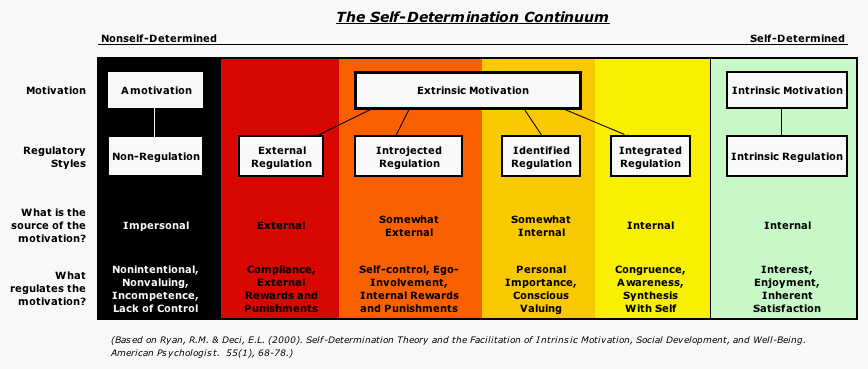
The gradations of motivation have been classified by psychologists Richard Ryan and Edward Deci of the University of Rochester, in what they call Self-Determination Theory, or SDT for short. In this model, the types of motivation exist on a continuum, with pure intrinsic motivation on the right, amotivation on the far left, and four shades of extrinsic motivation in between them. Your motivation towards a particular activity will fit into one of these categories, although there may be some overlap with its neighbours. Here’s the diagram they use to illustrate this (opens in new window):
The Self-Determination Continuum
From left to right, we have:
Amotivation – The state of lacking the intention to act. In this state, a person either won’t act at all, or will ‘go through the motions’, lacking any specific purpose or intention.
External Regulation –Activities are done purely to satisfy some external demand. When doing externally regulated activities, people typically feel controlled or alienated.
Introjected Regulation – Behaviours are still performed to achieve a reward or avoid a punishment, but these things are internal; for example, to avoid guilt or anxiety, or to boost the ego with pride.
Identified Regulation – This reflects a conscious valuing of a behavioural goal – they are activities people identify with, that are seen as personally important.
Integrated Regulation – An identified regulation has been fully integrated into the self. It has been brought into congruence with the other values and needs a person has.
Intrinsic Motivation – An activity is carried out purely for the inherent satisfaction of doing so.
(The diagram and these notes are based on reference 1)
For example, I try to do some form of exercise 3-4 times per week, usually weights. For me, this is integratedregulation. It’s been a regular part of my week for over 10 years, and it fits in with my other values and habits. Still, it’s not intrinsic. Despite how integrated it is, and how congruent it is with the rest of me, if it didn’t make me stronger, healthier, and look good naked, I doubt I’d do it. Imagine a guy who does not value health or fitness, and only works out so that people react to him more positively. For this guy, it’s introjected regulation – his motive is ego-based, he does it to maintain self-esteem.
On the other hand, playing the guitar is 100% intrinsically motivated for me. No one hears me, I don’t play to anyone but myself, and I don’t have any goals with it whatsoever. I scarcely even try to get better, I just enjoy playing a few songs I know. But I only play very rarely; in fact, my guitar isn’t even in my house presently. It’s not an integrated behaviour, but I’m intrinsically motivated to do it.
If you have a goal you’re working towards, where is it on the scale? Where’s your profession? If it’s far to the left, but important to you, you can take steps to move it to the right, but note that this isn’t a developmental scale – you don’t figure out where you are, then move through all the stages, mastering each one on your way to intrinsic motivation. Ultimately, the procedure to move a regulation further to the right is similar wherever you start from. However, if you’re not already intrinsically motivated, you might just end up at integrated – which shares many of the benefits.
How to develop intrinsic motivation
There are many things that we have to do in this complex modern life, and we can’t expect everything to be intrinsically motivating. But since it seems worthwhile to get more of our actions to the right side of the continuum, the question is, how do we stay motivated to do nonintrinsically motivating things? The answer lies in our psychological needs. Intrinsic motivation is developed and maintained when three of our basic psychological needs are satisfied. These needs are competence, autonomy, and relatedness. They are thought to be essential to human motivation and growth. Here’s a description of each and suggestions for how to satisfy these needs. (3)
Autonomy is the need to have control over what you do – to self-regulate, and make your own choices. I talked about its relation to happiness here. You’ll see that in the diagram above, the more to the right you go, the more internalised the behaviours are within the self – in other words, the more they feel ‘you’. This process involves adopting values from other people and from the environment. But a new value needs to be understood and synthesised with existing goals and values, which is a self-directed process – we need the opportunity to freely subscribe to new values. Any external pressures and controls will obstruct this process. As well as the integration of values, autonomy is important in a more general sense – having control over what you do and how you do it. The more control you feel you have, the more intrinsically motivated you’ll tend to be.
How to support autonomy:
1) Increase Control/Choice – Find ways to direct your actions and environments. Things as simple as controlling the layout of your furniture have been shown to increase autonomy, right up to having ultimate control over what you do. See what you are able to control and have choice over.
2) Integrate Values – Think about the ways in which you agree with the actions you’re taking. Why are they right and correct? Considering the value of a behaviour to yourself will facilitate its integration.
3) Create Novelty – Look for ways to inject novelty into your actions. Can you do the same thing in a different location, or alter the task or goals in some ways? Or can you even find new reasons to do them? This way you’ll get the benefits of increased novelty as well as autonomy.
4) Remove Deadlines – Deadlines will reduce intrinsic motivation drastically. Even if it’s a task you really like to do, the pressure of a deadline will remove your sense of autonomy and your motivation along with it.
5) Remove Pressured Evaluations – As with deadlines, high pressure evaluation will also reduce your autonomy and your motivation, and should be avoided if possible.
Competence refers to our innate drive to engage new challenges and experience mastery – to get good at things. For motivation, perceived competence is the important thing, rather than objective performance. Positive feedback on performance tends to enhance a person’s perceived competence, but only where they feel that they are responsible for the good performance. If they feel they did well by chance, and then receive positive feedback on the performance, this will tend to undermine intrinsic motivation because it will overshadow their feelings of autonomy. So it’s better to say what a person did well, rather than just saying “heck of a job, champ!”
How to support competence:
1) Get better – Sounds obvious, but the more competent you are at a certain activity, the more motivated you’ll be to do it. If you’re trying to learn a new skill and losing motivation because it’s difficult, at least take heart in the knowledge that the better you get, the more motivated you’ll typically get.
2) Get positive feedback – Your motivation will become more integrated if you can find some way of getting positive feedback on your progress. This feedback should be informational rather than controlling, and should highlight specific positive aspects of your performance. (4)(5)
3) Avoid negative feedback – Likewise, negative feedback will stand in the way of perceived competence, and therefore block intrinsic motivation too. (6)
4) Break complex tasks down – If a task is very complex and challenging, don’t take it on all at once. Break it down into moderately challenging subtasks. Once competence has been reached for each of the subtasks, then move on the the task as a whole. (7)
5) Set appropriate difficulty levels – Difficulty needs to be moderately challenging – not so easy that you become bored, but not so difficult that your feelings of competence diminish. If a task is too easy or hard, find some way to adjust accordingly.
Relatedness is the basic human need to feel connected to others. SDT suggests that people naturally internalise and integrate the values of the social groups around them, and as they do so, their motivation to do things in line with this new value system will improve – as long as they do not feel coerced, and have a sense of competence. This natural human need seems to be a part of our tendency to merge into social groups. Knowing this, we can hijack this system, and use it to consciously internalise behaviours that we want.
Relatedness is not essential for intrinsic motivation, which we can achieve alone (like my guitar playing, although some might say other people are better off not hearing it…). But, it is very important for internalising and integrating behaviours and activities – bringing activities into the ‘good’ side of extrinsic motivation. Note that researchers have not yet found high levels of intrinsic motivation without autonomy and competence to go with it.
How to support relatedness:
1) Improve the interpersonal climate – in group situations, the atmosphere should be supportive and informational, as opposed to pressuring and controlling. (8)
2) Find social groups – When people feel involved with groups that espouse certain values and behaviours, the way is smoothed for these values to be integrated. By finding groups that embrace the values and behaviours you want, you can adopt them yourself by joining these groups.
3) Supportive social connections – Friends, family and associates that are autonomy supportive and competence supportive (eg., encourage you to make choices, give positive feedback and encouragement, have the same values as you, and so on) will be generally beneficial to integration and intrinsic motivation.
When you’re using this model to increase your motivation, there are two ways to go about it. The first is to look at your life as a whole, and shift things around so that these three needs are better met. For example, switch jobs to one that better meets the above criteria, use your spare time for things you enjoy doing simply for their own sake, spend time with people of similar values, etc. This way, you’ll experience more integration and intrinsic motivation overall, and as the research indicates, greater well-being and psychological health will follow. If there’s a regular part of your life which thwarts these three needs, it would be worth thinking up ways to get out of it.
The second way, is to to take an activity that is important to you, but you are extrinsically motivated to do, and then integrate the three needs into the activity, such that they are better satisfied. This will increase your integration relative to that specific task. That’s what I’ve assumed you would be doing as I wrote this, so I’ve written the above suggestions from that perspective.
If you’re trying to motivate yourself to do something, this by definition is a self-determined process. So it would make sense to adopt more of a self-determined motivational style, rather than spend all day recanting affirmations, and reading uplifting stories. You can read all the motivational literature you like – and these things are well enough in their own way – but according to this theory, if you’re not doing anything to meet the three needs of competence, autonomy and relatedness, you might as well read cereal packets.
Have you ever started a diet or exercise program, and quit after a week? Have you ever lied in bed too long when you know you should get up? Ever woken up next to the missing link? Everyone has taken actions that they didn’t consciously plan to do. The reason for this is that different parts of your mind have different agendas. It’s pretty common knowledge these days that there’s a ‘conscious’ mind and a ‘subconscious’ mind. The conscious part is what you experience as being ‘you’. All the other parts of your mind are subconscious, and work away without your involvement.
Having a mind like this quite an interesting experience. The subconscious parts make a lot of our choices, and guide a lot of our actions. But because we only experience the conscious part of our mind, we don’t fully realise this. Plus we are very good at inventing stories and rationalisations, to make it seem like we decided to do all these things in the first place.
How we experience the mind makes it seem like driving a car. The subconscious is the car, and we’re the driver. With this metaphor, we call the shots and decide where to go – the unconscious mind then puts its resources to work in taking us there. We’re driving the car… we steer, we choose how fast we go, and we can change direction at any time. The subconscious can get us from A to B, but can’t choose where B is – all it can do is offer suggestions on the sat-nav, and hope we listen.
In reality though, it’s the other way around – the conscious mind exists to serve the subconscious mind. In The Happiness Hypothesis, Jonathan Heidt offers a different metaphor – a rider and an elephant. The elephant is the subconscious mind, the rider the conscious mind. The elephant is a big, burly beast, and will pretty much do whatever it wants. The rider isn’t strong enough to push the elephant around; all it can do is shout and nudge, and hope the elephant will listen.
Thailand Elephant Rider – painting by Helen Carson
The painting to the right, by Helen Carson, illustrates this idea perfectly. The rider has no whip, no reigns – no means of directing the elephant besides a word in it’s ear. The elephant leads the way and goes where it wants – even if the rider doesn’t want to!
Many clever studies have been done to show that the elephant is calling most of the shots. In one famous study, researchers asked people to write down behaviours they thought were characteristic of either intelligence or stupidity. Then each person was given a general knowledge test. Even though the participants had no idea that these two tasks could be related, the people that wrote about intelligence did better than average on the tests.
If you did a task like this, you might think it was a bit mundane. You wouldn’t really care about the characteristics of intelligence… but you’re getting paid, so you do it. Besides, maybe you can get in a bit of daydreaming while you’re at it. But behind the scenes, the elephant is doing some processing of its own, priming you for what might be ahead. The people that wrote about stupidity did worse than average on the tests.
This makes you wonder about news headlines. If exercises like this can affect things like test results, what’s the net effect of headlines like “Financial Crisis!”, “Knife Crime Increasing!” and “Terrorist Attacks”? Yet another justification of my decision not to watch television or read newspapers!
But why does the mind work like this? Why aren’t we in control as much as it seems we are? It’s because consciousness is a pretty new invention, whereas the rest of the mind has been around for a long time. It has survived millions of years of evolution, and been passed through many species. Along the way, bits have been added on and taken away – whatever didn’t work was weeded out. What’s left is a tried and tested formula. The rider is just the latest addition to that design, the latest hardware upgrade. The elephant is better off for having a rider, or it wouldn’t have one, but there’s no sense in reshaping everything that has proven effective for millions of years, just because the mind suddenly realised it can think!
All our subjective experiences, our identities and identity crises are basically the result of this new addition. They are there because they help the elephant to survive, just as things like memory and emotions helped other species’ to survive, at earlier points in time.
In reality though, there isn’t a divided mind. It’s all the same thing, just like the liver, lungs and heart are parts of the same body. It’s only the new rider module’s ability to self-reflect that makes it seem, to the rider at least, that there’s a divide. But as we’ll see, when the rider figures out that he exists, some more practical and useful conclusions can be reached – which is kind of the point of him being there in the first place!