Month: August 2009

  • Smoking and Stress

    Contrary to popular opinion, smoking isn’t relaxing.  The evidence shows smoking actually causes stress, rather than reduce it.  That “aahhhhh” feeling when you light up, is an illusion.  If you’re a smoker reading this, it’s hard to prove this to you, because from your point of view, you have a certain level of stress, then you light up a cigarette, and that certain amount of stress reduces.  Based on your first hand experience, cigarettes are relaxing, and what more evidence could you possibly need than your own first hand experience?

    The theory behind this is called the ‘Deprivation Reversal Model’.  Smoking creates stress between cigarettes, and removes it during and immediately after smoking.  There’s a little experiment that you can do that will make the idea behind this model more clear.  First, find a wall.  Any good, solid wall will do.  Next, walk right up to it, so you’re toes are touching it.  Then, repeatedly bash your head into the wall.  Go ahead!  Keep doing it for about a minute, taking note of how you feel.  Then stop, and again take note of how you feel.

    Now I’ve never actually tried this myself, but I’m told that after you stop, you feel relief, the pain is reduced and you just generally feel better than you did when you were banging your forehead against solid concrete.

    This the analogy for smoking.  Banging your head represents the time between cigarettes (withdrawal), and stress gradually increases during this time.  Stopping banging your head represents having a cigarette, after which, some of that stress is removed.  The low-stress period lasts about an hour, then you re-enter withdrawal, and you’re back up against the wall.

    How do you know?

    First you might ask yourself, if cigarettes relax you, why are they more pleasurable when there has been a long time since the last one?  Surely the opposite would be true; if you had eight cigarettes in a row, you should get more and more relaxed, and perhaps eventually fall asleep.  But you don’t.

    Second, when the mental health of a large group of people was tracked over a long period of time, researchers found that taking up smoking in the teens leads to various psychological problems further down the line; and these problems weren’t as prevalent in people that didn’t start smoking. (1)

    Third, there have been some experiments testing the link between smoking and stress.  Here’s one example; mood questionnaires were used to compare smokers’ stress levels with non-smokers and deprived smokers (smokers who had not smoked for about 12 hours).  Here are the results:
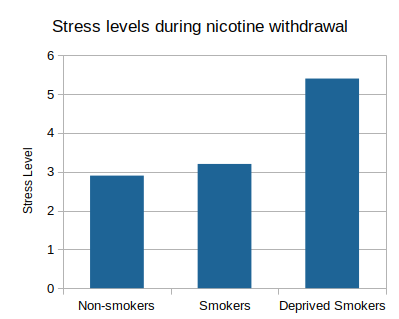
    smoking_and_stress_1

    As you can see, non-smokers had the lowest stress levels overall, but only marginally – smokers who had smoked earlier that day had roughly the same stress level as non-smokers, but smokers who had been deprived of cigarettes for 12 hours or more, had become pretty stressed out!

    Then look what happens if you let the smokers smoke, let the non-smokers sit and rest for five minutes or so, and give the test again:
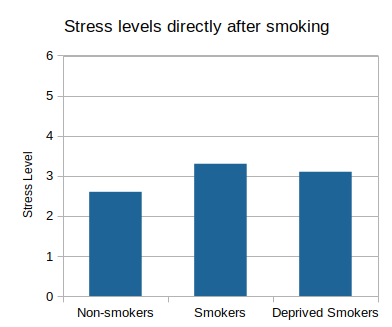
    smoking_and_stress_2

    Deprived smokers are no longer deprived, so now their stress level is roughly the same as everyone else’s.  It seems stress isn’t causing people to smoke, at least not primarily, but rather smoking is causing stress. (2)

    Because of this, smokers’ moods fluctuate through the day, with periods of increased stress between cigarettes and periods of normality just after smoking.  It’s a roller-coaster, not a particularly enjoyable one, and the heavier smoker you are, the heavier the ups and downs.

    This is one difference between cigarettes and other forms of addictive drugs; rather than being in a normal state and then getting ‘high’, you are in a stressed state and then get ‘normal’.  Let’s get normal!  But from a smoker’s perspective, it’s the same experience.  It’s just like your subjective experience of stopping banging your head against a wall – it removes pain, but only the pain it caused to start with.

    Double Whammy

    Where smoking differs from our earlier head-banging experiment – and by the way, if you actually tried that, you have bigger problems than smoking – is that smoking is a behaviour that reinforces itself.  You get chemically rewarded when you smoke, and chemically punished when you don’t smoke.

    I actually learned all this the day after I quit; by pure, ridiculous chance.  I had a lecture on nicotine.  I sat through 3 hours of talking about smoking and cigarettes, which wasn’t particularly what I wanted to hear.  But it did seem to work, because once I understood how nicotine worked, and the physical and mental effects smoking has on people, I didn’t smoke again.  Well that’s not true, I actually switched to cigars for a while (and eventually stopped that too – ten a day was getting too much), but I definitely haven’t smoked a cigarette since then.

    Quit Cold Turkey or Cut Down Slowly?

    Stress, along with the other withdrawal symptoms (irritability, anxiety, anger, poor concentration, strong cravings for cigarettes, restlessness, insomnia, increased appetite, weight gain, impatience, etc.) start about an hour after the last fix.  They then increase in intensity, and peak sometime within the next three days or so (The Three Days of Hell, as they are sometimes known).

    Studies tracking peoples’ moods over time find that the few weeks after quitting smoking invariably bring poor moods because of these withdrawal symptoms.  After which, they improve over the longer term.

    But, if you smoke during this period – even if you just have the odd cigarette – you’ll put yourself back into a state of withdrawal, and you’ll have to go through it all over again.  You need to quit cold turkey. Although, note that very heavy smokers should cut down before quitting altogether – if you go from heavy smoking to nothing overnight, it can be a shock to the body as it’s gotten used to all the nicotine and other chemicals being there, and adapted around it. It’s a little bit like a tug-of-rope where one side suddenly lets go – the other side, still pulling, fall all over themselves.

    Try to avoid passive smoking too.  From the point of view of trying to quit, it’s not really the bad moods that are the problem, it’s the cravings.  If you smoke after quitting, you’ll actually strengthen the cravings for more, not reduce them, which is what you’re hoping.  Don’t worry if you do give in though; it may take a few attempts.  Feel like making one today?


    Recommended Reading:


    References:

    (1) McGhee, R., Williams, S., Poulton, R., & Moffitt, T. (2000). A longitudinal study of cannabis use and mental health from adolescence to early adulthood. Addiction, 95(4), 491-503.

    (2) Parrott, A.C. & Garnham, N.J. (1998). Comparative Mood States and Cognitive Skills of Cigarette Smokers, Deprived Smokers and Nonsmokers. Human Psychopharmacology, 13, 367-376.

    See also: Parrott, A.C. (2000). Does Cigarette Smoking Cause Stress? American Psychologist. 54(10), 817-820.

    and: Parrott, A.C. (2000). Cigarette Smoking Does Cause Stress. American Psychologist. 1159-1160.
  • Why is Smoking Addictive?

    “I finally overcame my will power and started smoking again.” – Mark Twain

    There’s no better way to start an article than to quote a long-dead writer with a moustache; especially when he (or she – women can have moustaches too) makes a good point in an ironic way.  In this case, the point is that once you’ve started smoking, it’s tough to stop.  I know that first hand; I was a smoker for many years.  Right from the beginning though, I knew it was bad for me and that I’d eventually stop.  And eventually I did, on roughly the 378th attempt.

    It’s not that it’s just great fun, like going to the cinema – smoking is chemically addictive.  It has an effect on the brain that makes you want to keep doing it.  Despite the negative health effects being pretty well known by now, smokers seem to either disagree that smoking is harmful, or come up with interesting justifications for smoking.

    And for a smoker seeking to rationalise their behaviour, there’s plenty of material:  “Some people smoke all their lives and don’t get sick.”  “You could get hit by a bus tomorrow.”  “It looks cool.”  And of course, “I can quit any time I want!” But why do people get addicted to cigarettes, and not, say, apples?

    This is your brain on apples

    We have a reward mechanism in our brain, which is designed to help us survive by getting us to repeat actions that are beneficial for us.  All mammals have this.  It fires up when we eat, have sex, socialise; when we do anything that we like doing.  The fuel that this system runs on is called dopamine.  Some people call it the pleasure chemical, but maybe it’s more accurate to call it the reward chemical.

    Why do people become addicted to cocaine, alcohol, and nicotine?  It’s because these drugs ‘hack into’ this reward system, and cause dopamine to be released in large amounts.  Nothing is necessarily happening to you that your brain would recognise as a beneficial thing; the drugs just get in there and activate the reward system at the same time you are taking them.

    When I say ‘at the same time’, that really depends on how quickly the drug gets into your brain and triggers the dopamine release.  The quicker this happens (and the bigger the release, of course), the more addictive the drug is.  This is because the dopamine release will coincide more closely with the physical act of taking the drug.  Smoking is about the quickest method you can get.  The chemicals get to your brain quicker than if you had injected them.

    So, you take a drag of a cigarette.  The reward system quickly activates.  Your brain goes “Ah, dopamine, what I am doing is beneficial, I’ll make sure to do this again!” at the same time as you’re smoking.  Then you take another drag, “Ah, dopamine, this is beneficial…” etc., 30 or so times in the space of a few minutes.  The reward system is getting triggered quickly and repeatedly, and being linked to what you are doing at the time: smoking.  This is why it’s so addictive.

    Ever get a craving while stood at a bus stop?  Waiting for a train?  While drinking alcohol?  Same thing.  If you tend to smoke at a certain time – say you have a cigarette with your morning coffee – then over time smoking gets associated with that situation: if you drink a coffee on a morning, you’ll get a craving for a cigarette.  After you quit, and expose yourself to this situation repeatedly without smoking, the association weakens, along with the craving.

    This is why the old tactic of leaving empty cigarette packets around to give you the illusion that you are stocked up is bass-ackwards; it only serves as a trigger for a craving.  There was an anti-drug campaign a few years ago here in the UK, posters were found all over that displayed pictures of various drug paraphernalia, in a sort of “don’t use these nasty things” sort of way.  This was doomed to failure for the same reason.

    You can’t really blame anyone for being addicted to smoking.  This reward system is there to help us survive, not to be hacked into.  We don’t have Norton Anti-Addiction installed in our brains, which runs automatically once a week (and slows down everything else we are doing at the time).  If these pathways are activated, the brain has no idea there’s anything unnatural going on, so naturally we come up with rationalisations to explain the behaviour – some people don’t die from smoking, I could quit if I wanted, etc.

    There’s not only this reinforcing effect, chemically rewarding us for smoking, but there’s also the experience of withdrawal to deal with too.  We’ll look at that next time.

    Recommended Reading:

  • How to make people "get with the program"

    You know those loyalty stamp cards you get in coffee shops?  Ever wondered why you get a few stamps free when you get them?  It’s because of something called the endowed progress effect –  you’re more likely to keep working towards a goal if you think you’ve already made some progress towards it.  So you’re more likely to return and fill the card up if there are nine total boxes to fill, and two get stamped for free, than if there are seven total boxes to fill and none are filled for free – even though the cost and effort is exactly the same for both.

    2265739887_00b5e53c34_m
    Bob was convinced that milk was a better cleaner than soapy water

    This idea was tested, not in coffee shops, but in a car wash.  In 2006, researchers devised two loyalty schemes that the car was would use.  Customers either got a card that needed ten stamps to earn a free car wash, but the card already had two stamps on it, or they got a card that needed eight stamps to earn a free car wash.  Exactly the same number of purchases were needed to get the prize, but half the customers were under the impression they had already made some progress towards the prize.  And it worked; the redemption rate was 34% for the card with two free stamps, versus 19% for the card without free stamps.

    Not only that, but the customers with free stamps filled up their cards more quickly, and the time between washes got shorter and shorter as they progressed – the closer they got to the prize, the more effort they put in to get it.

    How does it work?

    Once we accept a goal, for whatever reason, we become strongly motivated to see it out.  We don’t complete everything we start, of course, but we’re more likely to finish something that we’ve already put some time and effort into than something that we haven’t started yet.  We like to get a return on what we’ve invested into.  This is partly the reason it’s hard to stop gambling once on a losing streak – the lure of getting something back on our investment is far more seductive than definitely accepting a loss.

    Interestingly, this is true even if we haven’t actually made any progress, or put any effort into the pursuit of a goal – as long as we merely appear to have done so (to ourselves), we’re suddenly under the same psychological pressure to see it though.  By creating the illusion of progress, the car wash owners made it seem like the task of getting to ten stamps had already begun, and was incomplete.

    Getting with the program

    The basic principle is this: people are more likely to stick to the program if you can make it seem that they’ve already made progress towards its end goal. If this basic principle carries over to other domains, the possibilities are endless.

    For example, if you run some kind of online course, offer the first two modules for free, and put a page up with a list of all modules, with the first two already ticked off.

    If you’re in a role where you have to motivate people, then pointing out the progress that’s already been made should help.  You could create a performance-based points system, where the points can be traded for prizes at the end of the month, but each person gets a certain number for free.

    If you’re promoting a book, give the first chapter out for free as an ebook.  This will not only get your work out there, but will set up an incomplete goal in your readers’ heads; and many will feel the need to complete the goal.

    This technique doesn’t have to be used for commercial purposes, of course.  As long as it’s used for a task-based goal, it should work.  So, say for example you’re trying to raise awareness of an important issue.  Frame your information as a course, and give it an official sounding title, such as *your organisation* certificate in *your issue* awareness.  Then give out a leaflet which contains the first two ‘modules’ of your course, probably basic stuff like “Introduction to X”, and of course include module list on the final page with the first two modules ticked off already.  Then point to your website or other location they can find the rest of the course, and once you can confirm they’ve completed it, post them a certificate or provide one for print out.  The idea is, people will think they’ve already completed modules 1 & 2, and they’d better complete the rest or that would be a waste of time.

    These are just a few ideas from the top of my head, I’m sure you can think of more for whatever your purposes are.  I hope you’ve enjoyed this little series of posts on persuasion, and it’s given you a few useful ideas as well as made you aware of how your mind responds to persuasion techniques and advertising.  Please, only use these principles for the forces of good.

    Recommended Reading:


    Reference:

    Nunes, J. C. & Dreze, X. (2006). The endowed progress effect: how artificial advancement increases effort.  Journal of Consumer Research. 32, 504-512.

    Image: Bob Dobbs opens a car wash by Radio Rover

  • 6 simple ways to get more tips as a server

    Being a waiter or waitress is hard work!  You’re on your feet all day, watching other people eat, laugh and have fun, and often the pay isn’t all that great; particularly in the US.  But, you have one ace in the hole – tips.  It is pretty much the norm these days to tip, even in places where service is included.  I always tip in a restaurant.  Usually I don’t fuss or worry about how much, I just stick some money onto the tray.

    This reminds me of the huge debate in Reservoir Dogs, where one of the characters, Mr Pink, tells the group he doesn’t tip.  His point is that you don’t tip people at MacDonalds, even though it might be an equally hard job.  You can watch a great version of this scene, performed by none other than the muppets, here (Note: Lots of swearing in this scene, definitely NOT safe for work!)

    Anyway, I digress.  It’s a fact that a server’s wage can bring much joy or sadness, depending on the tips (not to mention the effect your tips have when filing receipts on your income tax software at tax time).  So how would you get more?  Most websites will tell you to be efficient, polite, keep a check of what needs to be done so you don’t forget, and so on.  But scientific studies of persuasion have found other ways to increase your tips! These include:

    • Give mints or chocolate at the end of the meal
    • Kiss some ass (compliment customers on their menu choice)
    • Introduce yourself by name
    • Touch customers
    • Draw a smiley face on the back of the cheque (waitresses only)
    • Write “Thank You” on the back of the cheque

    1) Give mints or chocolate at the end of the meal

    It’s common practice to give diners a mint or some chocolate at the end of a meal.  Sometimes, there’s a basket of mints that you can take from on your way out, other times, the server will give them to you at your table.  Dave Strohmetz, of Monmouth University, lead a team of researchers to see whether actually giving customers the gift would result in more tips.

    First, they went to a restaurant in New York.  Half of the time, when customers asked for the bill, the servers would simply bring the cheque over.  The other half of the time, they gave a foil-wrapped piece of chocolate to each person, before giving the cheque.  At the end of the experiment the tips were added up, and indeed, patrons receiving the chocolate did tip more; they tipped roughly 18% of the bill, on average, while patrons who didn’t get the chocolate tipped 15%.  Not a huge amount, you might be thinking, but don’t worry; Strohmetz and his team had a few more tricks up their sleeve.

    They made a few changes to their study and travelled to New Jersey, for round 2.  They wanted to find out what was causing this small but measurable effect, and in doing so, they found ways to enhance it!

    This time, they compared four different methods:

    • Control Condition – Not giving patrons a piece of candy
    • 1-Piece Condition – Giving them one piece of candy
    • 2-Piece Condition – Giving them two pieces of candy
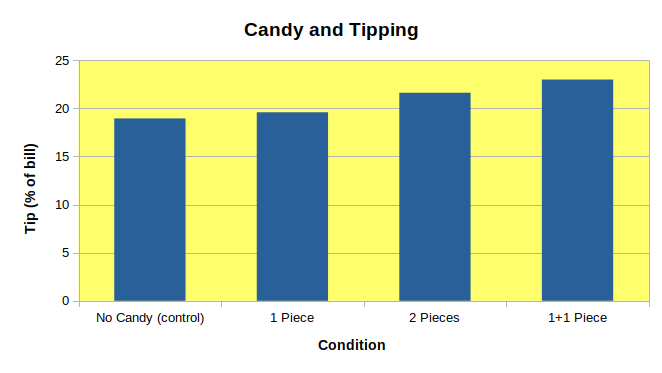
    • 1+1 condition – Giving them one piece of candy, then as the server was leaving the table, she stopped, turned back, and offered the patrons another piece

    Here are the results:

    server tips

    As you can see, 2 chocolates are better than one!  Not only that, but giving them separately, almost as if the second gift is a spontaneous gesture, is better than both together.

    How does it work?

    Why would giving the chocolates separately have a bigger effect on tips?  Could it be because the server makes a more positive impression?  Possibly, but it does not really explain the increased tips from giving 2 pieces rather than 1.  Could it be because the gift put the patrons in a good mood?  That’s possible too, but why would giving two the pieces of chocolate separately bring better moods than both at once?  It’s the same size gift, after all.  The explanation that makes the most sense is the norm of reciprocity, which we came across briefly in Randy Garner’s study using Post-it notes.

    Very often when people are on the receiving end of generosity, they feel the need to reciprocate.  This seems to work even when the act was not requested or expected.  In this case, the server seemed to be doing the patrons an extra favour.  It’s as if she was only supposed to give one chocolate, but then thought, “Hey, these are nice people, I’ll give them another!”  This type of generosity can influence our motivation to return the favour, which the patrons did by tipping more. (1)

    2) Kiss some ass

    Ingratiation has proven to be another useful method of increasing the tips you can get as a server.  A study by John Seiter looked into this, again in a real-life restaurant.

    waitress tips
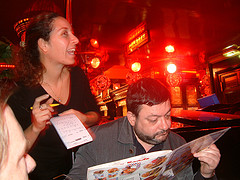
    “Ah! An excellent choice, sir!”

    The servers in the study would treat all customers exactly the same, except for one thing; after taking their order, they would either compliment the customer on their menu choice, or they wouldn’t.  What specifically did they say?  After taking the first order, the server said “You made a good choice!” and after taking the second order, they said “You did good too!”

    A concern that Seiter had was the size of the party.  If there are 14 guests, the server would have to either guess who the bill payer was, and compliment that person, or if they expected the party to ‘go dutch’, they’d have to compliment all 14 people in turn; which might be seen as just a little bit insincere!  So he restricted the experiment to parties of two – keep this in mind when you’re applying this information – it’s untested on larger groups!

    As in Strohmetz’s study, tip size was worked out as a percentage of the overall bill.  Overall, customers who received a compliment about their menu choice tipped 19% of their bill, while customers who weren’t complimented tipped only 16% of the bill!  This is a simple method, taking about 2 seconds per table, and again it results in a measurable increase in the amount of tips!  (2)

    The other studies in this field follow a similar pattern: they are done in a real-live restaurant, where the servers are told to do or not do the thing that is being studied.  So rather than describe the studies in detail from now on, I’ll just give the results.  Just know that they were all tested in real situations.

    3) Introduce yourself by name

    To test whether servers could increase tips by introducing themselves by name, researchers headed to a buffet brunch, taking their clipboards with them (presumably).  These researchers might be early paragons of multi-tasking!  I can imagine the thought process: “Hmmm.  I like research.  But I also like lunch.  How can I combine the two?”

    waiter_tips

    In this study, a buffet was a really good way to test the effect of the introduction, because customers pretty much fend for themselves after the first introduction, so there’s less chance that other factors could interfere with the results.  When the server introduced herself by name, there was a far higher tipping rate when the servers introduced themselves – 23%, compared to 15% when they didn’t! (3)

    4) Touch customers

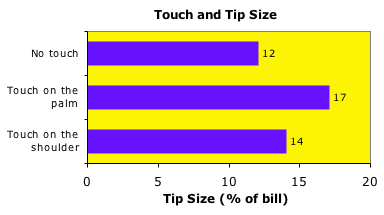
    In a study entitled “The Midas Touch”, April Crusco and Christopher Wetzel discovered what happens when waitresses touch their customers; either on the shoulder, the palm, or not at all, when returning change.  They found that the customers who were touched left the highest tips on average, that the palm was the most profitable place, and also that the customers largely weren’t aware they’d been touched. (4)

    touch_tips

    A follow up study found that when a man and a woman are dining alone, it is more profitable to touch the female customer than the male.  The reason might be that the servers in this study were all female, and touching the man might have brought out some jealousy.  So if you’re a male server, it’s unclear whether this would work for you or not. (5)

    5) Draw on the back of the cheque

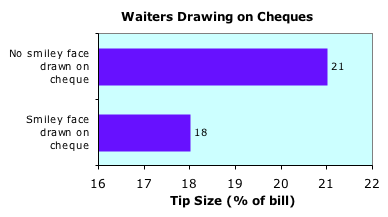
    I’ve never had this happen to me, but apparently some servers like to draw little pictures, like smiley faces, on the back of the cheques.  There are several reasons this might improve the tips; it might show that the server was pleased to have served the party, it might put the party in a better mood, or it might just be seen as a nice friendly gesture.  It does seem to work – but only for women.  Here are the results for the waitresses: (6)

    waitresses_drawing

    And here are the results for the waiters:

    waiters_drawing

    Waitresses seem to get more tips than waiters in general, and it also seems that drawing a smiley face had a slight negative effect on the waiters tips!  Perhaps it is seen as too feminine for men to do this.  if you’re a waiter, it might be best not to try this.  If you’re feeling brave, try drawing a monster truck, or a football, or even…

    6) Write “Thank You” on the Cheque

    When a server expresses their gratitude to the party, in the form of a little “Thank You” and signature on the back of the cheque, this has also proven to bring higher tips.  Although it wasn’t as effective as the smiley face, at least it should work for waitresses and waiters!

    thank_you_tips1

    As you can see, the signature isn’t strictly necessary – a friendly “thank you” message on the back of the cheque is enough to improve your tips. (7)

    All at once or one at a time?

    In all these studies, only one technique was tested at a time.  It might not be the case that doing all of them at once would have a better effect.  Then again, they might have an even stronger effect when they’re all combined.  You’ll have to do some experiments of your own to find that out.

    As I mentioned earlier, these techniques have been proven in real-life restaurant situations.  They aren’t based on laboratory studies or armchair theorising – they actually work.  I’m sure you can see that these ideas are worth trying – you should be able to increase your income by a fair amount by practising the methods here, and they are all very simple to do.  I’d be grateful if you would test some of these out for a few weeks, and leave a comment to let me know how you got on.  Thanks for reading!

    Recommended Reading:


    References:

    (1) Strohmetz D. B., Rind B., Fisher R. & Lynn M. (2002). Sweetening the till: The use of candy to increase restaurant tipping. Journal of Applied Social Psychology, 32(2), 300-309.

    (2) Seiter, J. S. (2009). Ingratiation and Gratuity: The Effect of Complimenting Customers on Tipping Behavior in Restaurants. Paper presented at the annual meeting of the International Communication Association, Sheraton New York, New York City, NY Online

    (3) Garrity, K., & Degelman, D. (1990). Effect of server introduction on restaurant tipping. Journal of Applied Social Psychology, 20,168-172.

    (4) Crusco, A. H., & Wetzel, C. G. (1984). The Midas touch: The effects of interpersonal touch on restaurant tipping. Personality and Social Psychology Bulletin, 10,512-517.

    (5) Stephen, R., & Zweigenhaft, R. L. (1986). The effect of tipping of a waitress touching male and female customers. Journal of Social Psychology, 126,141-142.

    See also:


    Hornik, J. (1992). Tactile stimulation and consumer response. Journal of Consumer Research, 19,449-458.


    Hubbard, A. S. E., Tsuji, A., Williams, C., & Seatriz, V. (2003). Effects of touch on  gratuities received in same-gender and cross-gender dyads. Journal of Applied Social Psychology, 33(11), 2427-2438.

    (6) Rind, B., Bordia, P. (1996), “Effect on restaurant tipping of male and female servers drawing a happy smiling face on the backs of customers checks”, Journal of Applied Social Psychology,  26(3), 218-25.

    (7) Rind, R., & Bordia, P. (1995). Effect of server’s “thank you” and personalization on restaurant tipping. Journal of Applied Social Psychology, 25,745-751.

    See also:

    Rind, B., & Strohmetz, D. (1999). Effect on restaurant tipping of a helpful mesage written on the back of customers’ checks. Journal of Applied Social Psychology, 29,139-144.

    Images: BarCampParis#7 by Franck Mahon.  Waiter by Alana Elliot

  • Mindless behaviour: How to skip to the front of a queue

    If there’s one thing us Brits are good at, it’s queuing.  We love it.  One day I want to get a few people and form a fake queue, leading directly to a brick wall, and see how many people we can get to join the queue.  I predict that this would work, and we could actually get a load of random people lining up to a wall.  I think they’d assume it was a queue to an ATM, and would not think to check whether there actually is one there or not.  It’s mindless faith that since a line of people leading to a wall has been for an ATM in the past, it probably will now.  And it’s this mindless faith that you can exploit to skip the line.

    Ellen Langer, Arthur Blank and Benzion Chanowitz carried out a famous study in 1978 to see if they could get people to let them go first to use a photocopier.  You might recognise Ellen Langer‘s name, I mentioned another of her studies in the priming article, where she found a way to reduce the biological age of a group of elderly participants.  In this study, the researchers tried three different approaches to getting people to let them go first.  They also told people they had either 5 or 20 copies to make, to help them discover which method was most effective.  Here are the methods they tried:

    1. Request Only “Excuse me, I have 5 (20) pages.  May I use the xerox machine?”
    2. Placebo Information “Excuse me, I have 5 (20) pages.  May I use the xerox machine, because I have to make copies?”
    3. Real Information “Excuse me, I have 5 (20) pages.  May I use the xerox machine, because I’m in a rush?”

    So a third of the time they just asked to skip the line, a third of the time they gave an irrelevant reason (of course they had to make copies.  What else do you use a xerox machine for?), and a third of the time they actually gave a good reason. And they tried all three methods while asking to make five copies, and again when asking to make 20 copies.

    Here are the results:

    because

    When you’re only asking a small favour, it doesn’t seem to matter whether you give a good reason or an arbitrary one – compliance is the same either way!  When you’re asking a big favour though, you do need to give a valid reason – if you give an arbitrary one, people don’t just mindlessly go along with it anymore.

    What’s going on?

    Over the years, many people have asked us for favours.  So many, in fact, that we’re very familiar with the general structure of a request; people ask for a favour, and then give a reason.  Countless repetition of this structure has made a rule in our minds, it goes something like this:

    Favour X + Reason Y = Comply

    But it’s not quite this simple – there are extra rules.  For example, when X is small, we can ignore Y – we’ve done so many small favours for good reasons that haven’t inconvenienced us too much in the past, that we probably won’t be inconvenienced now.  So why spend time and energy firing up our thinking processes? Why bother with the confrontation?  Overall it serves us better just to comply.

    In other words, when the stakes are low, the mind will take the mental shortcut.

    “Sometimes people don’t pay attention to the information they are receiving; only the the structure of it”

    When X is large, however – when someone wants a big favour – this changes the game a little.  Perhaps now, doing the favour will be a bigger burden than not doing it.  So the brain kick-starts our deliberate thinking processes: “Consciousness, wake up! We need some help here!”  Now you need to pay attention to the incoming information, now you care what Y is, and if someone’s asking for a big favour without a good reason, you’re likely to turn them down.

    Two other studies are described in the paper, which show a similar effect happening with written communication. People respond to short questionnaires, even when they are sent to random people, with no letterhead and no justification, just a request for people to fill out the form and send it back.  People just do it – and they are more likely to do it if they have more experience with correspondence, (for example if they work in institutions where this sort of communication is common) because they have created compliance rules for written communication.

    Because

    The point to take from this study is that when making a request, remember to back up it up with a reason (“Can you do X because Y”).  If it’s a small request, it doesn’t necessarily have to be a good reason “Come to the table because it’s time for dinner” should work as well as “Come to the table because this food looks delicious”; unless it would be seen as a big request (everyone is glued to the TV, for example).

    To skip a queue, just politely ask if you can, and give a reason.  Bear in mind that this study was done with a queue of one, so it may not work with larger queues where there’s social pressure from the people behind your ‘persuadee’ not to let you in.  But at the cash point you could try “Excuse me, can I use the ATM because I’m in a rush?”, at the nightclub you could try “Excuse me, can I go in first, because I need to find my friends”, and you already know how to skip the photocopier queue.  Play around with this and see what happens.  Don’t get carried away though or you’ll get in trouble (eg., “give me all your money because I have a gun!”).

    Sometimes people don’t pay attention to the information they are receiving; only the the structure of it.  If you can fit your request inside a structure that people are used to complying with, there’s a good chance that they’ll mindlessly comply with your request too.  Remember also to be more mindful yourself, and become aware of when you are habitually going through the motions.  I’m not saying to think every little thing through in full detail, that sounds exhausting.  But at the very least, make sure the ATM queue leads to a real machine and not just a brick wall. 🙂

    Recommended Reading:


    Reference:

    Langer, E., Blank, A., & Chanowitz, B. (1978). The mindlessness of Ostensibly Thoughtful Action: The Role of “Placebic” Information in Interpersonal Interaction.  Journal of Personality and Social Psychology, 36(6), 635-642.

    Chart made with http://onlinecharttool.com/

  • What happens when we label people?

    Ever been labelled? Ever labelled someone yourself?  Everyone’s done both, sometimes it’s benign, sometimes it’s a good thing and sometimes it’s a bad thing.  It starts from an early age and continues through life – he’s a jock, he’s conscientious, she’s a troublemaker.  Assigning labels to things seems to be part of how our brain makes sense of the world.  But what happens to a person when you give them a particular label?

    Researchers Alice Tybout and Richard Yalch devised an ingenious way to test this.  A week or so before an election, they went door-to-door, surveying people about their attitudes towards the different candidates and some current issues.  Then, while still in front of the participant, they compared the survey answers to a voter profile for an “average” citizen, and told the participant that, based on their answers, the likelihood they would vote was either average, or above-average. In reality, however, the voter profile was fake and this label was given randomly.

    Here’s how the labels were specifically given:

    Above average label:

    “That’s interesting, your proftle indicates that, relative to others in this community, you are an above-average citizen. Our research shows that people like you are very likely to vote in elections and participate in political events.”

    Average label:

    “That’s interesting, your profile indicates that, relative to others in this community, you are an average citizen. Our research shows that people like you have an average likelihood of voting in elections and participating in poitical events.”

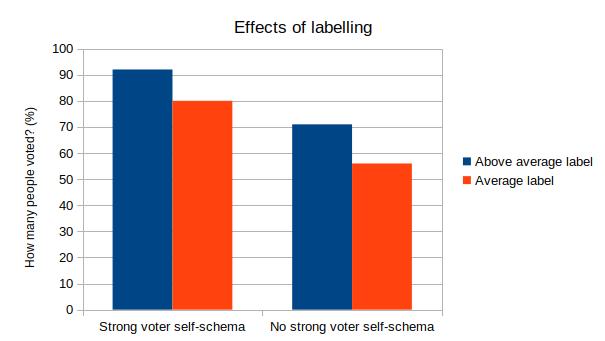
    As you can see, the label seemed to come from a place of authority, and they made sure that the participants knew what was expected of people with this particular label.  So how did these labels affect voter turnout?  As you might have guessed, labelling people as likely to vote did increase turnout – 86.5% of this group voted, versus 75.3% of the ‘average’ group.  But have a look at the chart below:

    label people

    The label had the strongest effect on people who already thought of themselves as voters; who had what psychologists call a “self-schema” for voting.  A ‘self-schema’ (pronounced skeema) is a generalisation you make about yourself based on your previous behaviour and experiences.  A self-schema will tend to affect how you interpret and respond to other information you receive about yourself.

    In this case, for example, people were more likely to vote when their self-scheema and the label they received were congruent.  Make sense?  Assuming this is true for every self-schema, you can see some practical application.  Labelling your workforce as a hard workers will have a bigger effect on productivity if they already see themselves as hard workers; though it will still have some effect if they don’t.

    You can see that when people already have a self-schema as being the voting type, telling them they are an average voter will make them more likely to vote than telling people who don’t have this self-scheema, that they are above-average citizens.  This might be because we don’t pay as strong attention to things when they don’t match our self-schema.  Or maybe, simply talking about political issues was enough to get these eager voters fired up.

    How long does a label last?

    Less than eight months, apparently.  In a following election, eight months later voter turnout overall had dropped to 54% for the group labelled above average, and 53% for the average group.  Labelling only seems to work in the short-run, probably because many other different labels, cues and primes will come along over time, and they might override a label that was only given once.

    Practical Applications

    This is another example of how a something deceptively simple can affect peoples’ behaviour. There are plenty of ways that labelling can be ethically applied.  Teachers could tell students that they seem able and competent, managers can tell their staff they are up to the task, and you can tell your date that she definitely seems like the type of girl who’d come home with you (OK, maybe not the last one!).

    What I’d want to know it how authority affects labels.  For example, if you really like and respect your teacher, and she tells you that she’s been keeping an eye on you and she really sees potential in you, you could go a long way, would that have a bigger effect than if one of your classmates said it, for instance?  You also have to wonder, if a police officer tells you that you’re worthless criminal scum, what effect does that have on you?

    I wonder what would happen if the police went around acting genuinely surprised whenever someone committed a crime, and absolutely insisted, to the full extent of their authority, that the perpetrator was a law-abiding, upstanding citizen, and the couldn’t understand why they did it.  Maybe some people would just bow down to the authority “I am?  Oh.  Didn’t realise officer, my bad!”

    Another application is you can become more aware of attempts to label you, particularly by advertisers.  This is definitely something you should do, I mean, after all, you’re worth it.  And if you can figure out your self-schema, you’ll be able to see what types of labels are more likely to affect you.

    Oh, by the way, I was analysing my web traffic statistics yesterday, and I suddenly realised that readers of Generally Thinking are a loyal, intelligent and open-minded bunch, who like to visit this site regularly!

    Recommended Reading:


    Reference:

    Tybout, A. M., Yalch, R. F. (1980). The Effect of Experience: A Matter of Salience? Journal of Consumer Research, 6, 406-413.

  • How to increase survey response rates using Post-It notes

    I love Post-its.  I use them everyday, to leave myself reminders, as bookmarks, and sometimes to make little stick-man animations; just a small part of my productive and fulfilling private life!  And this youtube video showing creative uses of Post-its, is pretty cool.

    But Post-its are not merely a tool of convenience and fun; they are also a powerful method of persuasion.  Randy Garner, at Sam Houston State University, wanted to find better ways of increasing survey response rates.  I sympathise; one of the hardest things in my psychology degree was getting people to take part in my dissertation project.  I tried everything; face-to-face solicitation, internet marketing, interpretive dance; I even advertised on Craigslist, of all places.

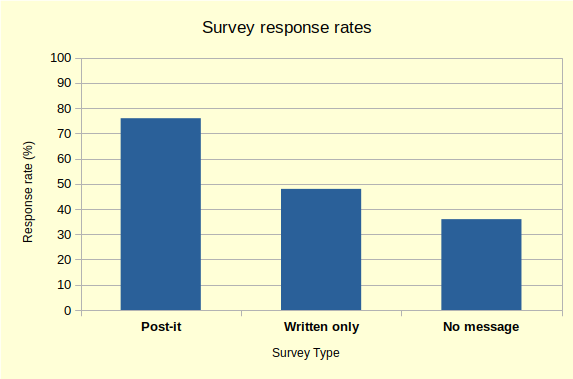
    I wish I’d read Garner’s study first!  He mailed out surveys to 150 participants.  Some received a survey with a Post-it (Post-It group), requesting that the survey be completed, some received a survey with the same message on the survey itself (written-only group), and some just got the survey with no message (no-message group).

    The results?  Look below:

    survey response rates 1

    The persuasive power of the Post-it is quite apparent!  People were more likely to return the survey if there was a Post-it message stuck onto it.  The same message written on the survey itself did not have the same effect, so it’s not simply the written request that is causing the higher response rates; the Post-it is essential.  But what would happen if you didn’t put a message on the Post-it?  Maybe the Post-it is just novel or attention grabbing, and that’s enough by itself?

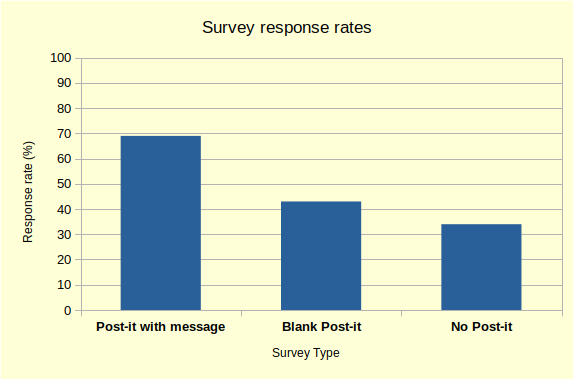
    Garner tested this too, making a couple of changes to his study.  Again, he used three groups, but this time one received a Post-it with a message, one with a blank Post-it, and the final group got a survey with no Post-it.

    Here are the response rates for the second survey:

    survey response rates 2

    Similar results.  Clearly, you need both the message and the medium for this to work; although a blank Post-it did increase the response rate slightly.

    In a third study, Garner found that the humble Post-it meant people responded to the surveys sooner, and also left more comments in the open-ended questions sections!

    How far can you take this?

    It makes you wonder.  If a simple Post-it note with a message can increase survey response rates, what else can it do?  If I write a love letter to a hundred women, and put a Post-it note on requesting that they send one back, would I get more replies?  If I write a letter of complaint to a company, with a Post-it note asking for a quick response, will I get one?  And also, how can the Post-it message be improved?

    Garner thought of this (this guy thinks of everything, doesn’t he?), and did a final study, this time with six groups.  Half of the participants got a similar survey to the one before, half got a monster-sized survey, 24 pages and 150 questions in length, mostly open-ended questions too.  The kind of survey that makes you think “Oh good! I needed something to put under that table leg!”

    Within these two groups, people either got:

    1. A normal Post-it message as before (saying “please take a few minutes to complete this survey for us”)
    2. A personalised Post-it message with the recipients name, the standard message, and “Thank you, RG” at the end as a signature
    3. Neither a Post-it nor a message (the control group)

    A bit more complicated this time!  Here are the results:

    survey response rates 3

    The red bar is the simple survey, and as you can see, the results increased slightly because of the personalised message.  But look at the purple bar, showing the complex, long-winded survey.  The standard Post-it message used previously performed quite poorly.  But when the message was personalised, the response rate was only 10% less than the easy survey!

    So if you’re trying to get people to do a complex task, you need to personalise the request.  Find out the name of the person you’re sending your survey (or whatever) to, and put it on the Post-it note, along with a thank you and your initials.

    How is this working?

    The idea behind this is that a Post-it with a message is viewed as a personal request, a favour.  It activates the principle of social reciprocity, more commonly known as ‘you scratch my back I’ll scratch yours’.  Someone’s gone to the trouble to write you out a message on a Post-it and stick it to the survey – it’s not just a machine, printing out letters from a mail merge and some person stuffing them in an envelope – there’s a human being reaching out and making contact with you.  The least you can do is respond!  Polite, reciprocal compliance is one of our cultural norms, and the Post-it activates this.

    Taking a wider view, we can see that the norm to return a favour is activated even when a the initial favour wasn’t even requested in the first place.  You might have seen this tactic used by salespeople, offering you a free toaster or pen.

    These findings will be useful to keep in mind, not only to tell when you’re being influenced, but also to help you out if you have a survey or project of your own that you need a good response rate to.  Spending a little time writing out a personalised Post-it request will be well worth the time and effort.

    To conclude, I’ll quote Randy Garner’s last sentence in his paper:

    “These findings suggest that the use of something as seemingly insignificant as a Post-it can indeed possess the potential for eliciting a sticky influence”

    (uuuhhhhhhh….)

    Recommended Reading:


    Reference:

    Garner, R. (2005). Post-It Note Persuasion: A Sticky Influence. Journal of Consumer Psychology. 15(3), 230-237.

    Note:  I made the graphs using http://onlinecharttool.com – completely free and recommended if you’re bored with the Excel graphs!