Month: December 2009

  • Why 88% of New Years' resolutions fail

    Jonah Lehrer wrote an excellent article for the Wall Street Journal on why New Year’s resolutions fail.

    Quick overview of reasons:

    • The more overloaded our brain is with ‘stuff’ (including resolutions we need to keep track of), the weaker its willpower is. We need to spread our resolutions across the year.
    • Just like a muscle, our will-power has limited capacity – don’t make it do too much or you’ll lose self-control.
    • Again, just like a muscle, exercising will-power uses up energy (glucose), so beware if you’re trying to lose weight as a resolution – starving yourself will reduce your will-power.
    • When you reach the inevitable point of temptation, distract yourself rather than trying to power through.
    • Will-power can be trained and training it in one domain (eg posture) increases will-power in others

    I really recommend the article, it’s great stuff. You can also find Jonah’s blog here.

  • Subliminal Advertising: Should we be worried?

    In 1957, a gentleman by the name of James Vicary created a new concept: Subliminal advertising. He flashed the words “Eat Popcorn” and “Drink Coca-Cola” for a fraction of a second during a film, and claimed increases in sales of these products of 18% and 57% respectively.

    But, there’s one other thing that bugged me about that ‘study’. The name of the film. It was called ‘Picnic’. I’ve never seen this film, and I don’t know if you have, but I find it hard to imagine that there weren’t multiple scenes of gratuitous eating and drinking in it! Could this possibly have a more powerful effect than a few words, flashed for only 1/300th of a second?

    Maybe, but this is all academic, as Vicary supposedly admitted to fabricating his results. Still, I think my general point is valid.

    Most people would see subliminal messages as some kind of slimy, dirty, underhanded advertising trick, right up there with spam emails. However it’s apparently OK to use every other persuasion technique in the book to get you to buy something: celebrity endorsements which bring authority and social proof. Free gifts to trigger the reciprocity principle. Short-term sales to activate the scarcity principle. Are these things underhanded? Oh no, these are all fine, but throw in a capitalised word for 1/300th of a second, and there’ll be riots!

    Advertisers are throwing the big guns at us, and we’re worried about the little pee-shooter in the corner. I think it’s the feeling of being cheated; that they are not playing by the rules. Manipulate us, sir, but not behind our backs; that would be wrong.

    But is this something we should be worried about? Probably not. In 1992, a review of over 200 studies of subliminal advertising concluded that there is very little evidence to support the idea that subliminal advertising can influence our behaviour. (1)

    But sometimes you’ll hear stories of people that were ‘influenced’. You’ve got to be careful that you’re not seeing what you want to see; adapting your interpretation of your experience to fit your beliefs, rather than the other way around. Vicary publicly announced that he’d run another subliminal message, this time on live TV. He flashed the phase “telephone now” during a program. Call-in rates didn’t increase, however some viewers reported that they had the uncontrollable urge to get a drink or use the toilet. Interesting. Because that never happens when people aren’t flashing subliminal messages at you!

    So how did we start at Vicary’s supposedly fabricated first study, go through the failed second one, the 1992 rebuke, and still end up at, for example, the telegraph, September 2009: “Subliminal advertising really does work, claim scientists.

    Claim scientists? Hang on a second. Weren’t the scientists the ones saying subliminal messaging in advertising DOESN’T work? What’s going on here?

    Well there’s a difference between subliminal messages changing someone’s behaviour, and the subliminal perception of a message. Very important distinction. The study reported by the telegraph asked people to rate whether the word was positive or negative; it didn’t look into behavioural consequences of that perception.

    We came across a similar study in the priming article. People seem unconsciously aware of whether subliminal messages are positive or negative, but it takes more overt priming to bring behavioural consequences. Not much more; but read the priming article for more information on that. This brings me nicely back to my point: Don’t worry about subliminal messages in advertising, they probably aren’t going to effect you. It’s the very blatant, obvious stuff you should be worrying about!

    Maybe blatant persuasion and propaganda is something we’ll look into another day. I’d cover it now, only I have the strangest urge to go buy some popcorn and coca-cola…

    References:

    (1) Pratkanis, A & Aronson, E. (1992). Age of Propaganda: The Everyday Use and Abuse of Persuasion. NY: W.H. Freeman

  • 6 Strengths of the working memory model

    The working memory model discussed earlier has a lot going for it compared to other memory models. Here are a few things:

    strengths of the working memory model
    The working memory model.

    1) Unlike some other models (eg, the short-term store model), the working memory model explains not only the storage, but also the processing of information.

    2) Specificity. Because the model proposes specific and separate functions and subsystems, new predictions and hypotheses can be drawn up for testing.

    3) It is consistent with records of brain-damaged patients. For example the visuo-spatial sketch pad is said to be made of two parts, the visual cache which stores information about colour and form, and the inner scribe, which processes spatial and movement information. Patient ‘LH’ had more difficulty with visual tasks than spatial tasks, which probably means that there is a different part of the brain controlling these things; just as the model suggests (1). Another example is ‘KF’, whose forgetting of auditory stimuli was higher than visual stimuli. (2) There are quite a few cases like this, which support the model.

    4) The model integrates a large number of research findings. As well as studies on brain damaged patients, there is also experimental evidence which supports the model (eg., Baddeley and his colleagues’ word-length effect (3) supporting the phonological loop), and a number of brain-scan studies have found different brain regions to activate when people carry out tasks involving the different components of working memory (4; this paper and many others are available for download here).

    5) A previous model placed enormous importance on verbal rehearsal for transferring information into long-term memory; this doesn’t match up well with our day-to-day experience. In the working memory model, verbal rehearsal is noted as one way to encode and store information, but there are other routes too (visual stimuli, the episodic buffer, etc). From this point of view, it’s more realistic.

    6) The working memory has a strong role in cognitive psychology and can be used to study other theorised systems and processes in the brain (eg., consciousness), by seeing how they relate to working memory. A perfect example of this, is how the central executive allows researchers to look into how memory relates to attention.

    There you go, six starting points for the evaluation section of any essay or exam you might have on this topic, or more detailed information for people who are just plain interested. By they way, if you’re a psychology student, you may also be interested in my study skills book!

    References:

    (1) Farah, M.J., Hammond, K.H., Levine, D.N. & Calvanio, R. (1988). Visual and spatial mental imagery: Dissociable systems of representation. Cognitive Psychology, 20, 439-462.
    (2) Shallice, T., & Warrington, E. K. (1970). Independent functioning of verbal memory store: A neuropsychological study. Quarterly Journal of Experimental Psychology, 22, 261–273.
    (3) Baddeley, A.D. et al. (1975). Word length and the structure of short-term memory. Journal of Verbal Learning and Verbal Behavior 14, 575–589.
    (4) Sala, J.B., Rama, P., & Courtney, S.M. (2003). Functional Topography of a Distributed Neural System for Spatial and Nonspatial Information Maintenance in Working Memory. Neuropsychologia, 41(3), 341-56.


    Recommended Reading:

  • 3 Keys to fantastic memory

    Fantastic memory. I really need this. I’m quite fond of such classic moments as walking into a room without any idea what I’m doing there, forgetting peoples’ names only seconds after I meet them, and once, completely forgetting how old I was (a liberating, if mildly frustrating experience).

    Maybe I need the help of one of the big names in the study of expertise, Dr K. Anders Ericsson. He’s done work on what separates good performers from master performers in a number of different fields, and he consistently found that the main factor in expertise is practice. When he turned his attention to the study of people with a fantastic memory abilities, he reports that not only is practice necessary, it is also sufficient.


    60s pinup memory

    “You’re so forgetful darling! That’s the third time you’ve covered me with suntan lotion!”(credit)

    He goes on to cover what he believes are the three essential requirements for fantastic memory:

    1) Meaningful Encoding

    We looked into what encoding is here. To encode something meaningfully means relating it to existing knowledge – making connections between material.

    2) Retrieval Structure

    Along with the information being stored, cues should be memorised too. This allows for much greater ease of recall later on – the more ‘paths’ to the memory, the more ways it can be accessed and the recalled. This is the principle behind the link system and the peg system of memory.

    3) Speed-up

    This is where practice comes in. People with fantastic memory have extensively practised encoding and recalling information – in a way, this trains the processes involved, so that they function more quickly over time. Eventually, as with many learned skills, the process becomes automatic. For example, if you’ve ever learned to drive, you’ll remember that at first you have to put your full attention on the job; but later, you could switch off while driving and think about whatever comes to mind. According to Ericsson, it’s the same thing with memory.


    fantastic memory

    Bill forgets to pick up his phone once again.

    I find Ericsson’s work quite encouraging. It’s kind of nice to know that given huge amounts of dedicated practice, natural talent doesn’t seem to play much of a role in performance. But does this mean we can do “Anything we set our minds to?” Or should we “Stick to our strengths?” The answer to that is here, and it’s probably not what you’re thinking.

    Either way though, I have to wonder just how much practice it will take for me to stop walking into rooms without knowing why I’m there…

    References:

    Ericsson, K.A. (1988). Analysis of memory performance in terms of memory skill. In R.J. Sternberg (Ed.), Advances in the psychology of human intelligence, Vol 4. Hillsdale, NJ: Lawrence Erlbaum Associates Inc.

    Ericsson, K.A. & Kintsch, W. (1995). Long-term working memory. Psychological Review, 102, 211-245

  • Change Blindness

    Ever notice a blank wall where a painting used to be, only to find out it had been gone for days? That’s change blindess at work. As we go about our business, our visual scene is changing frequently. We think that we have a clear and accurate view of the world as we move around it; but we’re actually not that great at detecting changes in our visual environment. This is going on all the time – things in your environment change, but you’re none the wiser.

    This even applies to changes that you would think were completely obvious. The classic study on change blindness had a researcher ask participants for help with some written directions. While they were talking, a brief distraction was arranged, during which a confederate switched places with the researcher, and continue the conversation. Amazingly, most of the participants did not even notice the switch, and carried on talking to the completely different person! (1) Here’s a video of a similar study, reporting that 75% of people didn’t notice!

    How is change blindness explained?

    There is still work to be done in this area, but the main theory is based on the idea of mental maps of scenes, which are stored in long-term memory. (2) When we fixate our attention on a particular aspect of our visual environment, it gets added to the mental map. These representations are thought to be fairly detailed, though not wholly accurate, and they stay for some time after they’re formed. Unless a particular aspect of a scene has been indexed in the mental map, there’s nothing to compare it with to realise there has been a change. So the most important factor in change blindness is not memory, but attention. If something hasn’t been fixated on, according to this theory, it doesn’t get added to the map, and changes to it (or its disappearance) won’t be noticed.

    Where to go for more information on change blindness

    For general interest, the You Tube clip linked to above is worth watching, but for academic interest get Hollingworth and Henderson’s 2002 paper (it’s on Andrew Hollingworth’s website for free download), also look up Rensink’s work.

    References:

    (1) Simons, D. J. & Levin, D. T. (1998). Failure to detect changes to people during a real-world interaction, Psychonomic Bulletin and Review, 5, 644–649

    (2) Hollingworth, A., & Henderson, J. M. (2002). Accurate visual memory for previously attended objects in natural scenes. Journal of Experimental Psychology: Human Perception and Performance, 28, 113-136.

    Recommended Reading:

  • Baddeley and Hitch: Working Memory

    I’ve been looking for information on memory recently, searching for ways to improve it. I know a few tricks (the peg system), but I don’t want to using a technique every time I try to remember something, I want general performance improvement. One way to improve the performance of a system is to learn how it works, and go from there.

    This is where researchers Baddeley and Hitch come in (1). Most people think of human memory as being a passive storage space, but this isn’t actually the case. According to Baddely and Hitch’s working memory model, memory is an active set of processes (this is short-term, not long term memory) – when we first perceive something, it is ‘worked on’ in working memory. This is called encoding. Memories have to be encoded before they can be stored in long-term memory.

    Baddeley and Hitch’s working memory model has a few separate parts to it, each processing different types of information:
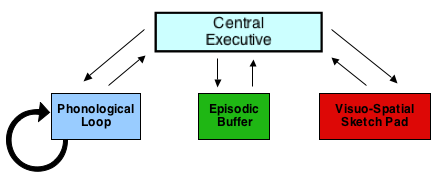
    baddeley and hitch working memory

    Baddeley and Hitch: Working Memory

    The central executive

    This is the master controller of the working memory system. It’s functions are thought to include switching attention between tasks, selecting/ignoring stimuli, and activating necessary information from long-term memory. At the moment it’s unclear whether the central executive is one unitary mechanism, or whether it can be broken down into subsystems.

    The phonological loop

    This component holds speech-based information. It has two parts – a phonological store, which temporarily holds speech information, and the articulatory control process (ACT; the arrow in the diagram), which is the part that’s working when you’re talking to yourself in your head. The ACT is one way of getting information into the phonological store, but, information in the phonological store starts to decay after a few seconds. This is why to remember a phone number you need to keep repeating it over and over until you find a pen – you’re refreshing the decaying information by it by putting it through the ACT again.

    Visuo-spatial sketch pad

    Not surprisingly, this is the part that processes visual information. This might be from your eyes, recalling a memory, or creatively visualising something. If you’re seeing with your “mind’s eye,” or mentally manipulating an image, this is the part that’s working.

    The episodic buffer

    Information is encoded differently in the phonological loop and the visuo-spatial sketch pad, while the central executive can only process, not store. The episodic buffer is able to combine information from the above components into a single representation. This was added to the model only recently (2000), because a number of research findings were hard to explain without it. (2)

    Anything useful in Baddely and Hitch’s working memory model?

    Study tip

    The phonological loop explains why it’s a really bad idea to listen to music with lyrics while studying. If you’re paying any attention to the music, it will enter the loop, and compete for encoding with whatever you’re reading – even if you don’t read ‘in your head’, looking at words visually seems to put them into the phonological store too. If you don’t encode the information, you won’t store it, and you’ll have a harder time remembering it tomorrow, let along in an exam.

    Repetition

    As the above stores only have a short capacity, one way of making encoding more likely is repetition. The more times you go over something, the better you’ll remember it. So read and re-read the thing you need to remember, in your head and out loud.

    Chunking

    Because the working memory system can only hold a limited number of discreet items (between 5 and 9 for the loop), to increase it’s capacity we have to chunk larger amounts of information together. For example, a string of 10 one-digit numbers could be chunked into a string of five two-digit numbers.

    Attention

    Generally speaking, anything we’re not fully attending to will face competition for encoding. Have you ever been on a bus, daydreaming, and later be completely remember what the person in front of you looked like? When your focus is on your internal images, the input from your eyes isn’t encoded as easily (if at all). The central executive is monitoring what’s going on, of course, so if the person turned around and was incredibly beautiful, or holding a weapon, your attention would be diverted accordingly.

    But the general point here is that giving something your full attention gives you a better chance of remembering it, because it will have less competition in the temporary storage areas outlined above, and is therefore more likely to be encoded and then stored in long-term memory.

    References:

    (1) Baddeley, A.D., & Hitch, G.J. (1974). Working memory. In G.H Bower (Ed.), The psychology of learning and motivation, Vol 8. London: Academic Press.

    (2) Baddeley, A.D. (2000). The episodic buffer: A new component of working memory? Trends in Cognitive Science, 4, 417-423

  • Creativity and Originality

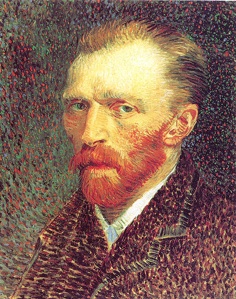
    Imagine the classic image of the troubled artist; filled with angst and pain, tormented by something-or-other, but pulls out these classic works of art that inspire people for generations. How does this stereotype fit in with studies showing that creativity is enhanced through positive moods and emotions? (1) Is there a contradiction here? No, there’s just a slight distinction that needs to be made between creativity and originality.

    Originality

    Originality refers to the production of a new idea, without any particular care for whether these ideas will be useful or not. So when you’re brainstorming and trying to turn out as many possibilities as you can, psychologists would call this originality, not creativity. It’s originality that is enhanced by positive moods. So when people are brainstorming ideas, good moods will help them come up with more ideas, all other things being equal. Remember the golden rule of brainstorming though: no idea is a bad idea. Just keep them coming and write them all down, review and analysis can come later.

    creativity and originality
    Van Gogh – troubled but creative

    Originality is usually tested through divergent thinking exercises, like the ‘Uses of a Brick’ test, where the researchers simply ask people to come up with as many uses for a brick as they can – no matter how silly. We tested this in class once, half of the class left to another room and watched a sad youtube clip, and the rest of us watched a happy one. Both groups did the Uses of a Brick exercises, those of us who watched the happy clip came up with more uses for a brick (my favourite one was ‘combing your hair’) – so the theory held up to our test.

    Creativity

    So what’s creativity then? Well, while originality is judged by the sheer number of ideas one can come up with, creativity places a more stringent criteria on these ideas – they not only have to be original, they have to be worthwhile or useful. So creativity is more beneficial than originality, but unfortunately it’s harder to measure, because the usefulness of an idea is not always immediately apparent.

    This is how creativity and originality are defined in psychology. This does not imply good moods are bad for creativity – only that there’s more going on in creative achievement than the simple generation of original ideas. Other things are being channelled into the work which make it useful, and of course when you’re talking about usefulness, difficult questions arise (useful for what? For whom?). But all the other factors involved mean that even although the tormented artist’s originality might be lowered to some degree due to less frequent positive emotions, this doesn’t necessarily mean she will also have lowered creative output.

    Reference:

    (1) Fredrickson, B. L. (2001). The Role of Positive Emotions in Positive Psychology. American Psychologist. 56 (3), 218-226.