Month: February 2010

  • Can we develop psychological resilience through physical activity?

    Psychological ‘resilience’ refers to the differences between people in how they respond to and cope with difficult or stressful experiences. People who are highly resilient would be less affected, recover more quickly, and/or might actually find such events to be growth experiences. For people low in resilience, the opposite would be true.

    Now here’s something to think about: many popular books and articles have mentioned the increases in mental disorder such as stress and depression over the last century, at least in the modern world. And if you think about it, there does seem to be a trend in which, as time has gone by, we’ve increased our use of technology to the effect that we physically move around much less.

    Could it be that there is a causal relationship here, that our lack of movement has reduced our psychological resilience to stress? And by becoming more active, could we increase our resilience?

    Stress

    In a sense, everything that we do involves stress. Even just reading this sentence is placing a particular demand on your brain, so what is important here is how we respond a particular stressor. Stress is also important for growth – our bodies are adaptive and generally respond to stress by becoming more able to deal with it; provided that stress is not too high. For example, doing bicep curls with 100kg would probably be too much stress and lead to injury, but 10kg might be enough stress to increase strength.

    So you could argue that placing the body under moderate amounts of stress could, over time, lead to lowered stress responses to future events, but the important point is whether resilience to the stress of exercise carries over to stress caused by other events (eg, in the workplace, traffic jams, etc).

    Exercise

    resilience_and_exercise
    Two great ways to get some exercise: Walk the invisible dog, and handshake the invisible man. (Credit: mikebaird)

    In one study, researchers put one group of participants on a 10-week walking and jogging program, and left another to continue their normal sedentary lifestyle. At the end of the program, the exercise group scored lower on state and trait anxiety, as well as less tension and fatigue. These factors could contribute to lowered stress responses to future events, however this was not tested directly, and additionally only 16 participants per group took part, and you’d typically want a minimum of 30, preferably more, to get a solid finding. (1)

    In another study, the effects of aerobic, weight, and no training on responses to a fiendishly stressful situation were compared. Participants had to answer mental arithmetic puzzles, which flashed up on a screen too fast to complete, while listening to distracting conversations involving numbers.

    Those who had undergone the aerobic training had reduced heart-rate and systolic blood-pressure responses relative to the control group (the weight training group only had improvements in systolic blood-pressure). So it seems apparent that exercise builds physical and psychological resilience to other events. (2)

    Mechanisms

    The mechanism of this effect is not yet fully understood, but Spalding et al (2) suggest it may by primarily due to improvements in general cardiac performance – the cardiovascular system becomes more efficient and doesn’t need to do as much work to mobilise resources in reaction to a stressor. In this way, exercise effectively raises the body’s natural ‘trigger point’ for the stress response.

    Additionally, exercise triggers the release of atrial natriuretic peptide (ANP), which has a direct effect on the body’s stress response by reducing the activation of the HPA axis. This is a route through which exercise can reduce immediate levels of stress, but there may be longer-term effects too; exercise may benefit chronic levels of stress by relaxing the resting tension level of the muscles, which can reduce chronic stress by breaking the stress-feedback loop (3).

    The body was ‘designed’ with the presumption that it would experience a certain amount of movement, and when this movement doesn’t take place, the body doesn’t perform up to spec. This is one example of many where we see that as humans are taken further from their ‘natural environment’, so to speak, various problems start to arise.

    Recommended Reading:

    References:

    (1) Blumenthal, J.A., Williams., R.S., Needels, T.L., & Wallace, A.G. (1982). Psychological changes accompany aerobic exercise in healthy middle-aged adults. Psychosomatic Medicine, 44(6), 529-536.

    (2) Spalding, T.W., Lyon, L.A., Steel, D.H., & Hatfield, B.D. (2004). Aerobic exercise training and cardiovascular reactivity to psychological stress in sedentary young normotensive men and women. Psychophysiology, 41, 552-562.

    (3) Ratey, J., & Hagerman, E. (2008). Spark. London: Quercus.

  • Is love really blind? Positive illusions in relationships

    One of the more interesting of our (many) cognitive biases are positive illusions – a tendency to be view ourselves more positively than others, be optimistic about the future, and exaggerate our perceptions of control.  Positive illusions are typically self-enhancing, but if you’ve ever seen a madly in love couple, or been a part of one, you might have the idea that maybe we project positive illusions onto other people.  And it’s true.  People in romantic relationships really do drench their partners in a wave of idealised qualities, and downplay their more annoying aspects. (1)

    A number of studies have found that people tend to rate their partners attractiveness as greater than their own (2), but there was one study in particular which was particularly ingenious. (3)  Photos were taken of couples, which were manipulated in a computer to create an array of seven faces – the real photo, three that were more attractive, and three that were less attractive (see ‘What is beauty?‘ for more on standards of attractiveness).  Participants had to identify their partners real face from the fake ones.  Couples who were satisfied with their current relationship tended to pick a more attractive face, couples who were dissatisfied tended to pick a less attractive face!

    positive_illusions
    If you look at your partner and see this, that’s an example of a positive illusion. Or an LSD high. (Credit: NaiM eL NoVaTO)

    Why does this happen though?  We’ve already seen that love can have a very powerful effect on us, perhaps these illusions help us to justify staying with a partner, just like a junkie justifies “one more hit.”  That’s an unromantic way of saying that this may just be a normal, healthy way of keeping a relationship going.  And likewise, when a relationship is going badly, the illusions disappear which again could be a way of helping us to make the right relationship choices.

    So, our mind may be responding to the amount of satisfaction in the relationship by altering our perceptions slightly, as a safeguard towards helping us stay in beneficial relationships, and against wasting time in bad relationships (when we could be looking for someone new).  And it does seem to be an effective system – one study followed couples over a 13-year period, and found that positive illusions predicted greater satisfaction with the relationship in the early stages of dating and marriage.

    So is love blind?  Perhaps not blind, but certainly partially-sighted.  However, this is not a phenomenon that is unique to love.  Our perception of reality is far from objective, particularly social reality, and positive illusions in relationships are just another illustration of the idea that we are specialised organisms rather than rational beings.  Natural selection has ‘designed’ our minds to cut the corners of logic wherever this helps us to solve our problems of survival and reproduction in a more efficient or effective way.  Well, there’s either that explanation, or the ‘love-is-magic’ Disney explanation.  Take your pick.

    References:

    (1) Murray, S., Holmes, J., & Griffin, D. (1996). The benefits of positive illusions: Idealization and the construction of satisfaction in close relationships. Journal of Personality and Social Psychology, 70(1), 79-98

    (2) Swami, V., Furnham, A., Georgiades, C., & Pang, L. (2007). Evaluating self and partner physical attractiveness. Body Image, 4, 97-101.

    (3) Penton-Voak, I.S., Rowe, A.C., & Williams, J. (2007). Through rose tinted glasses: Relationship satisfaction and representations of partners facial attractiveness.  Journal of Evolutionary Psychology, 5, 169-181.

  • Love on the brain

    Love is a topic that scientists have shied away from – perhaps in the same way as studying humour, they worry that they will take the magic out of it. But as Helen Fisher, one of the foremost researchers of love says, you can know all the ingredients of chocolate cake and it will still taste delicious.

    One of the more popular early theories was Sternberg’s triangular theory of love. This theory has immediate appeal because it points out three aspects of loving relationships that we can instantly recognise – intimacy, passion, and commitment. A relationship can have any two or all three of these, and in the theory, each combination has its own name (see this article for more on that).

    It’s a nice, tidy model. But one problem I first had with it, is that maybe it only has intuitive appeal because I recognise it in Hollywood movies, rather than in people. Is this love?

    It may be: Sternberg’s model matches up nicely with some work in neuroscience and animal behaviour. It seems that there are discrete but interrelated emotional systems common to most if not all mammals and birds, which solve the ‘problem’ of mating. These are lust, attraction, and attachment, and they correspond roughly to Sternberg’s passion, intimacy and commitment. Example behaviours are:

    • Lust / passion – craving for sexual gratification, associated with elevated levels of estrogens and androgens.
    • Attraction / intimacy – increased energy spent on the preferred mating partner, in humans this also includes ‘intrusive thinking’ about the love interest. Associated with increased dopamine and norepinephrine, and decreased serotonin.
    • Attachment / commitment – Characterised by mutual territory/resource defence, nest building, close proximity, separation anxiety. Associated with the neuropeptides oxytocin and vasopressin. (see references 1 and 2 for a review of this evidence)

    These are powerful chemicals, and the power of love should not be underestimated; in one study, evidence of romantic attraction was found in 147 of 166 societies (3). People elope together because of love, they sing songs because of love, and they kill themselves – and others – because of love. Clearly, it is more than a feeling. What is actually going in this attraction / intimacy part of Fisher/Sternberg’s models that has such a maddening effect on us?

    To find out, Helen Fisher stuck a bunch of madly-in-love people in fMRI scanners, while showing them pictures of their loved one. The results? It appears that romantic love is located primarily in the ventral tegmental area of the brain. This is part of the dopaminergic system, involved in reward, want, and craving. It’s the same area of the brain that fires up when addictive drugs are taken, particularly cocaine and the amphetamine derivatives. In other words, love is addictive – literally.

    But of course, every rose has its thorn, and love does not always end well. In another interesting study, Fisher and colleagues stuck people who had recently been dumped into an fMRI (4). Where is this experience located in the brain? The same place! But additionally, there was also activation in the nucleus accumbens, an area associated with judgements of gain and loss; the area that lights up when we’re willing to take great risks to achieve a high perceived gain – the same area involved in gambling. This is why we get people going to great lengths to get their love back – they are simultaneously focused on what they have lost and at the same time more likely to take high risks.

    So what is love? It is an addiction. It meets the criteria necessary for something to be classed as an addiction (tolerance, withdrawal, relapse). The implications of the above findings are massive – if love is associated with the above neuotransmitters, peptides and hormones, then our experience of love could be influence by anything that interferes with these chemicals – recreational drugs and anti-depressants in particular. In addition to this, the brain areas involved in love seem to suggest that, rather than being an emotion per ce, it is a goal-oriented state.

    old_couple_dancing
    (Credit: txd)

    But, at the risk of leaving on a low note, I’ll finish by mentioning a recent study by the same research team (5). So fond of sticking people into fMRI scanners, this time they scanned couples who had been married for 25+ years, and still report feeling in love with their partners. What was the brain activity in these couples? As Sternberg would predict, they showed greater activity in areas associated with long-term pair bonding in animals. But what about attraction / intimacy? Well, they found just the same activity as they did in the earlier experiments. Perhaps true love can last forever.

    PS. The titles of five love songs are hidden in this article. See if you can find them!

    Recommended Reading:

    References:

    (1) Fisher, H. (1998). Lust, attraction, and attachment in mammalian reproduction. Human Nature, 9(1), 23-52.

    (2) Fisher, H., Aron, A., Mashek, D., Li, H., & Brown, L. (2002). Defining the brain systems of lust, romantic attraction, and attachment. Archives of Sexual Behavior, 31(5), 413-419.

    (3) Jankowiak, W., & Fischer, E. (1998). A cross-cultural perspective on romantic love. Human emotions: A reader (pp. 55-62). Malden: Blackwell Publishing

    (4) Fisher,H, A Aron, G Strong, DJ Mashek, H Li, LL Brown. (2005). Motivation and emotion systems associated with romantic love following rejection: an fMRI study.

    (5) Aceveda, B., Aron, A., Fisher, H., Brown, L. L. (2008). Neural correlates of long-term pair-bonding in a sample of intensely in-love humans. Poster Session#297, Society for Neuroscience, annual meeting

  • Sternberg’s triangular theory of love

    Bob Sternberg is a pretty prolific guy in psychology. Among many other topics, he’s studied intelligence, thinking styles, leadership, and he currently holds 10 honorary doctorates. Below I present a quick overview of Sternberg’s triangular theory of love.

    In Sternberg’s theory, there are three main facets of love:

    • Passion – this includes sexual excitement, feelings of euphoria, infatuation, and physiological arousal generally.
    • Intimacy – includes closeness, feeling loved, shared disclosure, empathy, support and sharing.
    • Commitment –wanting to be with the other person, being loyal, long-term relationships.

    With passion, there is the initial infatuation, the strong emotions, and the attraction. With intimacy, the lovers become closer, inter-dependant, and psychologically their self-concepts begin to overlap. Commitment is the most volitional of the three, the decision to take steps to maintain the love and the relationship.

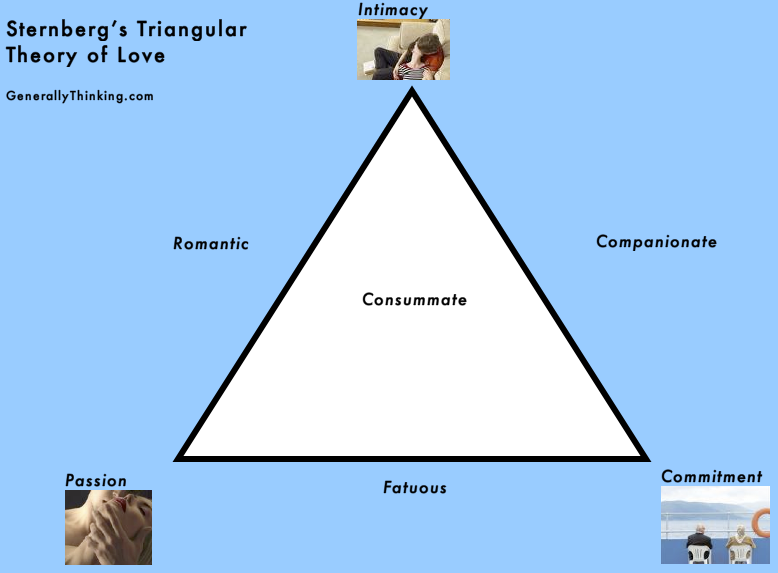
    There are actually eight types of relationships that the model loosely predicts. You can have none, any one, any two, or all three of the presented aspects in a relationship. I drew a diagram below to illustrate. I had visions of this being a glorious and beautiful feat of graphic designery, but it ended up looking like it had been thrown together in 20 minutes using Microsoft Word. Mainly because I did, in fact, throw it together in about 20 minutes using Microsoft Word:

    sternbergs_triangular_theory_of_love

    • No aspects = Nonlove
    • Intimacy + Passion = Romantic love
    • Intimacy + Commitment = Companionate love
    • Passion + Commitment = Fatuous love
    • Intimacy + Passion + Commitment = Consummate love

    So in romantic love you’ve got the passion, and the sharing and caring stuff, but the long-term commitment is not there. I can imagine this can be a frustrating situation. In companionate love, you’re in it for the long haul, and you’re each others’ best friend, but the lust isn’t there. Fatuous love sounds pretty good, if perhaps less stable; the heat is there, and so is the long-term commitment to make the relationship last, but you do without all the lovey-dovey-yucky-disney stuff. And consummate love is the crem-de-la-crem, the combination of all three aspects.

    It’s an interesting model. Do you recognise any of your current or past relationships in it? Or those of anyone you know? It is tempting to suggest that nowadays, younger people appear to be mistaking romantic love for one of the other combinations which involve commitment. Tomorrow we’ll look at love in more depth, but right now I have the strangest urge to listen to my “Best of Power Ballads” double album…

    Recommended Reading:


    Reference:

    Sternberg, R. J. (1986). A triangular theory of love. Psychological Review, 93, 119-135.

  • Casual sex in college

    No, before you get excited, that wasn’t an offer. Psychologists have chosen some fascinating topics for study. The evolutionary roots of personality. The nature of mental disorder. The antecedents of a fulfilling life. And now… “What happens when college students get horny!”

    Most ‘first-time’ experiences happen in the context of a romantic relationship, but there is a trend now, towards sex with a friend, or with strangers. And the earlier your first time is, the more likely you are to have casual partners in the future. So ‘casual sex’ can refer to hook-ups with a friend (some papers in the scientific literature really do refer to it as a ‘hook up’) or stranger, and can be of long or short duration (the relationship, presumably; not the act itself).

    This move towards more casual sex seems to be the general trend, rather than specific to a particular subculture. The reasons for this could be many – greater availability of contraception, alcohol, changing social norms. The explanation is unclear, but as a lot of experimentation happens at college, this seems to be a good place to look.

    Catherine Grello, Deborah Welsh, and Melinda Harper carried out a large survey, which asked people about their hook ups, alcohol use, previous sexual experiences, and also included a validated measure of depressive symptoms. (1) The results were pretty interesting. I present to you….

    The psychology of the hook-up

    cow_having_sex

    Sure I’ll call ya… (Storem)

    Gender

    Firstly, as the stereotype might predict, more males than females reported having engaged in casual sex. Maybe I’m missing something, but I can’t see how this adds up unless:

    • Females are viewing casual sex as something more
    • Males are viewing something more as casual
    • Males are hooking up more off-campus than females

    Also in line with stereotypes, females typically expected the hook up to be the beginning of a romance (18% female vs. 3% male), while more males expected the relationship continue on a casual basis (33% male vs. 16% female). Interestingly, females were more likely to view the sex as ‘experimentation’.

    First-time experiences

    As predicted, those who had earlier first-time sexual experiences were more likely to hook up. But more interesting is this: females who engaged in casual sex tended to describe their first sexual experience more negatively than either males or females who did not hook up.

    Alcohol and drugs

    Again fairly obvious, but alcohol and drug use were commonly involved in hooking up – 65% of those who reported casual sex were either drunk or high at the time. Beer goggles earning their money?

    Depression

    Males who had the lowest levels of depression, and females who reported the highest levels of depressive symptoms were the most likely to engage in casual sex. Added to this, the more depressive symptoms a female reported, the more casual sex partners she was likely to have. This did not hold true for sex with a romantic partner, which had no relationship to depression. Why are symptoms of depression higher among females who hook up more? The authors suggest a few possibilities:

    • They are seeking external validation from sex
    • They are maintaining a depressive cycle by unconsciously selecting partners with whom a healthy relationship is unlikely
    • The depression increases the desire for a healthy relationship, and they engage in casual sex to try to get into a romantic relationship

    And what about the less depressed males, why are they more likely to hook up? One possibility is simply that they are more attractive, as evolutionary theories predict that females perceive a self-confident man as having more resources.

    There were also more depressive symptoms in males and females in the people who regretted their hook ups.

    Infidelity

    Incredibly (or not?), 21% of those who hooked up were involved in a relationship with another person at the time! That’s one in five! Maybe they should try Urge Surfing whenever they feel the, umm, need. No gender was more likely to cheat than the other. When someone did cheat, they reported that the sex was less ‘affectionate’ than those who were not cheating.

    While people who cheated did tend to regret the experience, they did not have higher symptoms of depression.

    Although there are a number of limitations to the study such as whether the results are transferable to other colleges, and it was limited to heterosexual sex (due to not enough gay or bi participants), some of these results are very interesting, particularly the link between casual sex and depression. But maybe this is the wrong time of year to be talking about hook ups. Tomorrow we’ll look at love.

    Reference:

    (1) Grello, C. M., D. P. Welsh, and M. S. Harper. (2006). No strings attached: The nature of casual sex in college students. The Journal of Sex Research, 43(3): 255-267.

  • Useful, free speed reading tool

    I came across a very useful and free speed reading tool a couple of weeks ago:

    http://www.spreeder.com/

    The words appear in the middle of the screen at the rate you set, and you can paste in your own text to read. This is a great tool for ‘overclocking’ your reading speed: basically, you set the speed to just a little faster than you can comprehend, and then immediately move onto the book or paper that you want to study. You’ll find you read a little faster than normal after doing this. It’s a little like running with ankle weights or a heavy backpack, and then taking the weight off – you run a little faster.

    Set the font size to 10 or 12 so it’s comparable to things you will actually read. Also, set the chunk size to around 5, as you should try to get into the habit of looking at words in chunks and ‘jumping’ to the next chunk (these ‘jumps’ are technically known as saccades – it’s how we all read anyway you just need to find a way to jump along in the most efficient way).

    When you look at each chunk of text, don’t look directly at the first word. Look at the second. If you’ve been trained as a left-to-right reader, you’ll have a little peripheral vision to the left of the fixation point, and significantly more to the right of it. So even when reading a book, your fixation points should never be at the beginning and ends of each line, but a little in from the left and right margins.

    Overall I think Spreeder is a great way to train different speed reading skills in isolation – reading speed, concentration, comprehension, confidence, peripheral vision. Try setting the chunk size to 5 and speed to 400 words per minute. The average speed is 200-250 words, so if you can manage this you’ve probably almost doubled your reading speed.

    There are pros and cons to Spreeder though:

    Pros:

    • You can set your own reading speed
    • You can use your own text
    • Eliminates back-skipping completely (back-skipping is where you re-read something you’ve just read. It’s a bad reading habit as you’ll usually find you don’t gain much by going back, and you just need to be more confident that what you think you read is what you did read).
    • Very useful for skimming a text
    • You can alter chunk size to develop your peripheral vision

    Cons:

    • You are not reading a line of text as you would in a book, so the you’re not developing the right eye-tracking habits
    • Not great for active reading – only really useful for training and skimming
    • I prefer to spend as little time as I can staring at a screen


    Recommended Reading:

  • Approaches to cognitive psychology

    Cognitive psychology is a field concerned with the internal processes that we use to perceive our environment, process those perceptions, and decide on an output (action). Anything to do with perception, attention, memory, problem solving, creativity, etc., are of interest to cognitive psychologists.

    They say that the human brain is one of the biggest unsolved mysteries there is. Some people even say this is a mystery that can’t be solved; that the brain, cognition, and all that goes with it are too complex for us to really know what’s going on. Of course, people have said that about a lot of things. Research into cognition has been picking up pace since the 1950s, and started sprinting within the last 15-20 years when neuroscience got involved too. I remember watching a TED talk (don’t remember off hand who it was, sorry), where the speaker said we’d have a full specification of the brain and how it works by the 2020s. I think that’s a bit optimistic, but since there are so many useful approaches to cognition, it might not be far off. Here are the four main approaches to this area of psychology.

    Approaches to cognition

    1) Experimental Cognitive Psychology – This involves doing experiments under laboratory conditions, trying to get a handle on a specific brain process that has been theorised. For example, in tests of memory they might see how well people can remember a list of words under various conditions (long words, short words, interfering noises, and so on).

    2) Cognitive Neuropsychology – One way of investigating cognition is to study people who have suffered brain damage. Are there any specific cognitive impairments brought about by damage to a particular brain region? If so, it’s likely that the damaged area is involved in that cognitive function.

    3) Computational Cognitive Science – This involves creating computer-based models of human cognitive functions, as well as work from artificial intelligence.

    4) Cognitive Neuroscience – This has become very popular in the last decade or so, and involves using brain-imaging devices to study cognitive functions. This can help to discover where these processes occur in the brain, and when (including for instance, the order that different areas are activated when a person attempts a task).

    On their own, these approaches to cognitive psychology have their limitations. For example, you could argue that experimental cognitive psychology takes people too far out of their real-life environments to be able to generalise from, and computational cognitive science can often be used to create a huge number of potential models and there is controversy over how relevant it is to knowing where cognition happens in the brain.

    But the main value is in seeing where each approach agrees and disagrees with the others; there are four different ways to test a theory, so what comes out the other end intact will be good candidates for solid theories. This is commonly known as converging evidence, and it’s a very powerful way to conduct research. But powerful enough to give us a full map of the brain and how it works in the next 20 years? I’m saying no. What do you think?


    Recommended Reading: