“The things you own, end up owning you”
– Tyler Durden (Fight Club)
I’ve seen Fight Club about 58 times. It’s my favourite film. I love it so much I even had the above quote engraved onto the back of my iPod.
In the film, Brad Pitt’s character Tyler Durden is a pretty heavy anti-consumerist. He is disturbed by the way people look for self-esteem and happiness in material things, and senses a better way.

Was he right about materialism? Some researchers have been looking into the effects that materialism has on people. Here are five things everybody should know:
1) High importance of money = low satisfaction with life
Seven-thousand people, in 41 countries were surveyed about the importance they place on money, and on love. When these were correlated against life satisfaction it looked approximately like this:
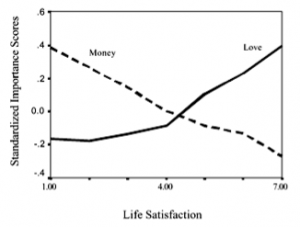
As you can see, unsatisfied people (to the left) thought money way important and love wasn’t, and satisfied people (to the right) thought the opposite. (1,4)
2) Materialism is associated with mental health problems
People who value financial success highly are more likely to report symptoms of depression and anxiety. Likewise, materialists have lower levels of self-actualisation and vitality, (2) and are more likely to be visited by ghosts at Christmas time. (3)
3) Material goals can never be fulfilled
First you want the iPod. Then the clothes, the car, the big house, the boat, the bigger house, the bigger boat. You get stuck on a hedonic treadmill; today’s luxuries are tomorrow’s necessities, as your income and consumption rise, so do your desires and expectations. It’s like moving to a higher weight division in boxing – you can do it, but there’s always a bunch of bigger guys there waiting for you.
And if you combine high material aspirations with low income, you’re like a flyweight fighting a heavyweight. This is the worst combination of income and materialism you can have, in terms of well being. (4)
4) You seek self-esteem in things
Another study found a way to manipulate how important people think money is: they had people write out a list of their inadequacies. Once their failings had been literally spelled out for them, they thought money was more important. Their self-esteem had lowered, and they thought money could fill the gap.
The problem with this, is that you’re rooting your self-esteem in things outside of your control. It’s unstable. So if you lose a load of money from, say, I don’t know, a stock market crash, you’re more likely to feel bad about yourself, feel unpleasant emotions, and so on. (5)
5) Materialists live avoidance-based lives
It seems that the link between materialism and poor quality of life can be explained through something called “experiential avoidance.” This refers to the tendency to avoid negative experiences, thoughts, and behaviours, rather than to seek out good ones. Experiential avoiders are focused on getting away from what they don’t want, as opposed to moving towards what they do want. (6)
When the road to their goals and values is paved with the occasional negative experience, they tend not to walk the path, preferring to develop avoidance strategies. Ultimately, living in fear of negative thoughts, experiences and behaviours is associated with a number of negative mental health consequences, and is emotionally draining. This isn’t a black and white thing, and experiential avoidance may not be the defining feature of a person; but it tends to be more pronounced in people who have strong material desires.
Unanswered Questions
As satisfying as it would be to say that materialism causes all the above ailments, the evidence isn’t clear. All the above studies are correlational, so they can’t tell us what is causing what. It could be that people develop unhappiness, mental health problems or experiential avoidance first, and then turn to material goals as a way of coping, as in point 4. Clearly though, if this is the case, materialism doesn’t seem to be the answer.
The Solutions
How can we reduce materialism?
1) Gratitude
Grateful people are consistently found to be less materialistic, and when people are told to express more gratitude, they find themselves becoming less materialistic. The exact instructions given in one study, if you wanted to try this, were as follows:
Please put your pen or pencil down, close your eyes,
and consciously disengage from unpleasant mental and
emotional reactions by shifting attention to the heart.
For a few minutes, focus on sincerely feeling apprecia-
tion for what you have been given in life. Now, in the
space below please write about your experience and
about some of the things that came to mind.
Simpler gratitude exercises have been tested, such as each day writing down three good things that happened that day, and why they happened.
Why does it work? Gratitude, as I mentioned before, tends to make people happier. It could be that more satisfied people don’t seek well being in possessions as much. (7)
2) Meditation
The difference between what you want financially, and what you have, is called your “aspiration gap.” The bigger your aspiration gap, the lower your well-being. Consumer culture tells you that, rather than reduce this gap, you should fill it with things. Another path, which is popular in Eastern philosophy, is to reduce your desire, learn to want what you have. (8)
One way to do this is through mindfulness meditation. I’m not qualified to give a run-down of how to meditate, but there are some good resources online: John Kabat-Zinn walks you through it in this video, and you can get guidance in mp3 format from Mental Workout (they are cheap: $1-2 each; I’m going through a few of their programs they seem pretty good so far). Otherwise, just Google.
3) Watch Fight Club 58 times.
Worked for me.
Recommended Reading:
References:
(1) Diener, E. and S. Oishi: 2000, ‘Money and happiness: Income and subjective well-being across nations’, in E. Diener and E.M. Suh (eds.), Subjective Well-beingacross Cultures (MIT Press, Cambridge, MA).
(2) Kasser, T., & Ryan, R. M. (1993). A dark side of the American dream: Correlates of financial success as a central life aspiration, journal of Personality and Social Psychology, 65, 410-422.
(3) Dickens, C. (1843). A Christmas Carol in Prose.
(4) Diener, E., & Biswas-Diener, R. (2009). Will money increase subjective well-being?: A literature review and guide to needed research. The science of well-being: The collected works of Ed Diener (pp. 119-154). New York, NY US: Springer Science
(5) Unpublished study, reported in (4)
(6) Kashdan, T., & Breen, W. (2007). Materialism and diminished well-being: Experiential avoidance as a mediating mechanism. Journal of Social & Clinical Psychology, 26(5), 521-539.
(7) Lambert, N., Fincham, F., Stillman, T., & Dean, L. (2009). More gratitude, less materialism: The mediating role of life satisfaction. The Journal of Positive Psychology, 4(1), 32-42.
(8) Brown, K., Kasser, T., Ryan, R., Alex Linley, P., & Orzech, K. (2009). When what one has is enough: Mindfulness, financial desire discrepancy, and subjective well-being. Journal of Research in Personality
Comments
4 responses to “Five things everybody needs to know about materialism”
Wow,you have some great info.
What I found humorous right away was that you engraved the quote into an object of materialism. Interesting how it is difficult to escape, but maybe technology in a way is helpful in the escape as we rely less on sensation and more on the rational calculations of a computer. I am writing a research paper and your page is invigorating the thought process. I wish I never started however. It gets too complex to have a time limit on the thought.
I totally forgot what it was called but it’s human nature to spend more as you earn more. So I guess the richer you are, the more compulsion it will be to spend more. This also explains why it’s very difficult to save money. It’s totally natural — but it can be controlled.
[…] crush style. It’s a quirk that I have kept through many terrible trends and it’s led me to question the reasons I keep this embarrassing book. I’ll keep you my nerdy little […]