The theory of sexual selection proposes that certain traits evolved due to the preference of the other gender. These preferences may evolve because the trait is an indicator or genetic fitness, for example through being related to better health. Random genetic mutations that lead an individual to better display this trait are make that person “sexier” to the other sex, and hence the gene is more likely to make it into the next generation.
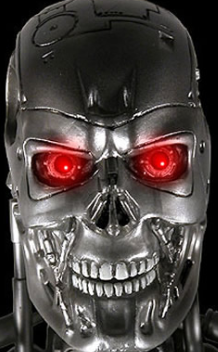
T1000 Getting jiggy with it. John Connor, get down!!
Many such traits are physical characteristics, as we’ve discussed before, but research on numerous species suggests that certain variations in movement patters can also be “sexy,” particularly when displayed by males and preferred by females, as seen in some birds, ungulates and crustaceans, for instance.
We humans seems to use this fitness indicator too — married couples dance together by tradition, strippers dance instead of just standing there taking their clothes off, and I’ve never heard someone say that they don’t want a partner whose a good dancer! So maybe dance serves to indicate beneficial traits in humans too? A study from 2010 tested this idea.
Confounds
A problem with testing this scientifically are certain confounds that tend to go along with good dancers. For example, if you got a load of people to dance in front of participants, then asked them to rate the dancers’ attractiveness, things like facial attractiveness, clothing or height might get in the way.
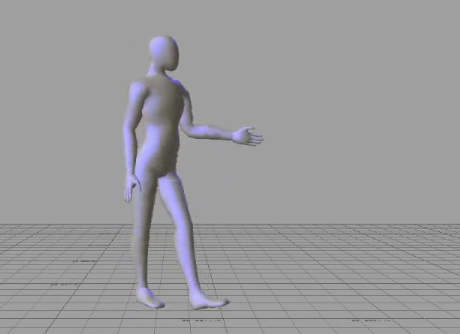
To isolate the effect of dancing alone, the researchers had males dance for 30 seconds using a motion-capture system. The movements were then mapped onto an avatar, a faceless humanoid shape that kind of looks like the T1000 from terminator two when it’s in the liquid metal mode. Females then rated the avatars on their dancing quality.
The best dancer
The results indicated that the following are preferable to females in a male dancer:
• Variability and amplitude of movements in the head, neck and trunk
• Faster leg movements
• Move and quicker right knee bending and twisting
Here’s the good dancer:
I know, it looks ridiculous to me too. Here’s the bad dancer:
These are really only preliminary results, and more tests need to be done to test this type of movement. Then it’s necessary to figure out if and how these particular movements could be signals of fitness and health. But in the mean time, now you know what to do on the dance floor!
And here’s (kind of) an attempt by a YouTuber to reenact the good dancer. He seems to have thrown a few of his own moves in, making it only slighty cheesier…
As with bilingualism, it’s generally assumed that being an expert completely beneficial and has no downsides to performance. However we know that expertise tends to be domain specific, for example, chess grand masters can memorise chess boards far more quickly and easily that novices, but on standard cognitive tests tend to fare no better. In fact, if you arrange chess pieces to positions that would never be encountered in an actual game, again their recall is no better than chess novices, showing just how domain-specific expertise can be. But surely within a given domain, expertise can only be beneficial?
Castel, McCabe, Roediger and Heitman suggest not. They gave 40 students a memory test consisting of eleven animal names and eleven body parts. The twist here was that all the animal names were also NFL team names, like dolphins, colts, seahawks and bears. After the memory test, participants were given an NFL quiz, and the group was split into two, those scoring above and below the median on this test, to give high expertise and low expertise groups in the domain of NFL knowledge.
The results on the memory test for the two groups was then compared. Indeed, the NFL experts remembered more of the animal names than the non-experts, while there was no difference between groups on the body parts test. So far so good, however, the researchers also tested for incorrect answers — NFL animal team names and body parts that were not part of the original test. The results indicated that the experts were much more likely to make incorrect guesses than the non-experts. The authors suggest that this represents memory errors, the domain-relevant information of the experts got in the way of their accurate recall of the animal names. Since there was no difference between groups in body part experience, false answers were about even between groups on that test.
Is this really the case though? Or was it that the experts consciously noticed that the animal names belonged to the NFL teams and simply reeled off as many as they could remember during recall. Perhaps it was not a case of the existing schema interfering with memory, but a recognition that they already know these names, so why bother taking the extra effort to think back and recall? Why not just reel off my schema? I wonder if the results would be the same if participants were told that they would score 1 point for a correct guess, but minus 1 point for an incorrect guess, which might increase the incentive to actually recall. In other words, maybe this effect is a conscious strategy used in situations where there’s no cost to an incorrect answer.
However, there are other studies that support the authors’ conclusions, which I haven’t read so perhaps my question has been answered before or since. Either way, it’s an interesting thought that the knowledge base acquired by experts might be detrimental in certain tasks.
ref: Castel AD, McCabe DP, Roediger HL 3rd, & Heitman JL (2007). The dark side of expertise: domain-specific memory errors. Psychological science, 18 (1), 3-5 PMID: 17362368
The Rosetta Stone people are making a killing through their concept of “natural” language learning. That is, their angle is that with their product, you supposedly learn a new language in the same way you learned your first, which allegedly makes the process easier.
To accomplish this, they use pictures. So you see and hear a foreign word, and a collection of pictures, and you pick the one you think the word represents.
This makes nice, intuitive sense, although if you were skeptical you might think that this method is simply an easier way to increase the size of your product line, since pictures are universal while using words would basically mean re-writing the whole thing for each country you’re selling in. So it’d be good to see a few tests of this learning method.
You’d certainly expect pictures to be more effective, but results have been mixed. Shana K. Carpenter and Kellie M. Olson devised a few studies to tease out the answers.
A Good Old-Fashioned RCT
Using Swahili as the target language, they first did a standard randomised controlled trial. Half were shown a Swahili word with an English word, while the other half got a picture and the Swahili word, probably something like this:
(Just to clarify, “kolb” is only the relevant part. Don’t run up to four legged animals in Kenya shouting “Here Photo Credit! Heeere Photo Credit!!”)
The results did not indicate a difference in the words learned by the participants — pictures were no more effective than words. Why could this be? One reason might be that the picture wasn’t encoded into memory very well. To test this, participants were also asked to free-recall as many pictures (or English words) from the test as they could. People who were presented images rather than words remembered significantly more items. This indicated that the lack of benefit from using pictures was not caused by insufficient encoding of the picture.
So if the pictures themselves are easier to recall than plain words, why weren’t their paired Swahili words easier to remember too? On to the second experiment…
The Multi-Media Heuristic
A heuristic is a basic rule of thumb that the brain uses to save time when processing. Think of it like a stereotype — to conserve the energy that would be spent taking people as they are, it’s easier to assume people possess characteristics associated to groups they belong to. There’s probably a survival thing going on here, since in life-or-death situations you need to respond quickly, so we have a built-in time saving “automatic” reasoning system.
The multimedia heuristic is the assumption people have that text combined with images is easier to remember than text alone. Seems like a reasonable rule of thumb, yet evidence doesn’t support it. Maybe when people see the picture with the foreign word, the energy-conserving multimedia heuristic kicks in and the brain allocates less resources to processing and encoding that word. Why bother with the effort? It’s got a picture with it!
So the test was repeated, but this time participants were asked, for each item, if they thought they’d remember it in five minutes. This test was repeated three times. In the first test, the pictures group was overconfident, and as before there was no difference in performance between groups. However, in the second test both groups saw a dramatic reduction in confidence (perhaps after seeing the results of the first test), and the pictures group did indeed recall more words than the words-only group! The same was found in the third test.
So it works! Perhaps by removing their overconfidence, the multimedia heuristic was assuaged and the brain provided more resources to the learning.
Don’t be overconfident!
In the third test, participants were split into two groups, each of which were tested on both picture-Swahili word and English word-Swahili word combinations. However, one group was given a little message telling them not to be too overconfident:
People are typically overconfident in how well they know something. For example, people might say that they are 50% confident that they will remember a Swahili word, but later on the test, they only remember 20% of those words. It is very important that you try to NOT be overconfident. When you see a Swahili word, try very hard to learn it as best you can. Even if it feels like the word will be easy to remember, do not assume that it will be. When you see a Swahili word with a picture, try your best to link the Swahili word to that picture. When you see a Swahili word with an English translation, try your best to link the Swahili word to that English translation.
Confidence was tested in the same way as the previous test, and indeed, the group receiving the warning reported lower confidence. Did this affect results?
Of course! People receiving the warning performed better than people who didn’t on the picture task, but not on the words task. Since overconfidence is not an issue when remembering word pairs, this both implicates the multimedia heuristic and suggests a way to improve learning of second language words — don’t be overconfident!
Maybe you can now remember the Swahili word for dog, presented earlier? It’s “kolb.” If you’re thinking “Photo Credit” I apologise profusely!
Reference:
Carpenter, S., & Olson, K. (2012). Are pictures good for learning new vocabulary in a foreign language? Only if you think they are not. Journal of Experimental Psychology: Learning, Memory, and Cognition, 38 (1), 92-101 DOI: 10.1037/a0024828
Imagine your kitchen floor is dirty. Since you don’t want to clean it yourself you log in to a robot design website, tell them that you want a robot capable of cleaning your kitchen floor. They give you a quote, you pay, and then they email the design to you. You click “Print,” the design goes to your 3D printer, and out pops a fully functioning robot, yours to command.
That might sound far fetched, yet perhaps it’s not so far away. 3D printing has been around for around three decades and can now print objects in glass, metal, plastics and even bio-degradable materials. It has been used to create everything from jewellery, shoes, aeroplane components and even mechanical devices.
Peter Schmitt of MIT has already successfully printed a mechanical clock, and is working on servo mechanism which could be used to make custom-built robots. Much has been made over 3D printing’s potential to revolutionise industry, putting manufacturing more strongly in the hands of garage hobbyists (if you think piracy of digital goods is a big issue, wait until everyone can pirate 3D objects!). But imagine if manufacturing was taken out of everyone’s hands.
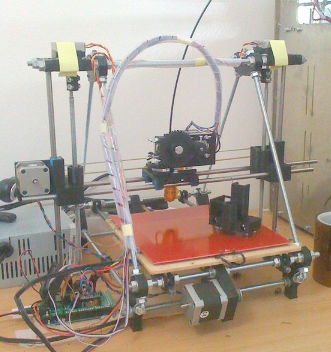
The Prusa Mendel RepRap 3D Printer from RepRap.org
Evolution. Skip this section if you know it.
Evolution works through a combination of replication, mutation and selection. Organisms develops through instructions contained within their DNA, which they gets from their parent/s. For example, daddy tiger and mommy tiger copy some of their DNA and store it in their sex cells. After an evening of tiger love, they combine these sets of DNA to create a new set of instructions for “building” baby tiger.
But the DNA copying process isn’t perfect, and mistakes — called mutations — cause changes a given trait or characteristic — called a phenotype — of the organism to which that DNA will eventually belong. These phenotypic variations may affect the organism’s chances of surviving or reproducing.
If a mutation in daddy tiger’s DNA causes baby tiger to have sharper claws, it might get food more easily and therefore have more chance of surviving and passing this beneficial mutation on. If it results in weaker knees, the tiger might not catch any food and then die without passing on it’s DNA. This is evolution through natural selection. It is this process that eventually produced intelligent humans like yourself, able to ponder their own ancestry.
Replication, mutation, and selection. If machines can print 3D items, mechanical devices and even robots, is it possible to create “life,” or at least, objects that reproduce and whose offspring is subject to selection pressures?
Replication
Replication would require a 3D printer able to print, and construct, itself. The RepRap machine, designed by Adrian Bowyer of Bath university and seen the video above, is almost there. It knows how to print the plastic parts necessary to build itself. With the ability to build components out of different materials, it doesn’t seem infeasible that a modified RepRap could include construction as well as production capabilities. The printer contains a small hard drive, and the parent copies its own design onto its child’s hard drive. Replication achieved.
Mutation
Naturally, you want your printer to build things perfectly, so designers will try to remove mutations from the process. Also, the “DNA” in this analogy is the design on the computer, which we know is highly resilient to copying errors. However, you could imagine some flaw that creates mutations in the child design, or a non-natural form of mutation where the printer theorises about future designs that would increase its child’s ability to reproduce itself, and tests these, keeping logs of previous “tests” in its hard drive.
Selection
Natural selection could work here, as the printers need access to a source of power and raw materials. For power, you could imagine each one has a solar panel, and tests theories on how to build more efficient ones. The raw materials area a harder part though.
Automation
At what point would you be able to leave the printer running, then move all humans off the planet with confidence that they would continue to thrive? Presumably, you’d need to give the printers a head start, for example, the ability to build none-replicating drone scouts to look for raw materials, and transport robots to return it to the replicating “queens,” with the queens playing a sort of real-life game of Civilization. Or perhaps the queens themselves would produce new queens that could move and source the raw materials. Perhaps the queens see scouts from other printer families as threats, and build warrior drones to fight their resource wars.
If self-replicating machines were made that were capable of finding the resources and energy they needed to continue to reproduce, at what point do you call it life?
Of course I’m just thinking out loud with all this, but I think it’s interesting and fun to consider the possibilities. Many people think of 3D printing as a door to a techno-utopian future where the means of production is held inside every household — and maybe it is. However, if we manage to build completely self-replicating machines with the capacity for mutation and a form of selection pressure, I’m just saying, they might lead to a different future.
Here’s another TV program that made me want to throw my shoes at the TV – Prime Minister’s Questions.
In PMQ’s, members of the opposition get to ask the PM questions about their party’s policies and actions. Ostensibly the point of this is to reach useful conclusions and actionable steps that will improve the country. Occasionally there is an inkling of that happening. But the bulk of it is shoe-throwing-bad (if you’re wondering, the other program that made me wish for more aerodynamic footwear is Big Brother).
I watch in complete disbelief as questions on issues affecting the country were answered with ducking, weaving, and ad hom attacks aimed at the asker. The aim is to “beat” the asker, rather than respond intelligently to the question. These attacks are always followed by jeering and cheering – this is all considered normal and acceptable.
This philosophy, of winning the discussion rather than productively debating, you also see disgustingly often when politicians are being interviewed on TV. It’s often done with a restatement of their position on the issue, or some random hyperbole. Something like:
Q: “How do you respond to the claim that your policies have increased unemployment?” A: “This is a complex issue and we need to look at all our options and make the right moves going forward, to encourage growth and get the economy back on track.”
Or…
Q: “How do you respond to the claim that your policies have caused unnecessary death during the pandemic?” A: “What I’m focused on now, is making sure that our brave front-line workers have the PPE they need to do their jobs, so they can keep themselves, and us safe.”
They don’t answer the question. They just say words.
The problem here is that free-form debating of a topic isn’t very useful. It’s too open to hacking. We are able to out-debate people even when we are wrong and they are right. We are able to change people’s minds to our way of thinking regardless of what the actual truth is. We even have scientifically researched ways of doing so — although sometimes good old-fashioned talking over the other person is all that’s needed.
This problem is exacerbated when groups of people are mass-debating because it’s hard to come to a satisfactory conclusion without someone else butting in first.
Free-form verbal debate is highly effective in finding out who the most charismatic, silver tongued and/or dominant person is. It’s not very effective in reaching productive conclusions.
For that, the scientific way is better. Scientist A writes a paper, and scientist B responds with their criticisms. Scientist A can then publish another addressing these, perhaps after collecting more data. And so on. Because it’s all laid out in writing, it is obvious to everyone if a question has been dodged.
This is too slow for politics, but maybe there’s a middle ground…
Who Dares Wins
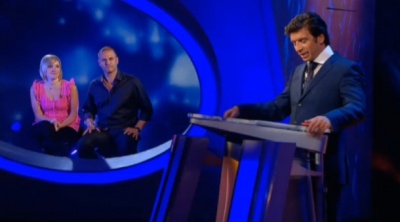
Future of British politics? (Note the isolation booth)
Who Dares Wins was a game show in which opposing contestants sit in sound-proofed booths, betting on which one of them can list the most items from a particular category, for example, films starring Johnny Depp, or number 1 singles. As soon as I saw this, I knew it was essential to politics.
I propose that this studio be repurposed for interviewing politicians, CEOs of companies that have done something naughty, and perhaps built into the House of Commons itself (neon lights, dramatic music and all).
Here’s how it would work.
The interviewer sits in one booth, the politician in the other. In the middle is be a large screen to display the arguments and responses thus far. A number of online tools have been created to visually represent debates in this way, so we already know how to do that.
The interviewer asks their first question, and it appears on the screen. During this time, the microphone in the politician’s booth is switched off. The booth is sound-proof, so no one can hear them no matter how loudly they shout.
Next, the politician gets his chance to respond. The interviewer’s booth is switched off and the politician’s turns on. They get their chance to reply, and their responses appear on the screen. Then the response is analysed by an impartial adjudicator, to ensure that it does in fact answer the question, and isn’t some clever ducking and weaving.
If the answer is suitable, it goes up on the board, and the interviewer gets to challenge these responses. The process continues in this way.
If the answer isn’t suitable, it will be quite obvious to all. The interviewer or adjudicator could then challenge the response, and if it cannot be defended, that answer would be stricken from the board and they could be invited to answer again.
Personal attacks and logical fallacies from either side would also be stricken off the board, and perhaps a small punishment applied, such as a smacked bottom or a gunging.
Head-to-head debates would work in a similar way, with each debater’s booth switched off while the other is talking.
Advantages
No longer would people be able to dodge questions without appearing to do so.
No longer would people be able to win arguments through verbal jiu jitsu.
No longer would people be able to win arguments by having the loudest voice.
Potentially hilarious.
Disadvantages
None.
Political debate is broken, people. To fix it we need sound-proofed booths and neon lights. Especially neon lights.
My belief about the nature of reality is that the only “thing” that exists is matter. That is, there is no soul, no heaven and no hell. Effects aren’t caused without an interaction with different pieces of matter, and consciousness exists within the confines of the physical head that gives rise to it.
However, although I used to be extremely firm in this position, now I am less sure, because of one question. I don’t know how to answer this from a materialist perspective. Maybe there’s just a really simple answer that I’m missing, but I’ve spoken to many people on this and no one has given it to me. Maybe you can. So here’s the question.
Where is the cat?
“HAHAHA puny humans you will never find me. (Photo by Tambako the Jaguar
I can make a picture of a cat in my head; I can close my mind and think of it. So I’m perceiving this image of a cat.
Where is the image? Where is the cat?
I first heard this question (well, I added the cat part myself) in a lecture on the mind/body problem, and my initial answer is that the cat is simply a 1:1 correlate of certain neurological activity in the brain. That is, if you open up my head you won’t see a picture of a cat, but you’d see something that’s the equivalent of it, sort of like the dots and dashes of Morse code are not English characters, but they are equivalents of them. From a materialistic perspective, you’d theoretically be able to interpret the activity in my brain through some technology, and recreate the image of the cat that I am picturing on a screen.
In fact, we’re past theorising on this, as a famous experiment last year that was widely reported as “Mind Reading” in the media demonstrated. Here’s what they did:
1) Measured brain activity as someone watched a load of YouTube videos
2) Linked up the brain imaging data with the image on the screen, creating a sort of database whereby such-and-such brain activity relates to, say, a red object in the middle of the screen, such-and-such relates to certain shape moving to the left, and so on. I’m probably over-simplifying, but that’s the gist.
3) Get the same person to watch a new set of YouTube videos, again while in the scanner measuring brain activity.
4) Use the database created in step 2 to predict what the person was seeing in step 3.
Here’s how the reconstructions compared to the original videos:
It’s important to note that the brain may not code imagined images in the same way as those you see with your own eyes, and also that each person’s brain will likely code the image of the cat in different ways (hence the need for steps 1 and 2), but, since all of the activity of the mind is thought to have a direct neural correlate, the principle is the same.
So when I was asked “where” my mental image of the cat is, that’s why I responded in this way — the image is located in the brain – it’s just in a different format.
But really, I’m not satisfied with that answer. Because in my mind I can see (well maybe not see, but certainly perceive) the cat; not the equivalent neural ‘code’, but the actual cat. I know where the neural code is, but I don’t know where the cat is.
I can’t think how the materialistic model can explain where the cat is. Doesn’t this mean then that there’s more to reality than the purely materialistic? That the materialistic model is incomplete? What am I missing?
To use a computer analogy, the words you are reading now (hello!) are represented in a chip in a computer as a string of 0’s and 1’s. That’s like the neural code in your brain. But the actual words are represented on the screen in front of your eyes. What’s the equivalent of the screen in the case of the cat? Where is it?
I’m actually asking this to you – do you know where the cat is? Am I making a simple mistake? Please leave a comment and help me out!
Where is reality?
That’s probably enough for one day, but just to take this one step further; we know that what we see is not the world. The image we see is a mental construction of the world, and psychology has identified numerous examples of how we each see the world a little differently. An obvious example is colour-blindedness. Since the brain is constructing the world we see around us, and if we assume that the neural code and the image are different things… where is reality?
Ref:
Nishimoto S, Vu AT, Naselaris T, Benjamini Y, Yu B, & Gallant JL (2011). Reconstructing visual experiences from brain activity evoked by natural movies. Current biology : CB, 21 (19), 1641-6 PMID: 21945275

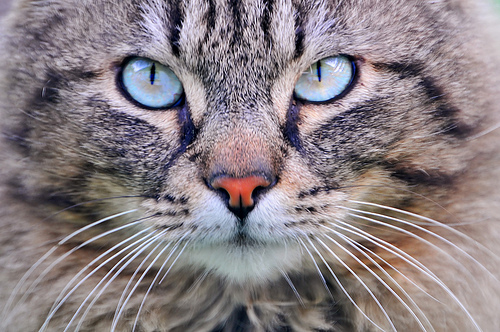 “HAHAHA puny humans you will never find me. (Photo by