Month: December 2010

  • Why Should Happiness Boost The Immune System?

    There’s an apparent paradox in the research on positive emotions, and how they relate to the immune system, something that doesn’t make sense on first inspection. But like many things in psychology, I think the answer has something to do with sex.

    I was quite surprised to find out how much research there is into the effects of positive mood on our physiological state. It’s interesting how many markers there are of positive emotions in our physiology. Some are quite obvious, such as duchenne smiles and other changes in facial expression, but there are also changes in neurochemistry, and activation in the left prefrontal cortex of the brain.

    One particularly interesting finding, though, is the result that positive emotions evoke an increased immune response. One example of such a study forced the activation of the left side of the brain using transcranial magnetic stimulation (something which sounds awfully painful but is apparently non-intrusive). This process actually increased the concentration of immunoglobin A in the saliva. This effect does not appear to be specific to the use of magnetic stimulation in general, because although stimulating the right side of the brain also caused an increase in immunoglobin A, the concentration dropped as soon as the stimulation of the brain did, while it remained for some time after left-side activation. (1)

    But the interesting question to me is, why would the immune system increase it’s output along with the experience of positive emotions? According to Barbara Fredrickson, positive emotions signal a time when things are going well, when there are no particular threats around. If there was a threat that we should attend to, the brain would narrow our thought-action repertoire towards dealing with that threat in the form of a ‘negative’ emotion. However, when there is no particular threat, when things are going well, we’re better off broadening our perceptions and action repertoires, because, the theory goes, this will allow us to build our personal and social resources in preparation for future challenges. This is broaden-and-build theory, it’s a theory behind the purpose of positive emotions (and probably deserves its own post to be honest).

    At first glance broaden-and-build theory seems somewhat at odds with the immune system studies. Surely, a time of broadened perception – a threat-free time – is a time to let the immune system rest a little. With no perceived threat around, why mobilise our defences? Why waste the energy? And also, why reduce our immune response when their is a threat?

    These findings suggest that there is something about the behaviours associated with positive and negative emotions that require higher and lower immune responses, respectively. Researchers apparently don’t know what that is yet, but there are some possibilities.

    Positive emotions are associated with approach related behaviours. This might include exploring the environment, playing, and, crucially, spending time with other people. Perhaps this latter point is important. Parasites and viruses would themselves be evolved and specialised for transmission between humans, and since times of positive emotions might involve building relationships with other people, including physical closeness, and in particular, more sexual activity, this is the time that the immune system is needed most.

    In other words, we might be more likely to catch an infection from another human than we are from the things in the physical environment that trigger a negative emotion in us. When we come across the proverbial sabre toothed tiger, catching a cold is the least of our worries. In these situations, we’re better off diverting our energy away from our immune system, towards our muscles, and getting the hell out of there (or fighting).

    Unfortunately I’m just speculating here, I definitely could be wrong and the reasons for this effect are not yet fully understood. But it’s an interesting possibility.

    Reference:

    Clow, A., Lambert, S., Evans., P., Hucklebridge, F., Higuchi, K. (2003). An investigation into asymmetrical cortical regulation of salivary S-IgA in conscious man using transcranial magnetic stimulation. International Journal of Psychopathology, 47, 57-64.
  • How relevant is Buddhism to positive psychology?

    Every noticed how when something is vaguely Eastern and mystical, it sort of gets a special kind of regard from people? Maybe it’s the way almost every old Asian character in film and TV is incredibly wise and insightful, or something.

    Anyway, I’ve noticed it. So I wanted to raise a few critiques of the science/Buddhism collaboration – which I think it’s a good thing overall – but might be a good example of the phenomenon I’ve just described. I’m quite interested in how old philosophies, systematically developed over thousands of years would compare to scientific testing (I found “The Happiness Hypothesis” a good book on basically that). But I think we have to be careful about these old philosophies, and how generalisable they are between cultures.

    Monks, at the behest of the Dalai Lama, are being sent over for use as lab rats, umm, sorry, participants, in neuroscientific and other studies. Some very interesting stuff has come out of it, but I’ll just pick one – monks, after tens of thousands of hours’ of meditation practice, have far greater activation in the left prefrontal corted (PFC) than the average joe. The amount of activation correlates with the amount of practice, too.

    The left-right prefrontal cortex asymmetry, is related to affect and well-being (with the left being associated with the positive emotions). The left side lights up, the right cortex dims down. When the left PFC lights up, certain limbic responses are also dimmed. So far so good. Also, changes seem to occur in the brain which affect it’s baseline state. Basically the results seem to be permanent, or at least, not limited to the time you are in meditation.

    Is that what we want? It makes some intuitive sense. If positive emotions are good, good, good, and negative emotions are bad, bad, bad, such baseline alterations in brain function could be seen as a good thing.

    But what else does the right PFC do, that we might not want to chronically inhibit through hours of meditation training? And what else does the left PFC do that we might not want to accentuate to a high degree?

    On one hand, it seem a bit presumptuous to say that these monks, with their accumulated knowledge of 8,000 years, and all their wisdom and training, might be wrong; but right and wrong is kind of a fluid concept here.

    Because really, what do these monks do all day? Some have completed 40,000 hours of meditation, blowing the 10,000 rule right out of the window. But what do you have to do to get to that amount? You have to do pretty much nothing else but meditate! Does the wisdom of someone who has sat in a cave all his life apply to the modern Western lifestyle?

    Monks come over here all the time, but they get a pretty specialised experience of the West – as far as I know at least, maybe I’m showing my ignorance here. But they seem to give seminars, get accosted by various neuroscience labs, etc. They don’t get off a plane, try to find a job, settle down, start a family, pay taxes etc., do they?

    So maybe inhibition of other brain functions might not be as apparent to them as it would be to someone with a different lifestyle.

    Here’s one example. This study indicates that right PFC activation is involved in the monitoring of episodic memory retrieval, in order to make appropriate responses, as well as episodic memory retrieval. Also, I would add that people with injuries to the right PFC are often happy, but also impaired in other ways. Just Google “right prefrontal cortex” and see all the stuff it does/is associated with.

    I guess I’m arguing against the extreme Buddhist position of devoting your life to meditation, which doesn’t really come up in practice very often. It’s not possible to meditate for 40k hrs and live a normal life, so the points kind of moot. And certainly less intense meditation practices are looking more and more like they are beneficial to modern folk too.

    But, we don’t really know a lot about the more realistic, in-between grey areas (say, 10k hrs). I think it can be easy to give Buddhism a kind of special status, given that it’s the most… systematic, of the religions (apparently its members see it more as training than as a religion). And to my knowledge it is the only religion that has gladly and willingly opened up its ideas and principles to potential falsification – which is worth a lot.

    It’s still important to be guided by data and theory, though. I’ve read a number of papers which have either tested monks, meditation, or some other concept related to Buddhism, and I’m sure I can pick up the high regard in which the authors hold Buddhism coming through between the lines. A bit of emotive language here, an unsupported statement there, maybe some Buddhist jargon thrown in… Nothing major, but enough to notice it. I wonder if anyone else has noticed the same.

    Maybe we’ll do 30 years of research and find out that the Buddhists were right about everything all along, and why didn’t we just believe them 30 years ago and save the time? Because no matter how passionate one might be about Buddhism, if you’re going to believe one thing without evidence, what reason do you have to not believe someone else without evidence? You don’t have one.

    Besides, it was Mr Miyagi who said:

    “Daniel-san, never put passion before principle. Even if win, you lose.”

    And as everyone knows, you can’t argue with Mr Miyagi.

  • How relevant is neuroscience to positive psychology?

    Not long ago, many scientists had the belief that after the age of about three, the brain was pretty much fixed in function. You could imprint new memories and learn new skills, but that was about it. There was an opposing belief too, that said the brain was a ‘blank slate’ upon which the various human parameters were written almost ad lib as life went on – an idea, of course, that Steven Pinker refuted in his famous book of the same name (Pinker, 2002).

    It is generally accepted that the truth is somewhere in-between. The brain appears to develop into a specific set of sub-systems, with the same ‘modules’ performing the same functions in different individuals (eg., Restak, 1994). But, these subsystems are flexible, and can be altered to some extent; brain areas can grow, connections can be made and broken, and new neurons can grow. This is a constant process; the brain is always changing; in fact, just by reading this sentence, your brain is changing. Same with this sentence. And this one. I’ll stop now.

    As you know, this is called ‘neuroplasticity’, and the $4,000,000 question is: how is this buzzword relevant to positive psychology? (1)

    Well, as fascinating as I find neuroscience to be, it’s no surprise (anymore) to find different brain areas involved in different functions, including so-called ‘positive’ functions. Accepting the above ideas (modular brain/no blank slate, neuroplasticity), it’s not a profound thing to find a brain area associated with, say, positive affect: or even large differences in that area between, say, novice meditators and Tibetan monks with 20,000 hours’ meditation practice. If there’s a massive difference on the outside, there should be one on the inside. It’s what you’d expect.

    To give another example, there are brain areas associated with motor tasks, allowing me to type this blog post (Cannonieri et al, 2007). These areas are probably very different in me than in the Tibetan monks, who have quite possibly never used a keyboard (or maybe they each take a MacBook Pro into the mountains with them; I really don’t know).

    But you wouldn’t need a brain scan to find this out. A simple typing test would do. I would be faster than the monks, and this functional difference has to have a biological correlate of some sort. It has to ‘be’ somewhere.

    Don’t get the impression that I’m ‘against’ neuroscience – no way, far from it. I like an fMRI study as much as the next person; I just think it’s important to remain skeptical, not get too carried away too soon, and understand that a neural correlate might not be the holy grail.

    There is even some preliminary evidence that diagrams of brains (McCabe and Caster, 2006) and neurological explanations (Weisberg et al, 2008) can increase the persuasiveness of even poor arguments! So let’s not mistake inherent fascination with our own brains as having any special relevance, and judge it as a starting point, like any other correlational evidence – until there is more data to go on.

    That said, I actually think neuroscience has a lot to offer. Here is where I think combining these two fields may be useful:

    1) Validation of scale measures

    Discovering neural correlates of variables can allow the questionnaires used to measure these variables to be tested for validity – as long as the neural correlates are themselves validated against things other than the questionnaire. For example, if there are studies testing things like altruism, humour, and so on, the neural correlates of these could be compared with VIA strengths inventory, which measures character. That could be interesting. Likewise, well-being measures have been compared to left-right prefrontal asymmetry, because the left prefrontal cortex is thought to be involved in ‘positive’ emotion.

    2) Building theoretical models

    Neuropsychology can provide evidence to help to build theoretical models, from which further predictions can be made. For example, the debate around whether positive and negative affect are along the same or distinct dimensions. Some people believe they lie on one continuum, e.g., -10 (negative) to +10 (positive). Others believe they lie on two dimensions, and can be largely unrelated. One way of digging into this is to measure the biological correlates of each, which Ryff et al (2006) did and found support for the ‘distinct’ hypothesis.

    3) A two-way street?

    Maybe positive psych is good for neuroscience too. If we accept Seligman’s founding premise that psychology had been skewed onto what you might call ‘less positive’ lines of inquiry – that is, focused (understandably, following WWII) on reducing illness and disorder as opposed to cultivating character and positive traits, then the same is possibly true of neuropsychology. Combining the two fields could bring a broader understanding of the brain and behaviour, encouraging lines of research that might not have been considered otherwise.
    I’m generally always in favour of combining different avenues of research – I think it’s good to look at things through a different lens – in science and in life in general!

    NOTE:

    (1) I mean that literally. The Templeton Foundation has pumped $4,000,000 into answering that question.

    References:

    Cannonieri, G., Bonilha, L., Fernandes, P., Cendes, F.,&Li, L. (2007). Practice and perfect: Length of training and structural brain changes in experienced typists. NeuroReport: For Rapid Communication of Neuroscience Research, 18(10), 1063-1066

    McCabe, D.,&Castel, A. (2008). Seeing is believing: The effect of brain images on judgments of scientific reasoning. Cognition, 107(1), 343-352.

    Pinker, S. (2002). The Blank Slate: The Modern Denial of Human Nature, Penguin Putnam

    Restak, R. (1994). The modular brain: How new discoveries in neuroscience are answering age-old questions about memory, free will, consciousness, and personal identity. New York: Scribner’s.

    Ryff, C., Love, G., Urry, H., Muller, D., Rosenkranz, M., Friedman, E., et al. (2006). Psychological Well-Being and Ill-Being: Do They Have Distinct or Mirrored Biological Correlates?. Psychotherapy and Psychosomatics, 75(2), 85-95.

    Weisberg, D.S., Keil, F.C., Goodstein, J., Rawson, E., Gray, J. R. (2008). The Seductive Allure of Neuroscience Explanations. Journal of Cognitive Neuroscience, 20 (3), 470-477

  • What is positive psychology?

    There are many definitions out there, but they all point towards roughly the same thing:

    * A science of well-being
    * A science of well-being and optimal functioning
    * A scientific study of the strengths and virtues that enable individuals and communities to thrive
    * Positive psychology is the study of the conditions and processes that contribute to the flourishing or optimal functioning of people, groups, and institutions
    * The scientific study of what makes life most worth living

    The rest of this article just expands on the above and adds some detail – if you already get the message, stop reading now!

    Martin Seligman founded positive psychology when he became president of the APA in 2000. His premise was that, quite understandably following the World Wars, psychology had placed a lot of focus on what is wrong with people – curing what ails them. Perhaps too much. The purpose of creating a field called “positive psychology” was to attempt to redress this balance.

    It’s not a new field. It’s just a label that pulls certain topics under an umbrella to get research going in a particular direction, and bring together lines of research that might previously have been separate. Of course, once you start labelling something, people will identify with it and start to relate to it. So naturally people will call themselves positive psychologists, there will be debate over what topics should fall under its purview, etc. But really, that’s not important. These topics have been discussed within psychology as far back as William James’s “Healthy Mindedness” in 1902. The topic is not new – the labelled umbrella is.

    To give a few examples, the following topic areas fall under the positive psychology umbrella, but have been studied for a long time; some for decades:

    * Happiness / subjective well-being
    * Optimism
    * Emotional intelligence
    * Intrinsic motivation

    But try looking for papers on the following topics before the year 2000, and you’ll find much less to go on (Gable and Haidt, 2005):

    * Awe
    * Curiosity
    * Gratitude
    * Character
    * Strengths

    That’s basically the gist of it.

    Isn’t this prescriptive?

    Although, naturally, there are applied ends in mind with the discussion of many of these topics, and some people feel positive psychology is a little prescriptive (Seligman even said one aim of pos psych is to increase the total tonnage of happiness in the world).

    I’m not sure I completely agree with that. I don’t read papers saying “People should do xyz”, just the usual “We found that x resulted in y.” If the problem is the study of topics which might become prescriptive in applied settings, the same argument applies to clinical psychology, and pretty much every other science too. Having said that, I do roll my eyes when yet another positive psychologist publishes a self-help book (how many books on happiness to we really need???).

    Why not get rid of the bad, then work on the good?

    There’s an argument that can be made. Why, if there is so much suffering in the world, do we not get rid of that and then all get to work on the positive side of things?

    It’s a good question. But maybe the study of removing suffering isn’t enough. You could argue that by studying the negative aspects of life, you are creating a lexicon, adding words to common vernacular… perhaps this alone isn’t beneficial. Perhaps you can’t get rid of the bad solely by studying the bad.

    Also, I’d question why ‘removal of suffering’ is zero point in this argument. The common way to describe this (which might not be all that accurate, but makes the point), is the -10 to +10 scale. If you go for psychotherapy, it’s to remove your illness. So you go from, say, -6 to 0. But why zero? Who decided that one? Why isn’t the ‘zero’ point +3; maybe a low level of contentedness? (or, why isn’t removal of suffering -3; however you want to look at it). That’s an inherent principle of positive psychology – ‘good’ is not ‘absence of bad’.

    What positive psychology is not

    The number of things that positive psychology is not is essentially infinite, so to save space I’ll mention just a couple of things off the top of my head:

    * The alternative to ‘negative’ psychology
    Calling a movement “positive” psychology and saying there has been too much focus on disorder up to a certain point is not the same as saying that there is “positive” and “negative” psychology. For most things that are studied, you probably couldn’t apply either label and be happy with it. Certainly clinical psychology you could say had gotten skewed, which I think is probably where the reaction of positive psychology largely came from, but no one is claiming that everything that isn’t “positive” psychology is “negative” psychology.

    Also, the claim is not being made that ‘positive’ topics are better in some way, or can teach us more about people and the world. Or that ‘negative’ topics are worth less or can teach us less. On the contrary – you could claim that it is precisely because the study of disorder has proceeded at such a magnificent rate that an imbalance between this and ‘positive’ topics has become apparent!! (Gable&Haidt, 2005)

    * Positive thinking
    Sometimes, I wish positive psychology had been called something else. I’ll be honest, I find the name quite cheesy, and I cringe inside a little every time someone asks what I’m studying. They assume I’m talking about positive thinking, Tony Robbins, or the “Law” of attraction.

    It is not a prescription to only look on the bright side. Instead, it’s a call to study these things scientifically. If all the data points to positive thinking, so be it; if it doesn’t, that’s fine too.

    It is also not a denial about problematic mental states, which are real and debilitating. This is not a take-over!! The study of topics like well-being, character, gratitude etc., is supposed to go alongside other topics – not take the place of them!

    References

    Gable, S.&Haidt, J (2005). What (and Why) is Positive Psychology? Review of General Psychology, 9(2), 103–110

    See this paper also for more info:

    Seligman, M. E. P.&Csikszenmihalyi, M. (2000). Positive psychology: An introduction. American Psychologist, 55, 5-14.

  • Happiness Broadens your Thoughts and Actions

    Although they are often unpleasant, negative emotions have an important purpose in our lives, because they prepare us to deal with potential threats. If someone transgresses against you, you become angry, so that you might retaliate and discourage future transgressions. If you find yourself in a dangerous situation, anxiety will help you avoid the same situation in the future. The purpose of negative emotions is to focus your attention, make you aware of things that are very important, and get you to take appropriate action. In a way, they are safety mechanisms – your mind thinks you’re in trouble and cuts off access to other states to make you react more quickly.

    In this sense, there are no ‘negative’ emotions. As an example, eyewitnesses to a violent attack can often describe the weapon used in detail, but remember little about what the assailant looked like. When there’s a dangerous maniac around, you need to know that he’s carrying a knife, and where exactly that knife is at all times; not whether he matched his shoes with his belt that day. The problem of course, is that in some people, these unpleasant emotions are triggered too often, or in situations where they aren’t needed.

    On the other hand, positive emotions have the opposite effect. Rather than narrowing our attention and potential behaviours, they broaden it. Instead of reducing the number of thoughts that enter your head, or the restricting your behaviours, these repertoires are increased. So when your happier, you’re more creative, flexible and you look at the bigger picture rather than the little details. This makes uplifting moods more useful for tasks like brainstorming, where you have to come up with new ideas. It also makes them less effective for tasks like proofreading, where attention to detail is essential. By understanding how our mood influences our perceptions, we can make sure our emotions are appropriate for the task at hand (such as through our choice of background music; something upbeat for creative tasks, and something more downbeat and thoughtful for tasks that need attention to detail).

    Refs;

    Fredrickson, B. L. (2001). The Role of Positive Emotions in Positive Psychology. American Psychologist. 56 (3), 218-226.

  • The Happiness Formula

    Note: I’m not sold on this theory. More on that later, but for now, this is how the theory of the happiness formula is commonly explained.

    What your instincts tell you about how to be happier is probably wrong. Most people try to change their happiness by changing their circumstances. The logic is, by changing their life situation to one they are happier with – more money, better house, different gender, whatever – they’ll become happier because they like the new situation more. This true to a certain extent, but is basically misguided.

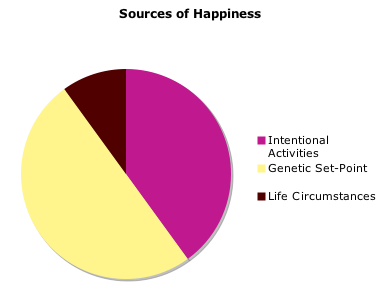
    The happiness you experience comes from three sources; your genetics, your life circumstances, and your intentional activities, split like this:

    So the ‘happiness formula’ is this:

    Happiness = Genetic Set Point + Life Circumstances + Intentional Activities

    According to this model, life circumstances account for only 10% of your happiness, genetics account for 50%, and intentional activities account for 40%. Intentional activities are the ways we act, think about, and respond to the world. In other words, the same life circumstance has the potential to cause different amounts of happiness in people depending on how they react to it. There are certain ways of thinking and behaving that cause people to respond to events with more negative emotions, and likewise, there are ways of thinking and behaving that cause people to respond with more positive emotion.

    While there is some debate about the specifics of this model, one thing is well accepted – if you want to be happier, the best way is to focus on changing your intentional activities. You can’t change your genetics, and circumstances seem to have a smaller effect. Of course, if your circumstances are particularly bad; if you’re in an abusive relationship, if you’re homeless, if you’ve recently been incarcerated – your circumstances will have a stronger effect on your emotions. But it’s not possible for me describe the way out of every bad situation every reader of this might find themselves in. Everyone can change their intentional activities, though.

    Why would circumstances count for so little? It might seem backwards, but it makes more sense when you add in the concept of hedonic adaptation, which we learned about earlier in this chapter. Many things give us a boost in happiness, but we adapt to them over time, and the happiness wears off. Circumstances are more long-standing. Intentional activities are either short-term (giving no time to adapt), change how we react to circumstances, or they make changes to the brain such that it brings more positive emotion and less negative emotion.

    Let’s try an example. Take marriage. Marriage is long-term, and seems to make most people happier for a few years, before they adapt to it. But expressing gratitude to each other, having those awful picnic things where you feed each other food (yuck!), savouring the good times, talking about all the other disgustingly romantic things you did together; these things boost happiness, but as they are episodic there’s no adaptation to them. You just have to keep doing different activities.

  • Happiness is partly genetic

    Picture the scene: you’re sat down relaxing one day, when your phone rings. You answer – it’s a good friend of yours. She explains that she needs to predict how happy someone will be in ten years time. She heard that you read a book about happiness, and wants your help. She’s rushed – it’s very important and you only have time to offer one suggestion. What one piece of information is the best way to predict someone’s happiness, ten years down the line?

    Really think about this. What would you suggest? Their income level? Whether they’re married? How good their health is? What line of work they’re in? Which country they live in?

    The surprising truth is that the most accurate single predictor of how happy someone will be in ten years time, is how happy they are right now. What’s the one thing that stays with you for all this time, and doesn’t change at all? No, not taxes. It’s your genes: the DNA code inside every one of your cells. Your genes are the recipe for how to build you, and research has shown that about 50% of the variation we see in happiness is down to variation in genes.

    There’s a common misunderstanding that if something is said to be ‘genetic’, then it is also fixed and unchangeable – this isn’t true. When people talk about genes vs environment, an analogy could be building a house. Genes are the blueprint for a house, and environment is how and where it is built.

    Take that blueprint, and give it to different contractors, build it in different locations, different weather conditions, and it will come out differently each time. The houses won’t be completely different – they do have the same blueprint after all – but changes will have to be made. Likewise, a gene doesn’t dictate how something will definitely end up in the real world. Genes are more like instructions for the living things that host them, telling them how to respond to different stimuli they might come across.

    For example, at some point in evolution, muscles developed the ability to grow bigger and stronger when they are being worked harder than normal. This helped us adapt to our physical environments, which allowed us to survive. The recipe for this system is contained in the genes. Put simply, it probably goes something like this: “If muscle is under x amount of stress, increase it’s size by y.”

    There’s a genetic element to muscle growth. The genes will ‘tell’ the organism how much they should grow by; how much of certain hormones to release, how much protein to synthesise, what stress threshold the muscles need to be under for this process to begin, and things like that. This is all genetic, and so some people find it easier to build muscle than others. But there’s also an environmental element – if you don’t exercise, the genes won’t get activated, no matter how ‘good’ they are. There isn’t a ‘big muscles gene’, but rather, there are genes for a system that makes muscles easier to build – if conditions are right.

    Likewise, there isn’t a ‘happiness gene’. It just means that some inherited traits and characteristics are leading us to experience a certain range of happiness levels, if conditions are right. Maybe they trigger more activity in the left hemisphere of the brain, which is associated with positive emotions. Or maybe our inherited personality leads us to do certain things. As an example, social relationships are a source of happiness. Extraversion is a personality trait that leads people to be more sociable. And extraversion happens to be strongly heritable. So while there’s a genetic side to happiness, don’t worry. ‘Genetic’ doesn’t mean ‘fixed’.

    Refs:

    Lykken, D., & Tellegen, A. (1996). Happiness is a stochastic phenomenon. Psychological Science, 7, 186-189.

    Tellegen, A., Lykken, D. T., Bouchard, T. J., Wilcox, K. J., Segal, N. L., & Rich, S. (1988). Personality similarity in twins reared apart and together. Journal of Personality and Social Psychology, 54, 1031-1039.

  • Wanting is a Separate Thing to Liking

    Daniel Nettle’s book, Happiness, devotes a chapter to explaining the distinction between wanting something, and liking it once you get it. Wanting and liking are separate. We can want something but not enjoy it, or we can not want something but then find we like it when we get it. Combined with our poor judgements of our future emotions, this can lead people to some pretty strange decisions.

    It is mainly through studies of drugs that we know this. In one study, heroin addicts were asked to press a lever 3,000 times to receive one of three possible injections – a low dose of morphine, a moderate dose of morphine, or just saline. Then they were asked to rate how much they enjoyed each shot. The group that received saline wouldn’t not press the lever again; they did not find the injection to be pleasurable and weren’t interested. In the group that received a moderate dose, they found the injection pleasurable and went on to work the lever for another shot. But the group receiving only a low dose was the interesting one. They too press the lever again, to get another shot – even though they did not find the dose high enough to be pleasurable. It was enough to trigger the wanting system, but not the liking system.

    People are not always looking for pleasure. We also look for status, power, creativity, meaning, and lots of other things. The implication is, something that gives us a little advancement in one of these areas, (say, a job that gives us a higher status at work), might activate the wanting system, but not the liking system (for example, we realise we don’t like management or responsibility).

    Why would the wanting system lead us to strive after things that we won’t? Well, the brain doesn’t much care how happy you are, as long as you’re surviving. We might not like our higher status job, but it boosts our ability to survive. Millions of years ago there was no welfare state, no agriculture, no civilisation. We roamed in tribes where higher status individuals had higher chances of survival. Although life is very different now, we have the same instincts.

    Unless we’re able to consciously realise the times when something we want isn’t something we like, we might end up making the same mistakes over and over.

  • Hedonic Adaptation

    The principle of adaptation is quite interesting, and is related to the progress principle. Hedonic adaptation means that very often it is changes in circumstances, not absolute conditions, that affect our happiness. Many people today feel they could not live without their x, where x is a new versatile solution for modern living, a new type of phone, say. But of course, they could. They have simply gotten so used to living with that phone, that they find it hard to imagine life without it. They have adapted to it. The happiness we experience is based on a comparison between our current state, and the one we have adapted to. If you take the phone away suddenly, they will be unhappy, but over time, they will adapt to not having it too.

    Lottery winners, perhaps the luckiest people of all, become extremely happy after winning. They are suddenly free of financial problems, their sex appeal immediately increases, and they can do or buy almost anything they want. But over time, they adapt to the high life, and their happiness returns to just about where it was before.

    Quadriplegics experience something similar after losing the use of their limbs. Their happiness understandably takes a considerable dip. But over time, they being to adapt to their situation; their goals and expectations change, and their happiness returns to almost (but not quite) the same level it was originally.

    In many ways, unfortunately, hedonic adaptation is in direct competition with the way modern life is set up. The deal is simple; you get the money, the clothes, the big house, and the nice car, and then bang! Well done champ, you made it, you’ll be happy forever. But then the new car is released, the new clothing line comes out, and you want a house with a pool and an ocean view. Your expectations rise, what was once a luxury becomes a necessity, and you find yourself wanting more again, like a hamster on a treadmill (this idea is often called the hedonic treadmill, in fact). There’s nothing wrong with wanting a better life for yourself and your family, but much of what you think will bring you that, won’t, because you’ll adapt to it. Meanwhile, if you’re spending a lot of your time working just to chase after these things, you’ll miss out on the opportunity to do other things that will have a stronger impact on your happiness.

    Refs:

    Brickman, P., Coates, D., & Janoff-Bulman, R. (1978). Lottery Winners and Accident
    Victims: Is Happiness Relative. Journal of Personality and Social Psychology, 36(8), 917-
    927.

  • The progress principle

    The progress principle is the science behind the famous saying “it’s the journey, not the destination, that counts.” In other words, more happiness will be achieved in the steps that lead up to a goal than in the final step of reaching the goal itself. In The Happiness Hypothesis, Jonathan Haidt explains the logic behind this. Say it takes 10 steps to reach a goal. Why would going from step 9 to step 10 bring more happiness than all the other steps combined?

    To give a personal example, I really wanted to get a first in my psychology degree, but I’d screwed up the first year and a half, work-wise, so I needed to make up for that. I worked hard in the final three semesters, my marks got better and better, and my average started to rise up to the magical 70% target. The final grade I got, for my dissertation, pushed me just over the 70% mark. But when I got that result back, I wasn’t jumping for joy. If I felt anything it was more like relief at that point. In fact, thinking back on the experience, I scarcely remember getting my final grade.

    This isn’t always the case, and some goals will have you jumping around. But speaking generally, happiness results from taking a step in a beneficial direction, but not from standing still at any particular point. The feeling of the final step is weaker than the previous steps, because the part of the brain associated with positive emotions (the left prefrontal cortex, as we discussed earlier) reduces its activity once you reach a goal. This isn’t such a bad thing; we need the progress principle so that we stay motivated to pursue goals. If all the happiness came at the destination rather than the journey, where would our motivation come from?