Month: December 2010

  • Six Success-Enhancing Behaviours that Good Moods Bring You

    Just like Santa Clause, happiness brings gifts with it too – and you don’t have to be good all year to get them!  In the last three articles, I’ve discussed a paper arguing that happiness leads to success, through a better career, better relationships and better health.  This works in part through behaviour – positive moods promote positive behaviours – ones that are friendly to success.  The evidence suggests six broad categories of behaviour that result from happiness.  Here they are:

    1) Positive Perceptions of Self and Others

    Happy people are optimists, who tend to have higher self-esteem.  They think well of themselves and the different areas of their life; family life, romantic life, education, leisure, and so on.  This positive attitude spills over onto other people too – happy people tend to like other people more.

    So what comes first, happiness or high self-esteem?  You’d think it was self-esteem, but in fact it’s a little of both.  Self-esteem does bring happiness, but being satisfied with your life also brings self-esteem and confidence.

    2) Sociability and Activity

    Happy people tend to be more extraverted – more outgoing, active and energetic.  Positive emotion is described my some researchers as the ‘glue’ that holds the different aspects of extraversion together.  Happiness is associated with more formal and informal social activity, including voluntary activities, time with friends, learning new skills and taking classes, and even being more informed about politics.  Happier people seem to be more informed and interested in learning new things.

    If people are induced into a positive mood (they usually do this with uplifting videos), they are more likely to start conversations with a ‘stranger’ (who was actually a confederate, working undercover for the researchers).  So there you go, if you want to be more social, cheer up.  It works.

    All those new skills and contacts would certainly be useful in trying to become successful, plus people with a larger social network tend to be luckier, too.

    3) Likability and Cooperation

    Are cheerful, upbeat people fun to be around, or just plain annoying for being so cheerful?  The former is actually true – happy people are liked more than unhappy people.  They are also perceived more favourable by people – they are seen as more intelligent, competent, friendly, assertive, less selfish and more moral.  People in happy moods are also more approachable and inviting to others.

    My favourite variation on a classic saying goes like this: “It’s not what you know, it’s who you know – and how much they like you.”  Success involves other people, being likeable and well thought of can only be beneficial.

    4) Prosocial Behaviour

    A great deal of research now supports the idea that happy people are more generous and charitable.  They just have a greater interest in helping other people.  This goes hand-in-hand with the authors’ original idea that happiness indicates conditions of abundance, so to speak (see the first post in this serious, second paragraph down).

    Why is prosocial behaviour helpful to success?  It makes people more likeable, strengthens social bonds and networks, and brings future profits through the principle of reciprocity (you scratch my back I’ll scratch yours!).

    5) Physical Well-Being and Coping

    Positive moods are associated with healthy behaviour both long and short-term – happy individuals are less likely to take drugs and eat unhealthy food in the future, and recent positive moods are associated with less cigarette and alcohol use, as well as better quality sleep and more exercise.  One study exposed participants to the cold virus, and people who generally have a more positive emotional style were less likely to develop a cold from it.

    Another interesting finding, is that happy moods help you resist temptation when you’re trying to quit something (eg, smoking, junk food).  If you’ve ‘given in’, then before you continue your indulgence, do something to bring your mood up.  Watch an uplifting film, a sitcom you like, count your blessings or do some other self-help technique.

    According to researchers, this replenishes the deflated ego, giving you more will power.  Just don’t use a pick-me-up that reminds you of the thing you’re trying to abstain from! (eg if you’re quitting junk food and you normally eat in front of the TV, don’t watch TV to boost your mood).

    Happiness also seems to have a direct effect on health.  Although there is little evidence at present, concepts related to happiness like humour and optimism have been shown to increase immune system efficiency.  One study found higher antibody activity on days with more positive moods than negative moods.

    A happy disposition also leads to better coping during life’s difficult times, probably through the increased optimism and hope that tends to come with happiness.

    6) Creativity and Problem Solving

    The studies that exist on happiness and creativity suggest that the two tend to come together in people.  There is a need for more research in this area, but is seems that it is moment-to-moment happiness that is beneficial to creativity, rather than happiness as a trait.  In other words, if you take a person who is usually in a bad mood and cheer him up, he should be more creative while his mood is good – even though his disposition might be as grumpy as the dwarf of the same name.

    Of course, you can always bring up the ‘troubled artist’ stereotype to challenge these findings – and in some studies, people in sad moods are more creative than people in a neutral mood – but it’s the cheerful ones that usually show the most creativity.  But it’s a valid challenge to the idea, and the apparent conflict might just be due to different definitions of creativity.

    The reason that happiness is good for creativity may be that it broadens your perception and thinking somewhat.  This is in opposition to ‘negative’ emotions, which narrow your potential thoughts and actions down as a survival instinct, eg. fear makes you escape or hide, anger makes you retaliate against a transgressor, and so on.

    When it comes to complex problem solving, however, the findings are quite mixed.  In some mental tasks, negative moods are more effective, in others, positive ones are.  The difference seems to be because good moods increase a person’s reliance on heuristics (heuristics = rules of thumb, stereotypes, or mental shortcuts) – rather than slowing down and thinking the task through carefully and analytically.  So positive emotions are perhaps better when there is existing knowledge and heuristics that can be applied to a task.

    Why would good moods increase your use of heuristics?  Perhaps because if things are going well for you, it makes sense to use heuristics you’ve already used, because these are probably what got you the success in the first place.

    But don’t start listening to your Radiohead albums before you do your evening Sudoku puzzle, thinking that the intense depression will help you out.  If you’re in a positive mood you can still access your analytical side; you just have to do it deliberately.

    Conclusion

    The point of these four posts was to hopefully give you perspective on happiness that you might not have taken before.  In summary:

    • It’s an action signal just like other emotions
    • The actions it signals are ones that help you move towards goals
    • Therefore, good moods are not solely a result of a consequence of success (although they certainly are that), they are part of the cause of success.

    Remember – ‘happiness’, in the paper I got this information from, is defined by frequent positive emotions and infrequent (but not absent) negative emotions – a slightly different definition than I’ve used previously.

    Even though ‘negative’ emotions are not that pleasant to experience, it’s easy to imagine that they serve a useful purpose, that when you’re scared it’s to keep you safe, to keep you from doing things that your mind associates with danger.  If you didn’t have fear, you’d get into a lot of trouble.

    Likewise, happiness has a purpose too.  It’s not just there so that you can feel good!  It’s a signal, information about your circumstances.  You’re progressing well towards your goals, you have resources, allies and security.  Because of this, happiness nudges your behaviour in a certain direction.  Unlike fear, though, the direction is towards goals, not away from them.

    Your mind then opens up a few mental resources for you; makes you more interested in goals, more creative, and gives you a positive outlook on any negative things that might be going on, so that they don’t interfere with your advancement.

    Happiness is not a guarantee to success, of course, but the point is that it plays a measurable role.  It’s one piece of the puzzle.  If you’re suitably convinced of this, you’ll probably want to read How to be Happier, to find tested ways of increasing your happiness.

    This series was based on the below paper published in Psychological Bulletin by Sonja Lyubomirsky, Laura King and Ed Deiner – three big names in positive psychology.  It was a huge effort, they analysed 225 studies with over 275,000 participants in total!  All three researchers have books out so if you like the stuff in these articles, stick their names into Amazon and see if there’s something you like!

    Apart from the side-splitting humour, all the points in this article came from this reference.  If you’re looking for the original studies, get the pdf of the above reference and do a Ctrl+F (or Apple+F) to search for the finding you’re looking for.  Then find the study in their reference list.

    Recommended Reading:


    References:

    (1) Lyubomirsky, S., King, L., & Deiner, E. (2005). The Benefits of Frequent Positive Affect: Does Happiness Lead to Success? Psychological Bulletin, 131/6, 803–855

  • How to manage your weaknesses

    There’s a big focus on weaknesses in the world these days. It seems like people want to balance themselves out by developing their weaknesses – to become rounded. Previously, I’ve argued that it’s best not to be rounded, that we’re better off focusing on our strengths. But if we do this, we will still have weaknesses, so what do we do about them? That’s what this article is about.

    First of all, why this focus on weaknesses, why are they so alluring? I want to suggest an explanation for why we’re so weakness-focused, and offer some suggestions on working around weaknesses, mainly garnered from the book ‘Now, Discover your Strengths‘.

    A potential employer wants to know your limitations to help decide between applicants. But even after you’re employed, you’ll hear about ‘development’, ‘areas that need work’, and so on. In certain roles this is unavoidable, because there’s a minimum standard of performance that is expected. But we’ll often see development programs with the aim of rounding off individuals, rather than trying to create specialists. This might be due to our inherent negativity bias.

    Our negativity bias is well documented by researchers. There are paragons of positivity in our species, for sure, but most of us are pretty focused on the negative. Not necessarily in a debilitating way; its more of precautionary thing. It makes sense because we evolved out in the plains of Africa, where what you don’t know might kill you. Where being ostracised from the group means potential death, not just pointing and laughing in the playground.

    “The mind reacts more strongly to the bad than to the good.”

    Say you find a new fruit. If it’s safe, you get a bit of sugar and some nutrients. If it’s dangerous, you’re dead. Say you hear a rustling in the bushes. If it’s a friend, you get a laugh and a joke. If it’s a predator, you’re dead. Something negative was many times more hazardous than something positive was beneficial. Hence our bias towards the negative. The mind reacts more strongly to bad than to good. Don’t believe me? Ask a newspaper editor which headlines sell more papers!

    Maybe this is why if we see a weakness, we want to fix it. It’s human nature, your mind thinks it’s important to you, to your safety. Even though you’re not living in a nomadic tribe in the African savannah (unless tribes have developed laptops and wireless internet), your instincts are wired for that environment.

    What is a weakness?

    If a strength is a trait that can be applied productively in a given domain, a weakness is something that hinders performance in a given domain. My inability to efficiently operate an industrial crane is not a weakness in running this website. My time-management and organisation skills are.

    People are typically much better at identifying their weaknesses than their strengths. If you need help, you could look at your strengths questionnaire outputs and see what’s ranked near the bottom, or think about a particular task and see if there’s something specific holding you back.

    Managing weaknesses

    You might be able to fool an interviewer asking you what your strengths and weaknesses are. Well, technically, they know you’re fooling them, it’s just a matter of being a better fool than the next applicant. But if you actually do have weaknesses that are relevant to your career, side-project, hobby, or whatever, they may need to be addressed. How do you deal with that, given that we’re now ‘sticking to our strengths’? Here are a few ideas:

    1) Practice

    I know. I’m contradicting my previous articles where I said to spend your time working on your strengths. But if a weakness is really holding you back and you can’t get around it, one of the options is to improve it. As was said in Now, Discover your Strengths, this isn’t really a charge for glory and success, it’s damage limitation. If you really can’t get out of or delegate a monthly presentation, you’d better work on your speaking and communication – if only a little bit. You can also look into the skills and knowledge you’ll need.

    2) Create a Support System

    As I mentioned earlier, I’m not a naturally organised person. I don’t immediately know the most important thing to do, or use my time in the best way. To get around this, I’ve been following the Zen To Done course – to gradually adopt a decent organisation system. After 10 months, the aim is to be fully organised and more productive. That’s an example of a support system.

    Or take something like social intelligence. Remembering a person’s name the second time we meet them might help us come across as more socially intelligent. This is a common problem, I hear. Actually for me, it’s more that I’m weak at recognising faces than remembering names, but I can’t think of an example for that. Anyway, there are memory techniques and mnemonic tricks you can use to do learn names, as well as remember other things about the person to bring up and ask about – makes you seem warm and friendly. That’s another example of a support system to get around a weakness – it’s not going to make you Mr or Mrs Charisma, but like I said, damage control.

    3) Outsource

    Get a partner – outsource your weaknesses to someone else. This can work when starting a particular project or venture, or even within a role if there’s someone who’s skilled in one area and you in another. Outsourcing weaknesses is something we all do anyway, much to our accountants’ delight.

    4) Drop it

    Most of the time, a weakness isn’t a threat to you – maybe to your ego, but not to your safety. So maybe it’s time to let that go a little bit. If it’s something you can’t avoid, then you’ll have to develop it or outsource it. If it’s really important to you, then you have no choice either. But my personal opinion is that we should get over the idea that we have to be rounded people, ready for any situation that might come up. Unless your name is James Bond, it just seems like a great investment of time and effort, for very little benefit.

    Recommended Reading:

  • How to identify your strengths. Part 1: Self-Reflection

    I recently made a case that it’s better to “stick to your strengths” than to do “whatever you set your mind to.”  The main thrust of my argument was that even if you could do anything you set your mind to, it’s a slower, longer, and more frustrating road to excellence if you’re not using your strengths.  So why not pick the more enjoyable journey?

    “If you’ve never applied your strengths productively, you might not realise you have any.”

    A strength is just a particular way of processing information that your brain is good at.  A strength has to be applied towards a productive outcome to be noticed as a strength, of course, so you might not realise you have any, or you might see it as a weakness.  For example, neurotic worriers are superb at anticipating negative outcomes, they can often do this all day long.  While this might not make them great people to sit next to on the bus, their natural caution and prudence gives them excellent potential for strategic planning roles.

    Maybe you’re looking to shape your life around your strengths, maybe you’re just reading out of interest.  Either way, you’re probably curious as to what your own strengths are.  Allow me to cater to your intrigue, by presenting the two ways you can discover them:  Self-Reflection and Questionnaires.

    These are each pretty big topics, so I’ll explain how to use self-reflection now, and review the best questionnaires to use in a future article.

    By “self-reflection”, I don’t just mean sitting and thinking “Hmmm….what are my strengths?”  Research has uncovered patterns in how people discover their strengths, and this gives you areas in which to focus your self-reflection.  This option would be best for people who have a high level of self-knowledge to start with, or people who dislike questionnaires generally. 

    The advantage of self-reflection is that you’re not limited to a fixed set of potential answers – a questionnaire can tell you which are your top five strengths out of a total of 24, but it can’t tell you about anything outside of that model.  Reflection is harder work, but gives you that extra flexibility.  You can discover your strengths by reflecting on the following five areas (1):

    1) Spontaneous Reactions

    If it is true that strengths are your brain’s efficient processes, you’ll probably use them as a kind of default response to various situations.  When a problem comes up, do you analyse the situation or jump straight in?  If you go to a party, is your spontaneous reaction to woo those people you don’t know, or spend time relating to people you do?  Looking for common spontaneous reactions over a variety of situations can give you clues to your strengths.

    2) Yearnings

    For whatever reasons, each of us is drawn to some activities but not to others.  There are some activities that turn us off, and some we get excited about.  This is partly because we get more satisfaction from activities involving our strengths, and it’s easier for us to get into a state of flow when we’re using them.  

    When we’re yearning to do a certain thing, it’s in part because of the good emotions we expect to get from it, so this is a good avenue to look at when trying to identify strengths.  Think about your yearnings, and find the commonalities, but beware of what Marcus Buckinham calls “misyearnings”.  For example, a yearning to be an actor because of the anticipated glamour and fame, not for the joy of acting.  The yearnings you look for should be those relating to an activity itself, not the end result of it – things that you’re intrinsically motivated to do.  If you’re unsure, it can help to interview someone already in the role you yearn for, to see what it’s really like.

    3) Rapid Learnings

    Unfortunately, this is something I’ve never really experienced!  I’m quite a slow learner, I can’t think of many things I’ve picked up easily.  But many people try something new and find they progress quickly and naturally in it.  This rapid learning is indicative of an efficient brain area, and therefore a strength.  Think back over times you’ve picked something up quickly, or found you were a ‘natural’ at something.  Your strengths may relate to the skills required by that activity.

    4) Satisfactions

    As positive psychologists have discovered, using your strengths makes you happier.  Reasoning backwards, we find that the things that make us happy may involve our strengths.  Of course, not everything that makes us happy can involve a strength, otherwise you’d come up with a rather silly list, maybe including “being surprised”, “drinking beer”, and “buying a carpet”.  Obviously, these are not strengths.  You have to use common sense and maybe look at activities that are challenging to some degree, activities that you’d like to do again.   

    5) Energy

    You’re more likely to draw energy from activities that use your strengths than those that don’t.  This is why it’s so hard to go against the grain of your strengths long-term – these activities are draining rather than energising.  Ask yourself where you get your energy from.  What activities give you a buzz when you’re doing them?  If you can think of some, they probably involve your strengths.

    “Looking for your strengths helps you to see yourself from the outside”

    As you’ll have noticed, discovering your strengths through self-reflection is hard work; not something you can do in an afternoon.  You might have to spend a few weeks noticing your spontaneous reactions and satisfactions, and remembering your rapid learnings.  You’ll have to be perceptive in order to discover where you get your energy from, and careful not to identify any misyearnings.  

    The advantage of all this, aside from figuring out what strengths you have, is the extra self-awareness.  You’ve probably never thought of looking at yourself from the outside, to see how your elephant naturally reacts to things when you’re not directly instructing it.  An exercise like this will greatly appeal to those of you seeking self-knowledge.

    Others will feel this is too much hard work!  For you people, there are some good questionnaires which are well supported by research; these will give you a good idea of your strengths.  There are also some crap questionnaires out there too, so next article I’ll review the best ones to use.

    Recommended Reading:


    References

    (1) The first four (Spontaneous Reactions, Yearnings, Rapid Learnings, and Satisfactions), are recommended in Now, Discover Your Strengths by Marcus Buckingham and Donald O. Clifton.  
    The fifth suggestion (Where your energy comes from), is Alex Linley’s advice, which you’ll find in the book Average to A+, you might also like this free pdf file: Alex Linley’s Strengthspotting Tips 

  • How to identify your strengths. Part 2: Questionnaires

    Previously, I’ve explained why it’s best to stick to your strengths, and explained how to identify your strengths through self-reflection.  In order to use self-reflection, you’d have to be aware of your body and mind, watch how they naturally respond to situations, and take some extra time to sit and reflect in the ways I outlined.  This is all well and good, and many people relish that type of self-analysis.  Others, including my own good self, don’t find that quite so appealing.  Personally, I’d prefer to just fill out a questionnaire and get the results.  If you’re like me then read on, and I’ll tell you where to go next. First of all – in case you’re unsure which way to go – here are the pros and cons of each:

    For Self-Reflection/Against Questionnaires

    Questionnaires are fixed and rigid – Although there are many thousands of possible outcomes from a questionnaire, it is still blocked into a framework, and cannot tell you about anything outside of the framework.  Self-reflection is more flexible.

    Questionnaires are focused on psychological and social strengths only – So you won’t discover any physical abilities like reaction time or balance except through reflection.  

    Self-Reflection is more personalised and focused on you – Its outcome is based on your real-life behaviour.  Questionnaires, on the other hand, give you a best-guess based on your answers to questions – this has potential for error.

    Increased self-knowledgeYou’ll surely learn more about yourself from doing this.

    For Questionnaires/Against Self-Reflection

    You may not have the wordsIf you don’t have a good vocabulary to identify strengths with, you might miss some, or not realise that a certain consistent behaviour can be applied productively.  Once you’ve very familiar with the strengths vocabulary, you might even try your hand at Talent SpeedReading, which could be useful if you’re in a managerial position.

    Personal tasteSome people find self-reflection difficult or boring.

    Backed by researchYes, responses are fixed into a framework, but there are good reasons that this framework exists.  These models are not arbitrary: research has been done to test their effectiveness.  

    Saves time and effort – 45 minutes to 1 hr, versus 1 or 2 weeks.

    Of course, you can always do both, and see how the results compare.  There are two dominant models in the field of personal strengths.  These are Values In Action, coming from positive psychology researchers, and StrengthsFinder, based on research by Gallup.  (Note: There is a third model, Realise2, coming out of the Centre for Applied Positive Psychology on June 2nd 2009.  As I know very little about it, I’ll leave it alone for now.)

    Values In Action  

    Legend has it, a group of intrepid researchers went into the mountains one winter, taking with them food and every major scientific, philosophical and religious text ever written, from the north, east, south and west.  For a long time, there was no word.  Some feared the worst.  Then, the next spring, the researchers returned.  Exhausted and emaciated, they came down the mountain, carrying over their heads a glowing, 800 page tome entitled Character Strengths and Virtues: A Handbook and Classification (CSV), which contained extensive information and background on 24 character strengths.

    I may have exaggerated this story slightly.

    In any case, these 24 strengths are grouped into six virtues.  To come up with this list of 24 strengths, the historical texts were examined, and commonalities were identified.  The researchers looked at what the great thinkers of our species agreed on, and tested these common ideas against a set of criteria of their own. 

    The end product is a model where the exercise and development of strengths leads to the achievement of virtue.  So it’s mainly concerned with developing good character.  

    The Values In Action model has an accompanying test, used to diagnose peoples’ “signature strengths”.  The test is called, inventively enough, the Values In Action Inventory of Strengths.  It is well supported by research, and a lot of effort has been put into making sure this is a valid and reliable reflection of human strengths. 

    For example, when the test is given to people in the military versus civilians, soldiers come out higher in strengths like teamwork, honesty and bravery (1).  Another example: executives tend to display less kindness and love, but higher leadership and self-control than their employees (2).  These findings and others like them are sensible; they show that the test is accurate.

    The VIA Inventory of Strengths can be taken at Authentic Happiness.  It’s free but requires registration (you also get access to a whole host of other tests) and it takes around 45 minutes to complete.  If you only take one test, take this one.  I recommend it because I’ve read much of the research using this model, so I know it’s been well validated and tested. 

    Also, studies have shown that when people use their signature strengths, as identified by this questionnaire, they get happier, and continue to get happier the more they use them (up to the 6 month point where the study ended, that is). (3) 

    StrengthsFinder  

    This is a more well-known approach to strengths, due to the popularity of the book “Now, Discover Your Strengths”.  Rather than focusing on good character and virtue, the authors have focused on the workplace, and job performance.  The model is based on a survey of 2 million people in just about all known professions.  Each participant was interviewed, then the data was analysed and compiled into what is known as StrengthsFinder.  

    If you’re interested in strengths to help you find or progress in your career, this is probably the model for you – it’s specifically designed for that purpose.  To develop strengths, you first must identify your talents.  Talents are defined as “any recurring pattern of thought, feeling or behaviour that can be productively applied”. 

    After discovering your talents, you practice them, learn complimentary skills and knowledge, and eventually the talent becomes a strength, which itself is defined as “consistent, near perfect performance in an activity.”    

    Like the VIA Inventory of Strengths, the test takes around 45 minutes to complete, and gives you an output of your top five strengths.  Unlike the VIA, the StrengthsFinder model includes a total of 34 strengths, rather than 24, and unfortunately it isn’t free.  

    To take the StrengthsFinder test you have to first purchase one of their books, StrengthsFinder 2.0 will give you access to the newer test, or an older publication like Now, Discover Your Strengths will get you into the older test (convenient links below).  These books are pretty cheap in paperback and worth getting if you’re interested in strengths.  Once you have an access code, head over to the StrengthsFinder website and log in!


    Recommended Reading:


    References

    (1) Matthews, M. D, Eid, J, Kelly, D, Bailey, J. K. S, Peterson, C. (2006) Character Strengths and Virtues of Developing Military Leaders: An International Comparison. MILITARY PSYCHOLOGY. 18(Suppl.), 57–68.

    (2) Character Strengths of Executives and Employees 

    (3) Seligman, M. E. P., Steen, T. A., Park, N., & Peterson, C. (2005). Positive psychology progress: Empirical validation of interventions. American psychologist, 60(5), 410-421.

  • Strengths and Weaknesses

    Are you aware of your personal strengths and weaknesses? In this article we’ll look at:

    • The distinction between strengths and weaknesses, and why it may be more important to focus on strengths.
    • How to identify your strengths and weaknesses
    • How to manage and work around your weaknesses when focusing on your strengths

    “What are your strengths and weaknesses?” This is probably the most hated interview question, but apart from the enjoyment of watching us squirm while trying to answer it, there’s a good reason employers might want to ask it; it could allow them to fit you into a role in which you could use your personal strengths, and has minimum focus on your weaknesses.

    Alas, this doesn’t tend to happen – Gallup report that 68% of employees don’t get to use their strengths on a daily basis! The thinking seems to be that there’s a global characteristic called ‘talent’, and if employers can find people with ‘talent’, they can train them to do whatever job is necessary – after all, they’re ‘talented’!

    However, talent doesn’t work like that; there are many possible talents that a person could have. When we see someone who does well in their profession, we generally call them talented; but in fact they usually have just focused on their natural strengths, and minimised their weaknesses. There are plenty of examples: the genius artist who lives like a slob; the expert computer programmer with no charisma; the incredible athlete who has no skill with numbers. You wouldn’t hire the first person to be your interior designer, the second to lead your sales team, or the third to do your taxes, yet they are all talented.

    So, ‘talent’ is not defined by being a whizz in everything you do. It’s a case of finding activities that require your strengths but not your weaknesses, and developing your expertise in these areas.

    Your strengths

    How do you find out what your strengths are, so that you can use and develop them? There are several ways, the best one will depend on your personality. If you are reflective and perceptive, you might want to try self-reflection. If you think you’ll find this difficult, you could take a questionnaire. These questionnaires are not the flimsy little tests you find in popular magazines; they are empirically validated measurements based on a great deal of research. The main ones at the moment are the Values In Action model and the StrengthsFinder model. A new model, Realise2 has recently entered the fray too and looks interesting. Here are the strengths from the former two models:

    StrengthsFinder

    Achiever
    Activator
    Adaptability
    Analytical
    Arranger
    Belief
    Command
    Communication
    Competition
    Connectedness
    Context
    Deliberative
    Developer
    Discipline
    Empathy
    Consistency
    Focus
    Futuristic
    Harmony
    Ideation
    Includer
    Individualization
    Input
    Intellection
    Learner
    Maximizer
    Positivity
    Relator
    Responsibility
    Restorative
    Self-Assurance
    Significance
    Strategic
    Woo

    VIA

    Wisdom and Knowledge
    Creativity
    Curiosity
    Judgment, Open-Mindedness, critical thinking
    Love of Learning
    Perspective, wisdom
    Courage
    Bravery
    Perseverance, industriousness
    Honesty, authenticity, integrity
    Zest
    Humanity
    Capacity to Love and Be Loved
    Kindness, generosity and nurturance
    Social Intelligence
    Justice
    Teamwork
    Fairness
    Leadership
    Temperance
    Forgiveness & Mercy
    Modesty & Humility
    Prudence
    Self-Regulation, self-control
    Transcendence
    Appreciation of Beauty and Excellence
    Gratitude
    Hope, optimism, future-mindedness
    Humor
    Religiousness & Spirituality

    More information on these models can be found in this comparison between VIA and StrengthsFinder article. Once you’ve identified your strengths, next you’ll need to know what to do with them.

    Weaknesses

    Weaknesses can be identified in the same way: self-reflection or questionnaires. If you take the questionnaires, this time, of course, look at the bottom section of your results. Note that the StrengthsFinder model does not report your weaknesses; only your top strengths, so you’ll have to use the VIA questionnaire to figure out your weaknesses in this way.

    The next question that arises is, if we’re better of focusing on our strengths, then what do we do about our weaknesses? Do we just ignore them? The answer will depend entirely on the situation. You should avoid trying to develop your weaknesses if you can, by outsourcing or finding technical solutions if possible. There’s more information on how to work around weaknesses here.

    Recommended Reading:

  • What to do with your Strengths

    Short Version

    1) Find ways to use strengths more in your life
    2) Look for supplementary knowledge on using these strengths in the domains you have chosen
    3) Practice the activities that use the strengths and/or get training in them

    Long Version

    lego strong man hammer

    Alright.  So you understand that a strength is a part of your brain that’s more efficient than other parts, like broadband is to dial-up.  And you agree with me that life is easier when you stick to your strengths.  Potentially, you can do anything you set your mind to, but it’s going to be a better experience if you set your mind to something that employs your strengths.  Also, you’ve figured out what your strengths are through either self-reflection or questionnaires.

    Now what?

    The next step is to blend your strengths into your life, and get over the obstacles that come up as you do so.  As I imply above, I’m assuming you’re sold on the idea of doing this; if not, re-read the links above to review the benefits, do some further reading through the books I mention or on the web, and ponder the issue further.  If you’re still not convinced, then move along: there’s nothing more to see here.

    If you’re still with me, let’s start with…

    Strengths and Career

    You probably spend between 30 and 50 hours per week working.  Most visitors to Generally Thinking are from the UK and US, so you’re probably near the top end of that scale too; congratulations if you’re not.  In any case, career seems like a good place to start.

    You’ve got two possibilities:

    1) Rearrange your present work so that it involves your strengths
    2) Switch to work that does involve your strengths

    Which of these you do, is up to you.  I suppose it depends on how much you like what you’re doing now balanced against how much you want to fit your strengths into your career.  If your current career doesn’t appear to make use of your identified strengths, don’t immediately conclude you’re miscast, because using option 1 you might later find yourself a good fit.

    Rearrange

    Here you have to discover what strengths you are currently using, then see if you can add the other ones into your role.  Your position might employ one or two of your strengths really well, then it’s a matter of finding ways to add the others in.  If you can’t find ways to add any of your strengths in, you’re currently going against the grain.  You should consider what’s keeping you doing this, and consider Option 2.  If your current role is temporary or a stepping-stone job, you’ll still enjoy it more if you can rearrange the way you do it around your strengths.

    “You might have to get a bit creative, to blend your strengths into your career.”

    The various books on strengths offer basic examples on how to rearrange, such as a cashier with the strength of social intelligence, who started engaging customers more in conversation at the checkout.  If I described how to use every strength in every possible role, I’d be about 80 when I finished this article, so you’ll have to get a bit creative.  But since Gallup discovered that successful people find ways to do this, it’s potentially worth the effort.

    The other day I was reading interviews with two rock-band front-men, Rivers Cuomo of Weezer, and Tim Wheeler of Ash.  Here’s an example of two people in the same role, unconsciously fitting their strengths into it.  Rivers is shy, introspective, and did an English Literature course at Harvard.  He’d probably show up strengths like intellection, analyse or learner.  Tim seems more charismatic and confident, he parties a lot and might have the strengths of Woo and Positivity.  Both are the primary songwriters for their respective bands, so their biggest strength will surely be Arranger, or the VIA strength Creativity.

    But they seem to lever their other apparent strengths into the mix too: Rivers analysed songs by the Beatles, Nirvana and other bands, and created a file called “The Encyclopaedia of Pop”.  He then extrapolated a songwriting framework from this analysis, which he uses to write his songs.  Tim writes upbeat and positive songs, drawing inspiration from things like sunshine and having a good time.  Both of them are very successful, with multiple platinum selling albums.

    Switch

    Option 2 is easier from the point of view of fitting your strengths in, but harder in that you’re making a big change, which most people don’t find easy.  If it’s time to make a change, then looking at your strengths, it should be fairly easy to draft up ideas for roles which involve them.

    “Switching careers makes it easier to use your strengths, but most people don’t find change easy.”

    For example, looking at my own readout in the last article, my strengths were based around learning, curiosity, critical thinking, and forward thinking.  So I’m suited perhaps for something like research, where all of these come into play, and also something like writing or blogging, so I can make extra pocket money by writing about what I learn, and of course learn more about it in the process.  Hmm, what a coincidence, this happens to be the direction I’m heading in.  Don’t say I don’t practice what I preach!

    What strengths can’t tell you is the field you could go into – Gallup’s research did not indicate a relationship between fields and strengths.  For example, you could play the role ‘journalist’ in any number of fields: science, politics, celebrity gossip, and so on.  Strengths offer guidance on the role – not the field.

    Managing Expectations

    Remember, your aim is to look for ways to make more use of your natural and spontaneous ways of responding to the world.  You’re not searching for something that you’re already a master at!   Excellence will come later.  Faster, but still later.

    This is an important point to remember, which Marcus Buckingham makes clear in Now, Discover Your Strengths.  What if you arrange your whole life around your strengths, and then still don’t find the good life?   You’ve already given it your best shot, and with your strengths, no less!  Buckingham says “When the cause of failure seems to have nothing to do with who we really are, we can accept it.”  I’ve already drilled into you that your strengths are an enduring part of you, so what kind of torment would partner this kind of failure?  Buckingham suggests the fear of this could put you off trying.

    “It seems more sensible to deal with a wounded ego than to not bother trying anything.”

    If you never give it your best shot, you’ve always got an excuse, haven’t you?  Like the would-be suitor in a nightclub who acts like a little strange when talking to the attractive girl; a little bit too cocky, a little bit exaggerated.  If the girl turns him down, it’s not him she’s rejecting, it’s the act.  His ego and pride are protected, safe and sound.  But of course what he gains in ego-protection he loses in effectiveness.

    I think the parallels here are similar.  To me, it seems more sensible to find ways of dealing with a wounded ego than to not bother at all.  There’s all kinds of ways out there that offer to do that; meditation, cognitive behavioural therapy, progressive exposure, and so on.

    To bring up a final question for this section: is feeling a certain way really a good reason not to do something?  I had this idea when thinking about Steve Olson’s article on procrastination.  I’m not talking about safety and survival instincts; if you feel a dark alley is unsafe, that definitely is a good reason not to walk down it.  I mean more benign decisions.  There’s a lot going on in this culture – more people around than our brains are really designed to cope with, then there’s media, bills, careers; a whole cacophony of expectations placed on us.  How would you know whether a certain feeling you have should be trusted, like you would with the dark alley, or when it comes from something that you’ve arbitrarily integrated from the outside, with no particular relevance to you personally?  I don’t know the answer to this, so please let me know if you do.

    Add skills and knowledge

    Using the strengths more in your life is a road to happiness, more engagement, and all sorts of other benefits.  It’s also a road to greater performance – a better chance of reaching excellence in your chosen field.  But as we’ve just seen, you still need to hone your strengths further, by deliberately practising them, and also by adding in skills and knowledge.

    “To get ‘consistent, near-perfect performance’, you need skills and knowledge, as well as talent.”

    The reason for this is summed up in Gallup’s definition of a strength – to achieve “consistent, near perfect performance”.  In fact, Gallup define a strength as a strength only after the skills and knowledge have been appropriated.  They call them ‘talents’ prior to this; I’ve just used the term strength for convenience, and to compare models.  To get this level of performance, you may need to focus your efforts on one or more strengths, like the rockstars I mentioned above, who apparently focus on creativity, and use the other strengths to support this effort.  This was an easy choice for me too, as three of my top five strengths are mental/reflective, so it was obvious that this is the place to focus.

    The skills and knowledge you pick up will be experiential as well as deliberately researched or taught.  Some things you simply can’t get except through hands on practice, other things you can get from a book or trainer.  Our rockstars above may have had knowledge training in the form of music theory, skills training through tuition and practising scales, but their unique style of guitar playing and song-writing, that can only come through hands on practice – allowing their brains and nervous systems to end up with pathways and connections, causing them to respond to a guitar and to music the way they do.  There’s really no way of getting around this.

    This just about wraps up this series on strengths, barring a couple of loose-ends to tie up (managing weaknesses, for one).  Thanks for reading, hope it’s been useful!

    Recommended Reading:


    [Lego Strength image by Coldpants]

  • Leadership strengths

    Strengths-based approaches to work and life are popular these days; particularly in how personal strengths can improve leadership, as better leaders mean better experiences for employees, more productivity, and more money (or other bottom line).  But a key question is, do leadership strengths exist?  Are there strengths that all leaders share?  If so, what are they?  And if not, how can the current perspectives on strengths create better leaders?

    What makes a good leader?

    “Good Leader” seems to be a fluid concept, depending very much on the context.  Strengths-based approaches to leadership argue that good leadership isn’t a matter of having a specific set of “leadership strengths,” but rather, it’s a matter of leveraging the strengths a leader already has in a way that gets the job done.  This isn’t to say that certain skills and abilities aren’t required by most, if not all leaders; it’s just that there isn’t one particular ‘mould’ that a person has to fit into to be a leader – they come in all shapes and sizes.

    There are two major models of strengths – StrengthsFinder and Values in Action. If you’re a follower of the ‘strengths movement’, you’ll be familiar with at least one, if not both of these; if not, you can find a comparison here: Values in Action Vs StrengthsFinder.

    The StrengthsFinder Perspective

    Gallup’s work on leadership strengths is found in the book Strengths-Based Leadership.  They conducted thousands of interviews to create the Strengths Finder model, and they didn’t find any one strength that all leaders shared.  But, they did find that the most effective leaders invested in their own strengths – and the strengths of their team.

    Why aren’t certain strengths more common among good leaders?  It could be because of leadership styles.  Research identified four common styles: executing, influencing, relationship building, and strategic thinking.  The 34 Gallup strengths are linked up to these categories, and the style of leadership you’re likely to use is related to which of these categories your personal strengths are in.  This is why good leadership is more a matter of using your own strengths, as opposed to fitting the mould of a mentor, or stereotype.

    But this line isn’t so concretely drawn, as they found a few more interesting things:

    • Followers look for trust, compassion, stability and hope from a leader
    • Leaders understand their followers’ needs
    • Leaders create teams based on people who have strengths that compliment their own, as I briefly mentioned in strengths and weaknesses.

    So while no particular StrengthFinder strength is necessary, leaders do need to know their own strengths and weaknesses well enough to form a team around them, and they also need the necessary perceptiveness to understand their team members’ needs.

    The Values in Action Perspective

    The VIA model views the ability to lead as a strength in itself.  They measure leadership one-dimensionally, rather than scoring you on different theoretical aspects of leadership.  And it’s done through self-report, so your leadership strength is reflected by your answers to questions about how often you lead, your opinion of yourself as a leader, and your opinion of your friends’ opinions of yourself as a leader, and so on.

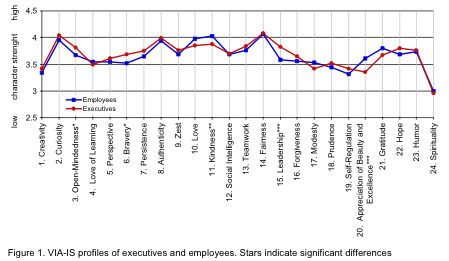
    This is a bit open to error, just as all self-report measurements are, but based on the Gallup findings it might be the most accurate way to do it.  I only found one study looking at the VIA strengths of leaders, which compared CEOs with their employees.  You can get a pdf from the University of Zurich’s website.  The results are below, hopefully they won’t mind me copying this graph here:

    As you can see, there’s very little difference between the strengths of CEOs and employees, which the Gallup research would predict.  There were a few differences though – CEOs were higher in ‘open-mindedness’, ‘bravery’, and ‘leadership’, but lower in ‘kindness’ and ‘appreciation of beauty and excellence’.

    (You may notice other differences on the graph, but these weren’t ‘statistically significant’, which is jargon basically meaning the scores are too close together to know if the slight difference was a fluke finding or not).

    Although these differences seem to go against the StrengthsFinder results, they don’t really.  As I know Gallup reached their conclusions through interviews, so it would have been qualitative research and open-ended questions.  So they wouldn’t be able to pick up subtle differences like the VIA questionnaire would.  Also, this study only looked at one type of leader – CEOs, a very distinctive type, which might attract people with a particular leadership style.

    With the graph showing such similarities between CEOs and employees, the general idea that there’s no specific leadership strengths holds up here too – at least based on this one study, and exluding ‘leadership’ itself obviously.

    So what makes a good leader, from a strengths perspective?

    • You don’t need any leadership strengths per se, but you need to know and invest in the strengths you do have (which you might do through self-reflection or questionnaires).
    • You must know your weaknesses, and shape your team to compliment them.
    • Finally, be perceptive enough to understand the needs of your team.  Individual needs, you’ll have to work out yourself, but generally speaking people tend to look to leaders for trust, compassion, stability and hope.

    Although this field is quite well researched, it’s not without critics.  So if you’re interested, you should look into the field further and see if you think it’s worth trying out.  The book Strengths-Based Leadership would be a good place to start, and there are also some good blogs that deal with strengths and leadership, like Clifton Strengths Blogger, and The Practice of Leadership.

    Recommended Reading:


  • Five things everybody needs to know about materialism

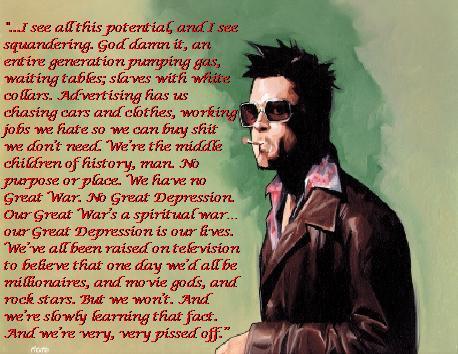
    “The things you own, end up owning you”
    – Tyler Durden (Fight Club)

    I’ve seen Fight Club about 58 times. It’s my favourite film. I love it so much I even had the above quote engraved onto the back of my iPod.

    In the film, Brad Pitt’s character Tyler Durden is a pretty heavy anti-consumerist. He is disturbed by the way people look for self-esteem and happiness in material things, and senses a better way.

    Tyler Durden Fight Club

    Was he right about materialism? Some researchers have been looking into the effects that materialism has on people. Here are five things everybody should know:

    1) High importance of money = low satisfaction with life

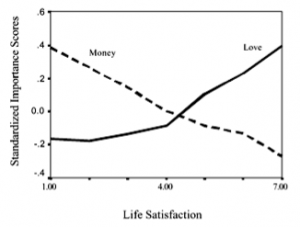
    Seven-thousand people, in 41 countries were surveyed about the importance they place on money, and on love.  When these were correlated against life satisfaction it looked approximately like this:

    money_love_happiness

    As you can see, unsatisfied people (to the left) thought money way important and love wasn’t, and satisfied people (to the right) thought the opposite. (1,4)

    2) Materialism is associated with mental health problems

    People who value financial success highly are more likely to report symptoms of depression and anxiety. Likewise, materialists have lower levels of self-actualisation and vitality, (2) and are more likely to be visited by ghosts at Christmas time. (3)

    3) Material goals can never be fulfilled

    First you want the iPod. Then the clothes, the car, the big house, the boat, the bigger house, the bigger boat. You get stuck on a hedonic treadmill; today’s luxuries are tomorrow’s necessities, as your income and consumption rise, so do your desires and expectations. It’s like moving to a higher weight division in boxing – you can do it, but there’s always a bunch of bigger guys there waiting for you.

    And if you combine high material aspirations with low income, you’re like a flyweight fighting a heavyweight. This is the worst combination of income and materialism you can have, in terms of well being. (4)

    4) You seek self-esteem in things

    Another study found a way to manipulate how important people think money is: they had people write out a list of their inadequacies. Once their failings had been literally spelled out for them, they thought money was more important. Their self-esteem had lowered, and they thought money could fill the gap.

    The problem with this, is that you’re rooting your self-esteem in things outside of your control. It’s unstable. So if you lose a load of money from, say, I don’t know, a stock market crash, you’re more likely to feel bad about yourself, feel unpleasant emotions, and so on. (5)

    5) Materialists live avoidance-based lives

    It seems that the link between materialism and poor quality of life can be explained through something called “experiential avoidance.” This refers to the tendency to avoid negative experiences, thoughts, and behaviours, rather than to seek out good ones. Experiential avoiders are focused on getting away from what they don’t want, as opposed to moving towards what they do want. (6)

    When the road to their goals and values is paved with the occasional negative experience, they tend not to walk the path, preferring to develop avoidance strategies. Ultimately, living in fear of negative thoughts, experiences and behaviours is associated with a number of negative mental health consequences, and is emotionally draining. This isn’t a black and white thing, and experiential avoidance may not be the defining feature of a person; but it tends to be more pronounced in people who have strong material desires.

    Unanswered Questions

    As satisfying as it would be to say that materialism causes all the above ailments, the evidence isn’t clear. All the above studies are correlational, so they can’t tell us what is causing what. It could be that people develop unhappiness, mental health problems or experiential avoidance first, and then turn to material goals as a way of coping, as in point 4. Clearly though, if this is the case, materialism doesn’t seem to be the answer.

    The Solutions

    How can we reduce materialism?

    1) Gratitude

    Grateful people are consistently found to be less materialistic, and when people are told to express more gratitude, they find themselves becoming less materialistic. The exact instructions given in one study, if you wanted to try this, were as follows:

    Please put your pen or pencil down, close your eyes,
    and consciously disengage from unpleasant mental and
    emotional reactions by shifting attention to the heart.
    For a few minutes, focus on sincerely feeling apprecia-
    tion for what you have been given in life. Now, in the
    space below please write about your experience and
    about some of the things that came to mind.

    Simpler gratitude exercises have been tested, such as each day writing down three good things that happened that day, and why they happened.

    Why does it work? Gratitude, as I mentioned before, tends to make people happier. It could be that more satisfied people don’t seek well being in possessions as much. (7)

    2) Meditation

    The difference between what you want financially, and what you have, is called your “aspiration gap.” The bigger your aspiration gap, the lower your well-being. Consumer culture tells you that, rather than reduce this gap, you should fill it with things. Another path, which is popular in Eastern philosophy, is to reduce your desire, learn to want what you have. (8)

    One way to do this is through mindfulness meditation.  I’m not qualified to give a run-down of how to meditate, but there are some good resources online: John Kabat-Zinn walks you through it in this video, and you can get guidance in mp3 format from Mental Workout (they are cheap: $1-2 each; I’m going through a few of their programs they seem pretty good so far).  Otherwise, just Google.

    3) Watch Fight Club 58 times.

    Worked for me.

    Recommended Reading:

    References:

    (1) Diener, E. and S. Oishi: 2000, ‘Money and happiness: Income and subjective well-being across nations’, in E. Diener and E.M. Suh (eds.), Subjective Well-beingacross Cultures (MIT Press, Cambridge, MA).

    (2) Kasser, T., & Ryan, R. M. (1993). A dark side of the American dream: Correlates of financial success as a central life aspiration, journal of Personality and Social Psychology, 65, 410-422.

    (3) Dickens, C. (1843). A Christmas Carol in Prose.

    (4) Diener, E., & Biswas-Diener, R. (2009). Will money increase subjective well-being?: A literature review and guide to needed research. The science of well-being: The collected works of Ed Diener (pp. 119-154). New York, NY US: Springer Science

    (5) Unpublished study, reported in (4)

    (6) Kashdan, T., & Breen, W. (2007). Materialism and diminished well-being: Experiential avoidance as a mediating mechanism. Journal of Social & Clinical Psychology, 26(5), 521-539.

    (7) Lambert, N., Fincham, F., Stillman, T., & Dean, L. (2009). More gratitude, less materialism: The mediating role of life satisfaction. The Journal of Positive Psychology, 4(1), 32-42.

    (8) Brown, K., Kasser, T., Ryan, R., Alex Linley, P., & Orzech, K. (2009). When what one has is enough: Mindfulness, financial desire discrepancy, and subjective well-being. Journal of Research in Personality

  • Does Happiness Lead to Success? Part 3: Health

    This series is discussing the idea that not only does success bring happiness, but happiness also brings success.  Previously, we found that happiness helps people to have better careers and better relationships.  Today, we’ll see that they also have better health, too.

    The authors of the paper put the question this way: “Is happiness associated with superior physical and mental health?”  I like the sound of that!  Superior physical and mental health – that has a nice ring to it, that’s definitely something I want.  In fact, that’s what I want on my gravestone: “Here lies Warren Davies. Had superior physical and mental health.”

    As with the previous two articles, I’ll show some of the findings from cross-sectional/correlational studies first (comparing happiness with health at one point in time):

    Mental Health and Happiness

    • Happier people have fewer symptoms of psychopathology (eg., depression or schizophrenia)
    • The absence of positive emotion is a distinguishing feature of depression
    • Happier people are less likely to suffer from social anxiety or phobia
    • Happy people are less likely to use drugs
    • Unhappy teens are more likely to show delinquent behaviour

    Physical Health and Happiness

    • Happy people have smaller allergic reactions
    • In one study, positive mood was associated with fewer visits to the hospital, less medication use, and other positive outcomes in people with sickle cell disease
    • Optimism is associated with less pain in ageing war veterans
    • Optimistic women are less likely to deliver low-birth weight babies

    Just like before, the above findings can only tell us that “happiness” and “superior physical and mental health” tend to occur together in people.  They can’t tell us what causes what, because measurements were only taken at one point in time.  Plus the mental health findings are pretty obvious – no one’s getting a Nobel Prize for those discoveries!

    So, here are the longitudinal study findings to save the day (studies trying to find out if more happiness now means better health later):

    • Happiness measures taken from 5,000 people were reliable predictors of how many days were missed due to illness, and days spent in hospital, over the next five years
    • People with higher positive mood had lower incidences of stroke 6 years later
    • Happy hockey players experience fewer sports-related injuries over the ensuing season
    • Happier people were found to be less likely to die in automobile accidents (!)

    There are a few more findings, but you get the point.  No doubt good health is a source of happiness, but interestingly, happiness is a source of good health and a long life too.  I’ll look at the reasons this might be in the next article, but it appears there are both direct and indirect effects.

    So now you know the different ways that happiness can improve your success in life, as well as the the other way around.  Generally speaking, happier people do better at work, earn more, have more friends, are luckier in love, and enjoy better health.

    In the next article we’ll look at how happiness is thought to bring these benefits. By the way, you can find more info on health and happiness here.

    This series was based on the below paper published in Psychological Bulletin by Sonja Lyubomirsky, Laura King and Ed Deiner – three big names in positive psychology.  It was a huge effort, they analysed 225 studies with over 275,000 participants in total!  All three researchers have books out so if you like the stuff in these articles, stick their names into Amazon and see if there’s something you like!

    Apart from the side-splitting humour, all the points in this article came from this reference.  If you’re looking for the original studies, get the pdf of the above reference and do a Ctrl+F (or Apple+F) to search for the finding you’re looking for.  Then find the study in their reference list.

    Recommended Reading:


    References: (1) Lyubomirsky, S., King, L., & Deiner, E. (2005). The Benefits of Frequent Positive Affect: Does Happiness Lead to Success? Psychological Bulletin, 131/6, 803–855
  • Does Happiness Lead to Success? Part 2: Love and Relationships

    This series is discussing the idea that not only does success bring happiness, but happiness also brings success.  Last time we found that happiness helps people to have better jobs and earn more money; today we’re going to see whether they enjoy better relationships too. I’ve already written articles on happiness as it relates to marriage, and social relationships, so I’ll just add a few extra findings today.

    Romance, Marriage and Happiness

    • One of the strongest findings in happiness research is the positive correlation between social relationships and happiness
    • Happy people tend to have more friends and more social support
    • Happy people are more satisfied with the friends they have and less prone to jealousy of other people
    • On the other hand, loneliness has a negative correlation with happiness, and a positive correlation with depression
    • Happy people are good for society – they spend more time volunteering

    More Evidence

    Just like last time, the above evidence in cross-sectional, which means you can’t determine from it what is the cause and what is the effect.  You need longitudinal evidence for that – studies that track a variable over time.

    Although studies tracking happiness and relationships over time are sparse, there are a few.  One paper reported that happier people received more emotional and tangible assistance from others, over a year after the happiness measures were taken.

    In terms of romance, it’s a two-way street  – if you’re happier, you’re more likely to find a partner and get married, and when you get married, you receive a boost in happiness that lasts over the long term.   For example, college yearbook entries for a sample of women were analysed for how much positive emotion they conveyed.  Amazingly, this could be used to predict how satisfied they were with their marriages, 31 years later!

    These findings fit into the authors’ theory that happiness is a signal to expand as well as a result of successful expansion – it’s a kind of dry way of putting it, but when you get married you effectively double your resources.  You pool tangible possessions, money, you both have access to more emotional support, meet new people from the other family and so on.  So it makes sense that marriage would bring happiness.  Oh yeah, plus there’s all the love, sex and mushy stuff too.  Let’s not forget that.

    So far so good for the theory – happiness can be a cause of social and romantic success, not just a result of it.  Next time we’ll ask whether happiness improves our health.

    This series was based on the below paper published in Psychological Bulletin by Sonja Lyubomirsky, Laura King and Ed Deiner – three big names in positive psychology.  It was a huge effort, they analysed 225 studies with over 275,000 participants in total!  All three researchers have books out so if you like the stuff in these articles, stick their names into Amazon and see if there’s something you like!

    Apart from the side-splitting humour, all the points in this article came from this reference.  If you’re looking for the original studies, get the pdf of the above reference and do a Ctrl+F (or Apple+F) to search for the finding you’re looking for.  Then find the study in their reference list.

    Recommended Reading:


    References:

    (1) Lyubomirsky, S., King, L., & Deiner, E. (2005). The Benefits of Frequent Positive Affect: Does Happiness Lead to Success? Psychological Bulletin, 131/6, 803–855