Month: December 2010

  • Does Happiness Lead to Success? Part 1: Work

    Let’s look at happiness from a different perspective.  Most people see happiness as a response to good things happening; a natural assumption to make, considering that when good things happen, it makes us happy.  But the evidence is piling up that happiness is also a cause of good things happening.  And by ‘good thing’, I don’t mean that people smile at you more because you’re cheerful, or some other pleasant but ultimately feebly benefit.  I mean a better career, more chance of finding love, better resistance to disease, and many other things.

    How is happiness supposed to bring success?

    road_to_success

    Happiness is a signal that things are going well.  You’re safe, you have access to the resources you need, and you’re making progress towards your goals – life is good.  When things are good, it makes little sense to put walls around you and carefully guard everything you have (a hallmark of ‘negative’ emotions).  It’s a better time to expand, take on new goals and challenges.

    Imagine you’re really rich.  A multi-millionnaire if you like.  Someone comes to you with a proposal for an investment.  It’ll cost you £10k, and it’s risky, but the return could be pretty good.  Do you do it?  Probably!  £10k is small change to you, you wouldn’t even notice the loss.  That’s an extreme example, but basically it’s a similar principle with happiness.  It encourages a person to expand, because the mind thinks opportunity is knocking.  Therefore happy people should get more success, because their emotional state essentially makes trying to succeed more appealing.

    Now the researchers in this field aren’t saying that the direction of causality is only from happiness to success.  This wouldn’t even logically follow.  If you got some success, your resources and abundance would increase, which according to this theory is one of the reasons you get happy in the first place!  So if it’s true that happiness contributes to success, it can only be true that success contributes to happiness as well.  So you could get a kind of upward spiral (though other things, like adaptation, complicate the matter).

    This series of posts is based on a huge analysis done in 2005 (1), see the footnotes for more information on the researchers.  They pulled together a huge amount of evidence together to see if this perspective on happiness holds up, and find that it does in three areas: work, love and relationships, and health.  Here we’ll look at work, but first let’s make sure we know what we’re talking about.

    What do they mean by ‘happiness’?

    The definition of happiness in this study was slightly different to the one normally used in studies (life satisfaction or subjective well-being, see what is happiness?).  The definition here, is the experience of frequent positive emotions, and less frequent (though not completely absent) negative emotions.

    Why this different definition?  Because in this framework, it’s positive emotion that leads us to pursue new goals and opportunities in the moment – rather than how pleased we are with life generally.

    So technically they are saying that success comes from from a happy state, not a happy disposition, but, a person with a happy disposition will be in a happy state more of the time.

    What is success?

    What do you think success is?  You might see success as lots of money and a family.  A man in the Mursi tribe of Ethiopia might see success as living to the age of thirty and marrying a woman with a 10″ ceramic plate in her lip.  So success means to do well relative to the goals valued by the society you’re in.

    As this study was done in the US, the researchers decided to use work, love and health as the markers of success.

    Work

    If you’re reading this from anywhere outside of a Western culture, let me assure you, we love to work!  Well, most people complain about work, but they still get up at 7am every morning to do it.  There’s very little I’d choose to get out of bed for at 7 in the morning, and yet I’ve woken up at that time and earlier, thousands of times, to go to work.

    “Most people complain about work; but still get up at 7am every morning to do it!”

    Work gets a bad rep, but it’s pretty normal human behaviour; even back in hunter/gatherer times we had to, well, hunt and gather.  We assume we did anyway, based on the tools and other goodies we’ve dug up.  I’ve never actually met a 40,000 year old person so I don’t really know for sure, but it’s a safe bet.  Work is just the name given to activities which allow people and groups to build their resources.  In modern life, we get tokens called ‘money’ in exchange for work, which we can exchange for the work of other people.  Work also (potentially) allows us to do something meaningful, and produce the things our society needs.

    Plus, as we live in a meritocracy, the better we are at work, the more we produce for society, the more money tokens you get and the more good stuff we can exchange them for.  That’s one of the reasons we want to do well at work.  So are happy people more successful at work than their unhappy colleagues, generally speaking?

    Happy Workers are Successful Workers

    happy_workers

    Here are some interesting findings about happiness in the workplace. Happier people:

    • Are more likely to get job interviews
    • Are more likely to receive positive evaluations once on the job
    • Are more productive
    • Handle managerial roles better
    • Have less ‘job burnout’
    • Tend to be more satisfied with their jobs
    • Earn more money

    It seems clear that happiness and success go hand-in-hand at work.  But these are all correlational studies, and you’ve probably heard the catchphrase “correlation does not mean causality.”  In other words, they may go together but we don’t know which is the cause and which the effect, or whether both are an effect of something else altogether.

    So more evidence is needed.  The next step is longitudinal evidence.  This is where something is measured at time 1, then something else (or the same thing) is measured at time 2.  In this case, the researchers looked for studies that measured happiness first, then symptoms of success months or years down the line.

    They found a few.  For example. after a job interview, happier people are relatively more likely to get a second interview three months down the line.  In another study, people with more positive emotion at age 18, were more likely to be financially independent, and generally doing well in their career.  The researchers also found that doing well in their career made the participants happy too – so the link between happiness and career is a two-way street, as expected.

    Happy people also earn more money tokens!  One study found that happier Australians were more likely to receive an income increase in the near future, compared to their less happy mates.  A similar result was found with a Russian study panel.  Yet another study found that students who were more cheerful in their first year of study were earning more money some 16 years later.

    In other words, more happiness now = more money and better career later.

    So, in terms of career and money, it seems that happiness is not just a consequence, but also a cause.  The idea that happiness causes success gets some support from the workplace.  Next time, we’ll look into love and relationships.

    This series was based on the below paper published in Psychological Bulletin by Sonja Lyubomirsky, Laura King and Ed Deiner – three big names in positive psychology.  It was a huge effort, they analysed 225 studies with over 275,000 participants in total!  All three researchers have books out so if you like the stuff in these articles, stick their names into Amazon and see if there’s something you like!

    All the points in this article came from the reference below.  If you’re looking for the original studies, get the pdf of the above reference and do a Ctrl+F (or Apple+F) to search for the finding you’re looking for.  Then find the study in their reference list.


    Recommended Reading:

    References:

    (1) Lyubomirsky, S., King, L., & Deiner, E. (2005). The Benefits of Frequent Positive Affect: Does Happiness Lead to Success? Psychological Bulletin, 131/6, 803–855

    Images:

    Roads and ‘Success’ by Toban Black, Happy Workers by fauxels.
  • Money and pain

    Some researchers have proposed that, because people can get through money certain things they can get through acceptance, money might act as a substitute for social acceptance. Since social distress and physical pain seem to have similar underlying mechanisms, a few interesting experiments have been done to test this idea. One study reports six experiments, which I’ll summarise briefly here.

    Money and pain might be linked (not just through paper cuts)

    Rejection

    Participants got together in groups of 4. They spent 5 minutes breaking the ice, then were led to separate rules and asked who they wanted to work with as a pair on an upcoming task. The researcher came back a little later, and randomly assigned the participant to one of two groups (method of random assignment was not mentioned). Either everyone wanted to work with them, or no one did.

    After that, participants’ desire for money was assessed in three ways. They were asked to draw a coin from memory (previous research shows people with a bigger desire for money draw bigger coins), they were asked whether they’d permanently give up certain pleasures for money (e.g, chocolate, the beach), and they were asked to donate to an orphanage. Participants who were in the rejection group drew bigger coins, were more willing to give up pleasures for money, and donated less.

    So social rejection appears to increase the desire for money, although maybe it’s negative emotions generally rather than rejection.

    Pain

    I love priming research. Just being exposed to words (sometimes so quick they are below conscious awareness) can have measurable effects on behaviour. Makes you wonder how much you’re being influenced by advertising and such as you go about your life (hope you’re enjoying the subheaders by the way!).

    So money and rejection might be linked, what about money and pain? They might too. Exposing people to words like headache, sore, and pain caused increased desire for money, as indicated by the coin task and the giving up pleasures task. So as expected, social rejection and physical pain both seem to trigger desire for money, or priming related to pain at least.

    More rejection

    Participants were first asked to “test their finger dexterity”, by either counting money, or plain paper. They they played a computerised ball tossing game (Cyberball), which they thought they were playing with other people by computer link-up, but really was a simulation. For some people, the computer included them, for others, it started excluding them from the game after 10 throws (never trust a psychologist. They’re always up to something). Measures were taken of distress, positive and negative affect, and self-esteem.

    What happened? People who had just counted money reported less distress and higher self-esteem after just being excluded. Maybe that’s why Scrooge took so long to change his ways – the money was a slight buffer against exclusion.

    More pain

    I’m probably going to put people off of ever taking part in psychological research by writing this. Another test of money and pain, similar set up to last time. Participants (or should we call them subjects?) counted money or paper, this time followed by a pain task – hand immersion in water at 50 degrees C. Then they rated how painful it was and took a mood scale.

    Counting money prior to the task reduced self-reported pain. So now you know what to do before your next flu jab. There was no overall effect on mood.

    Losing money, and being rejected

    Maybe the previous results were due to being distracted by the money. To test this, the researchers tried to bring up feelings of losing money, and then exposing people to rejection (Cyberball again). Half of the participants wrote about what they’d spent recently, half wrote about the weather.

    As you’re expecting by now, distress from Cyberball was higher in people who had just been writing about their expenditures. This also goes along with the main idea that money can be a proxy for social acceptance – soon after it’s gone (or you perceive it as going), the sting of rejection hits you harder. Unemployment must be a tough time.

    Losing money, and pain

    You get the idea by now – participants did the writing task from the previous test, followed by the hot water test from the one before that. Losing money and pain were also linked. People who had just been reflecting on the money they spent over the last 30 days reported that the water was more painful than people who had been reflecting on the weather.

    These studies fit the general idea that money helps people to cope. Maybe it gives you a sense that, if something went wrong you’d be able to handle it, in much the same way that having close friends does. Since social rejection and physical pain seem to be closely intertwined, this proxy effect seems to carry over to that, too. Note that it’s a general sense of being able to cope that money provides, because in none of these studies would money be any help at all (unless you pay people to throw balls to you). And the effects seemed to be specific to rejection and pain, as the mood scores were not affected by the tests.

    It’s interesting that we can be influenced subtly by symbolic and abstract things like money (or thinking about money). If these results are correct, and because of the repeat occurrence of the words ‘pain’ and ‘rejection’, presumably most people reading this article will be feeling a stronger desire for money right now than the people who chose a physics one. Maybe you’re one of them.

    Need a hug?

  • The impact of 9/11 on American character

    Let’s have some fun and pick apart a paper (try saying “pick apart a paper” 10 times fast!)

    The question is, did 9/11 impact the character of Americans? I mean that personally not just in political attitudes towards this or that. It’s a tough question to answer empirically.

    “What do you mean by character?” is the obvious first hurdle. Peterson and Seligman (2003) had a go, using their VIA model. They have a website, authentichappiness.com, where people can take a VIA self-report strengths test. I’ve discussed this model previously, here’s an overview, and here’s a comparison to another model of strengths. Your interest in the rest of the article will depend on how suitable you think that tool is to answering this question. It’s pretty new and quite easy to pick it apart (see the previous posts and comments).

    So, thousands of people log in to that site and take the strengths test, giving the researchers a good opportunity to compare the results pre and post 9/11. First they looked at the 30 days before compared with the 30 days after 9/11. They found an overall difference, and then narrowed down to look at individual strengths. This is a part I’m confused about. There are 24 VIA strengths in this model, but they used a p value of .01. Surely they should have used .05 / 24 = .002? I’ve looked through the paper several times and can’t see a justification for using .01, it seems pretty arbitrary.

    Anyway, using .01 they found significant differences for the strengths of gratitude, hope, kindness, leadership, love, spirituality and teamwork. Kind of interesting, teamwork makes sense, maybe you’d expect a drop in things like hope straight after a terrorist attack.

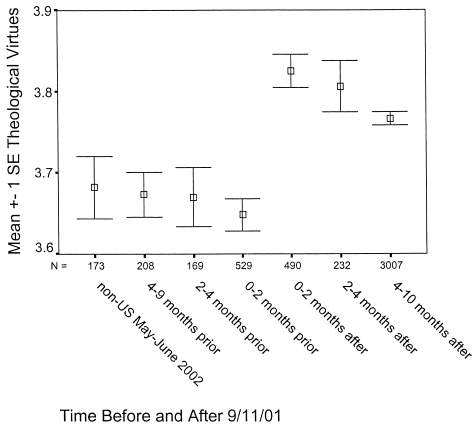
    When testing longer time periods, they stuck to the strengths that were significantly different in the month immediately after “For the sake of convenience”. Here are the results (this is a composite measure of the strengths identified in the first analysis which they name “Theological Virtues”):

    At first glance 9/11/01 is clearly separating this increase. But how big is the difference? Effect sizes are not reported in the paper. As you can see in the graph, the difference is from about 3.7 to 3.8. What does it mean to be .1 higher in a combination of gratitude, hope, kindness, leadership, love, spirituality and teamwork? Does that mean anything in real terms, or does the difference only exist statistically? Even then, the exact p value is not given, in favour of “ps < .05". So we're back to .05 now, even though they say they tested each of the pre to each of the post time-points (12 tests), and presumably the ps are between .01 and .05 otherwise why not say < .01, or less than .001? We should also note that the sample sizes are massive - 4510 participants overall, which cannot help but contribute to lower p values, regardless of real-world effects. Anyway, even if this result was correct, maybe it isn't truly representative of the nation. As I mentioned, these results were from people who found the website (not a controlled sample). "Walk-ins" you might say. Another explanation is, after 9/11, people with more hope, leadership, gratitude etc., were more inclined to seek out and complete questionnaires of this type. I started by asking whether 9/11 affected the character of Americans. The answer is, "Who knows?" Saying that 9/11 gave Americans more gratitude, hope, kindness, leadership, love, spirituality and teamwork is a nice story, but I don't think these results really show that. Reference: Peterson, C.,&Seligman, M. E. P. (2003). Character strengths before and after 9/11. Psychological Science, 14(4), 381-384.

  • Battle Of The Strengths: Values In Action Vs StrengthsFinder

    These two dominant models of strengths are slightly different in concept.  Gallup’s Strengthsfinder is more workplace-oriented, helping people to do better in their careers and organisations to work better.   Perhaps performance-oriented is a better term.  Values In Action (VIA), which we looked at in depth earlier, is character-oriented, helping people to achieve virtue.

    First of all, I should say that StrengthsFinder doesn’t measure something Gallup calls ‘strengths’.  They measure ‘talents’, which are defined as natural ways of thinking and behaving, and by adding skills and knowledge, they say talents can become strengths, which they define as consistent near-perfect performance.  Since SF talends and VIA strengths are the same thing, I’ll just call talents strengths for consistency.

    Given these basic conceptual differences, I wondered whether their respective questionnaires would return slightly different results. If you look at the list of strengths below, you’ll notice there are overlaps, but maybe these labels aren’t measuring the same psychological constructs. Maybe ‘Positivity’, measured with the workplace in mind is different to ‘Optimism’ measured with virtue in mind.  Here’s the list of strengths in each model:

    StrengthsFinder

    Achiever
    Activator
    Adaptability
    Analytical
    Arranger
    Belief
    Command
    Communication
    Competition
    Connectedness
    Context
    Deliberative
    Developer
    Discipline
    Empathy
    Consistency
    Focus
    Futuristic
    Harmony
    Ideation
    Includer
    Individualization
    Input
    Intellection
    Learner
    Maximizer
    Positivity
    Relator
    Responsibility
    Restorative
    Self-Assurance
    Significance
    Strategic
    Woo

    VIA

    Wisdom and Knowledge
    Creativity
    Curiosity
    Judgment, Open-Mindedness, critical thinking
    Love of Learning
    Perspective, wisdom
    Courage
    Bravery
    Perseverance, industriousness
    Honesty, authenticity, integrity
    Zest
    Humanity
    Capacity to Love and Be Loved
    Kindness, generosity and nurturance
    Social Intelligence
    Justice
    Teamwork
    Fairness
    Leadership
    Temperance
    Forgiveness & Mercy
    Modesty & Humility
    Prudence
    Self-Regulation, self-control
    Transcendence
    Appreciation of Beauty and Excellence
    Gratitude
    Hope, optimism, future-mindedness
    Humor
    Religiousness & Spirituality

    The bold headings for the VIA are the virtues, the strengths below them are the routes to expressing that virtue.  These categories were not empirically determined, although there are arguments as to why they’re distributed as such.

    “The VIA strengths are meant to be positive and wholesome; StrengthsFinder is all about performance.”

    The first thing you’ll notice is that there are more strengths in the StrengthsFinder, but the second thing you’ll notice is that the VIA model has no compunctions about grouping similar strengths under one label.  Most of the time they are similar, but some of them I feel might be better off  separated.  For example, ‘hope’ and ‘optimism’ are similar but not quite the same thing; hope accepts the possibility of failure where as optimism is almost dismissive of failure.  And ‘future-mindedness’ is put under the same label, even though if you were future-minded and pessimistic, your forward thinking nature could be called a strength but it wouldn’t be picked up as well by the VIA questionnaire.

    The VIA strengths are (primarily) meant to be positive and wholesome, to not have potential to detract if not used or attract jealousy when they are.  If more people exercised these strengths, the world would be a better place, both for the individuals and the people they affect.  This is kind of the point.

    StrengthsFinder is (primarily) about performance, becoming more effective and more productive.  This does not mean you can’t be virtuous with the StrengthsFinder strengths or effective with VIA: it’s just worth keeping in mind the intentions of the models when you’re deciding which one to use either for your self or in applied settings.

    For example, I’ve argued elsewhere that it’s a good idea to stick to your strengths, on the basis that maybe we can’t “Do anything we set our minds do,” and even if we can we have to take the quality of the journey into account, and it’s less satisfying against the grain (though to be fair the experimental evidence is still a little thin).  But with the VIA model based on building character, you might find something like love or honesty at the bottom of your profile.  It seems incorrect to say to someone “Forget being honest; it’s not your strength so you might as well just lie to people!”

    If your aim is to improve your performance in some domain, it might make more sense to go with StrengthsFinder or use common sense when interpreting your VIA profile; focus on the top strengths, but be aware there might be benefit in developing weaknesses of character while there’s possibly less benefit in developing performance-based weaknesses.

    As I said before, there is a lot both models agree on.  Ultimately, it’s impossible to know whether the strengths listed in both models relate to the same things without looking at both questionnaires, and doing a dedicated study and analysis – which hasn’t been done as far as I am aware, because the Gallup StrengthsFinder is copyrighted intellectual property.  But I expect they are very close, so out of curiosity I did my own experiment; I took both tests to compare the results.

    I went to the Authentic Happiness site to take the VIA Inventory of Strengths, then the next week I took StrengthsFinder 1.0, using the code from a Now, Discover Your Strengths book.  The Authentic Happiness website stores your results, so I intentionally didn’t look at them after I’d finished so as not to unconsciously influence my answers to the StrengthsFinder.

    With a sample size of 1, my experiment is flawed, but still, the results were pretty interesting.  These are my profiles:

    My VIA Strengths

    Curiosity and interest in the world – You are curious about everything. You are always asking questions, and you find all subjects and topics fascinating. You like exploration and discovery.

    Love of learning – You love learning new things, whether in a class or on your own. You have always loved school, reading, and museums-anywhere and everywhere there is an opportunity to learn.

    Hope, optimism, and future-mindedness – You expect the best in the future, and you work to achieve it. You believe that the future is something that you can control.

    Judgment, critical thinking, and open-mindedness – Thinking things through and examining them from all sides are important aspects of who you are. You do not jump to conclusions, and you rely only on solid evidence to make your decisions. You are able to change your mind.

    Caution, prudence, and discretion – You are a careful person, and your choices are consistently prudent ones. You do not say or do things that you might later regret.

    My StrengthsFinder Strengths

    Harmony – You look for areas of agreement. In your view there is little to be gained from conflict and friction, so you seek to hold them to a minimum.

    Intellection – You like to think. You like mental activity. You like exercising the “muscles” of your brain, stretching them in multiple directions. This need for mental activity may be focused; for example, you may be trying to solve a problem or develop an idea or understand another person’s feelings.

    Futuristic – “Wouldn’t it be great if . . .” You are the kind of person who loves to peer over the horizon. The future fascinates you. As if it were projected on the wall, you see in detail what the future might hold, and this detailed picture keeps pulling you forward, into tomorrow.

    Learner – You love to learn. The subject matter that interests you most will be determined by your other themes and experiences, but whatever the subject, you will always be drawn to the process of learning.

    Focus – “Where am I headed?” you ask yourself. You ask this question every day. Guided by this theme of Focus, you need a clear destination. Lacking one, your life and your work can quickly become frustrating.

    I have to say, these are pretty accurate for me.  Curiosity and love of learning are probably my main drives, tempered by my caution and critical thinking.  So I’m curious about the world and how it works, but I don’t go jumping in caves just to see what’s in them, and you won’t find me at tarot card readings.  I also like to know as many facts as possible before making a decision, and get a both sides of a story.

    My StrengthsFinder results propose harmony, which is true, I’m the “can’t we call get along?” type, and focus which is also accurate as I’m more of a ‘choose a destination and go there’ person than a ‘go with the flow’ type, which is probably where the futurism comes from.  Harmony also apparently covers looking for harmony between ideas as well as within groups.

    So, it seems you now have me at a disadvantage; you know so much about me, and I know so little about you.  All I know is that odds are, you live in the UK or US, are viewing this site with Microsoft Internet Explorer, and will stay here for 5-15 minutes before you move on.  Doesn’t seem quite fair…

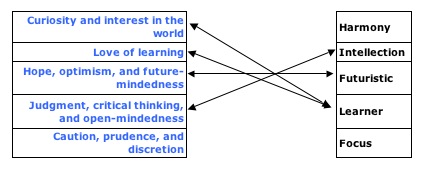
    Anyway, the strengths that appear in each output are very comparable. The outputs are roughly the same, but flipped. Look at it this way:

    strengthscomparison

    In most cases, the questionnaires results have equivalents.   You could make a case that ‘Hope and Optimism’ is similar to ‘Focus’, but it’d be a weak one; focus is more about getting to a certain place in the future rather than having a time-perspective pointing that way most of the time.  ‘Caution’ and ‘Harmony’ have no equivalent, although my 6th strength on the VIA list is ‘Forgiveness and Mercy’, which is similar to Harmony.

    Even though this proves nothing generally, maybe both questionnaires are measuring similar things. It also makes it easier to recommend one; if they are measuring similar things, go for the VIA at Authentic Happiness – it’s free. If you want to try StrengthsFinder, you’ll need a code from the book StrengthsFinder2.0 to take the latest version of the test (my results above came from version 1.0).

    If you do take one of the tests, I dare you to put your results in a comment.  I’ll feel less exposed. 🙂

  • Happiness and music

    Music has a remarkable ability to conjure up strong emotions in people.  It can cheer you up, bring you down, and in the case of boybands, cause severe anger and disgust.  And it’s old; some scientists believe music even predates language, this based on flute-like instruments dug up in France, believed to be over 50,000 years old.  But music is a bit of an evolutionary puzzle.  It’s hard to think of any survival value it may have brought us; a niche it filled better than any other human faculty.  So why do we love music so much?  What’s going in inside our skulls when we hear music we enjoy?  What music makes the best pick-me-up?

    Happy music = Music you like

    Starting with the latter question, there are a few ways to figure out scientifically what happiness-inducing music might be.  The first would be to give people a CD containing music of different varieties, and measure their happiness before and after a week-long listening binge.  This hasn’t been done yet, to my knowledge.  The second way would be to hook people up to devices that measure their physiological state, and play them different types of music to see what happens.  A few studies like this have been done: here’s an example.

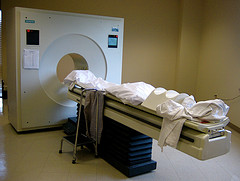
    PET scan

    Music-lovers were given a PET scan while they listened to one of their favourite pieces of music; something that gave them the “chills,” or “shivers-down-the-spine.”  One participant chose Barber’s Adagio, which, rather freakishly, my itunes just started playing as I write this.  Fair enough, I happen to be listening to The Most Relaxing Classical Album of All Time (classical music is the only type that doesn’t distract me from writing), but still…

    Back on track.  When you listen to music, it’s processed in brain areas associated with, among other things; language, memory (short- and long-term), and emotion.  But when that music is something you really like, something that gives you chills, the brain areas involved in pleasure and reward light up too. (1)


    These reward circuits turn on when you eat, have sex, or do pretty much anything that’s naturally rewarding.  They are also activated directly by many drugs, which is partly why these drugs are so addictive.  In this study, brain activity when the music was played was similar to that of euphoria and pleasant emotions.  The areas the music activated are crammed with opioid receptors (eg., endorphins).  In fact, another study found that blocking these opioid receptors with a drug called naloxone reduces the chills people get from music. (2)

    But this is definitely all happening through music to your own taste – when the participants listened to ‘control’ music, that they didn’t choose themselves, there was less brain activity in these areas and fewer reports of chills.  So using music to bring pleasure and happiness requires a knowledge of your own personal tastes.

    Music and Happiness

    These internal goings on are all very interesting, but “music you like makes you happy” doesn’t really satisfy as an answer.  It’s obvious: of course the music we like makes us happy.  That’s why we like it.

    Does Jazz Flute make you happy?

    What we’re really asking is, what type of music, on average, brings out the most positive emotion in people.  Accounting for taste is easy – you just average it out with large enough sample sizes, and look at the trends in the data.  This is how psychology studies are typically done.  It’s not a ‘hard’ science like physics, so researchers drown out individual differences with big sample sizes.

    So, what’s the utilitarian approach to happiness music?  If you had a group of people, and you want to make the group a little happier overall, what’s your best bet?

    happy_baby_headphones

    Well, some studies compared different aspects of music with emotion and physiological responses.  Although there were some connections, for example, up-tempo music in a major key evoked similar responses to positive emotions, and consonant music was rated more pleasant than dissonant (3), as one paper pointed out, “this [preference for consonance] presumably indicates that listeners have internalized the tonal rules of music in their culture and react to violations of these rules.” (2, p383)

    So for now at least, we might be stuck with the subjectivity answer.  There is some evidence that our musical tastes may be innate, for example, 4 month-old babies seem to prefer consonant to dissonant music (4), but the evidence doesn’t seem conclusive.  What I really wanted, but didn’t find, was a study comparing the effects of different genres on various emotions.  Does jazz flute make you happy?  Does emo make you depressed?  Do boybands make you want to puke?  Big questions, but apparently, scientists have not yet considered them a valuable addition to the knowledge base.

    Music and Memories

    As mentioned earlier, listening to music activates brain areas associated with memory.  I’m sure you have some songs that remind you of the good times – a holiday, a particular person, a bar you used to like going to.  Memories work by association, and when you hear these songs the brain areas associated with the memory turn on too, sometimes bringing back feelings along with the memories.

    In How to be Happier, I mentioned a study on reminiscence.  It’s a strange thing to consider, but people who spend 10 minutes or so per day reminiscing about good memories of the past, became more satisfied with their life in the present.  Some participants were asked to use items to aid their reminiscence; trinkets from the past that ‘brought back memories’.  I don’t see a reason that music couldn’t do the same thing.

    Music and People

    As I’ve said before, building social relationships is among the biggest – if not the biggest – things people can do to become happier.  So by extension, music will make people happier if it’s part of some social event. This will include live music, playing music in a band, or anything that involves other people as well as music.

    What kind of music can make you happier?

    • More than any specific type of music, music that’s to your own taste is most likely to bring pleasant emotions
    • Songs that bring back happy memories may also work, if you reminisce while listening
    • Live music will also work, if you take your friends along with you
    • Failing all the above; if you’ve been exposed to western culture: consonant, up-tempo music in a major key, is the best choice

    References:

    (1) Blood, A. J. & Zatorre, R. J. (2001). Intensely pleasurable responses to music correlate with activity in brain regions implicated in reward and emotion. PNAS, 98(20), 11818-11823

    (2) Goldstein, A. (1980). Thrills in response to music and other stimuli. Physiological Psychology, 8, 126 –129.

    (3) Blood, A. J., Zatorre, R. J., Bermudez, P. & Evans, A. C. (1999). Emotional responses to pleasant and unpleasant music correlate with activity in paralimbic brain regions. Nature neuroscience, 2 (4), 382-387.

    (4) Trainor, L. J., & Heinmiller, B. M. (1998). The development of evaluative responses to music: Infants prefer to listen to consonance over dissonance. Infant Behavior & Development, 21, 799–806.

    Images:

    PET scan by Muffet

    Rockin’ Baby by Beaukiss Steve

  • Flowers = Happiness? The emotional impact of plants

    In positive psychology, most theories of positive emotion have focused on discovering their relative costs and benefits to humans. These theories, to a greater and lesser degree, see positive emotions as being evolved adaptations to our environment. Greater mood brings wider though-action repertoires, allowing us to build our resources (1), they regulate our motivation to work towards goals (2), and when in the right balance with negative emotions, provide optimal conditions for mental health (3).

    But all life on Earth is intertwined; could it be that our positive emotions exist not only for our own benefit, but to the benefit of other species, too? Researchers Haviland-Jones, Rosario, Wilson and McGuire (4) argue that they do. What species could be manipulating our positive emotions to their advantage? Could it be the intelligent dolphin? Man’s best friend, the dog? Or perhaps our closest cousin, the chimpanzee?

    Nope. It’s the simple flower!

    flowers_happiness
    Do these flowers cheer you up?(Credit: Per Ola Wiberg)

    The logic behind this argument is that there is an evolutionary ‘niche’ open for species that can elicit emotional rewards in mammals. The first step towards testing this idea, is to establish an emotional connection between humans and flowering plants; something romantics have known for centuries!

    In a series of studies, Haviland-Jones et al report that:

    • When women were given flowers, they always responded with a ‘real’ duchenne smile, and reported more positive moods three days later.
    • When men or women were given a flower, they responded with a duchenne smile and engaged in more prosocial activities (compared to control conditions of being given a pen or nothing).
    • Flowers given to elderly people resulted in more positive mood and improved episodic memory!

    The researchers also reported other “unusual emotional displays that they were unprepared to measure,” (4, p122), including:

    • Hugs and kisses.
    • Invitations to participants’ homes for refreshments.
    • ‘Thank you’ cards and letters – some with photographic evidence of the continuing beauty of the bouquet.

    As they sum up – “In many years of studying emotions, we have never received hugs and kisses, thank you notes or photographs, not even for candy, doghnuts, hats, gift certificates, or direct monetary payment; flowers are different.”

    blue_daisy
    What about this one? (Credit: Flowery *L*u*z*a*)

    These findings are difficult to account for using the theories under the positive psychology umbrella. The emotion does not seem to be relevant to a goal process, or related generally to receiving a gift. And why would the presentation of flowers bring a broadened thought-action repertoire? Perhaps something to do with Fredrickson’s cognitive maps; as flowering plants were part of our ancenstral environment, could their presence trigger a positive emotion to allow greater awareness and therefore knowledge of the environment?

    Haviland-Jones et al suggest three better explanations:

    1) Learned associations between flowers and happiness from positive social events

    Possibly true, but typically the socialisation of positive emotions and flowers is specific to women, and the studies also found effects in men. Additionally, learned associations do not account for the prevalence and meaning given to flowers cross-culturally. Still, this can’t be ruled out without studies in cultures that place little or no significance on flowers – if there are any.

    2) Evolutionary food association

    Rather than a positive social event, perhaps flowers are associated with potential foraging success – as they signal the current or future availability of nuts and fruits; nutritionally dense foods.

    3) Flowers evolved as human mood enhancers

    Perhaps the sensory aspects of flowers directly influence positive human moods. This reaction to flowers would be expected without learning an association between flowers and happiness, but would make learning such an association easier.

    How could this all be working? Emotional processing occurs in a specific part of the brain, based on certain ‘rules’ applied to the input to this area. Over vast periods of time, and where it is in their interest, organisms attempt to access the ‘rules’ of other organisms and adapt to them. It’s a kind of evolutionary cold war, all happening through the trial and error of natural selection, without any conscious or deliberate direction (an important point).

    Flowers have adapted to our preferences in a number of ways, it seems. We have a preference for symmetry, we have a preference for certain colours, and we may also have a preference for certain smells. These preferences all evolved for specific purposes (pattern recognition, to distinguish between high- and low-protein leaves, etc), but because they are general preferences, we would not necessarily need to be exposed to a flower to be attracted to it – it is configured in a way that our brain ‘likes’, which triggers the release of chemicals that result in our positive emotions.

    happiness_flowers
    I’m kind of limited in the range of pictures I can provide you with in this article. Here are some more flowers. (Credit: o b s k u r a)

    This may be serendipitous though, because the smells, colours and shapes of flowers may have evolved to attract the birds and insects with which their cross-species pollination efforts are usually associated. Either way, this configuration appears to be beneficial to the plants; for many species of plants, humans are the main agents of seed dispersal, even those that have no nutritious or medicinal value. They have discovered the secrets of our positive emotional response mechanisms, and have adapted themselves to exploit it. We’re being manipulated!

    Although this idea is far from confirmed, and there are a lot of unanswered questions, the theory does provide an interesting angle on positive emotions that we maybe don’t consider in positive psychology. When we think of the purpose of positive emotions, we immediately think “How do they benefit us?” But for a fuller picture of the role of positive emotions, we might have to think about how they benefit other species, too.

    References:

    (1) Fredrickson, B. (2001). The role of positive emotions in positive psychology: The broaden-and-build theory of positive emotions. American Psychologist, 56(3), 218-226.

    (2) Carver, C., & Scheier, M. (1990). Origins and functions of positive and negative affect: A control-process view. Psychological Review, 97(1), 19-35.

    (3) Fredrickson, B., & Losada, M. (2005). Positive Affect and the Complex Dynamics of Human Flourishing. American Psychologist, 60(7), 678-686.

    (4) Haviland-Jones, J., Rosario, H. H., Wilson, P., & McGuire, T. R. (2005). An Environmental Approach to Positive Emotion: Flowers. Journal of Evolutionary Psychology, 3, 104-132.

  • Some Thoughts And Questions On Csikszentmihalyi’s Flow

    ‘Flow’, or the ‘flow state’, refers to what you might know as being ‘in the zone’. It is that state where you are wrapped up in the activity that you are doing, so much so that you are ‘one’ with it (in the sense of being fully engaged that is; not a strange zen thing).

    The main researcher of flow is the delightfully unpronounceable Mihaly Csikszentmihalyi (Chick-sent-me-high). Generally it is associated with more intrinsic motication for the activity in question, and although you lose sense of yourself and time while you are in flow, you are said to return with a stronger sense of self afterwards.

    Conceptualisation of Flow

    Flow is certainly a broad concept that can be applied in a number of fields, from education to sport. It has also been studied in a number of different countries, mainly the US and Italy, but also in Japan (Sato, 1984). This suggests that although the context of flow might differ from place to place, the experience may be universal, or at least ubiquitous.

    These cross-cultural studies are important because flow was defined initially through interview with people. So these people are giving their subjective interpretation of the state and not necessarily an accurate description of the objective state of flow (if there is one). For instance, my description of flow is limited by my vocabulary. So to really say that the state is universal, more studies of non-English speaking countries could be conducted, each with their own cultural nuances and language, not to mention non-rich countries.

    However, another perhaps more important step is to measure the physiological and neurological correlates of flow. Although I could not find a direct study of this, I would propose that the flow state may be characterised by activation in the dopamine system, in the ventral tegmental area of the brain. Such brain activity is thought to be important in attention, particularly with ‘important’ stimuli (Donahoe and Palmer, 1993), and there is some evidence that this activity is involved in tasks that you might expect to produce flow (eg, video games; Koepp, 1998). But, I could not find one that measured flow at the same time.

    This idea makes some theoretical sense also, as dopamine serves to label stimuli as appetitive, and is associated with pleasurable feelings. This might support the suggestion that flow is a state of ‘ecstasy’ that we like to return to – but would beg the question of whether the dopamine release is ‘tagged’ to the state, the activity, or both.

    Theoretical issues of flow

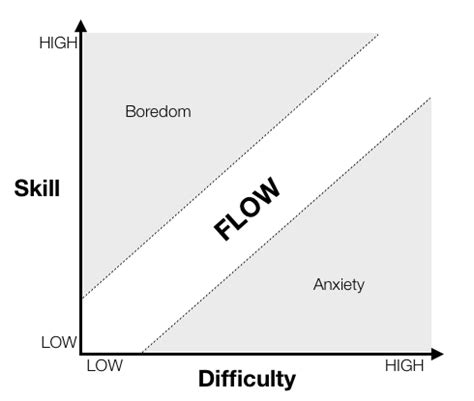
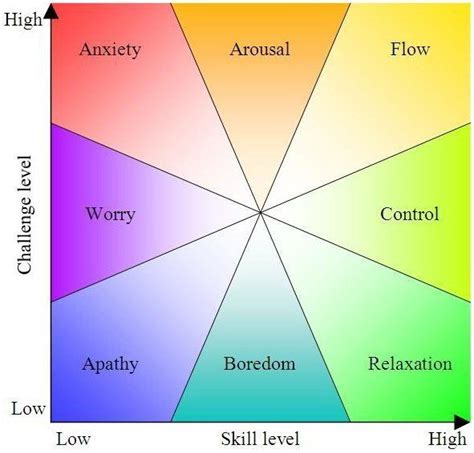
    Flow is theoretically the result of a certain balance between challenge and skill (or resources), and the theory is presented as a general model that covers all behaviours. But does a high level of challenge and skill always result in flow? Also, are there any differences in the level of skill required for flow to occur, or is it always context-specific?

    For instance, the flow model began life by stating that one simply had to match skill with challenge – even if they are low.

    Later, this section of the model was labelled ‘apathy’, due to inconsistent results.

    Additionally, some studies have failed to find a difference between the flow state and the boredom/relaxation state in terms of the constituent factors that make up flow (eg concentration and intrinsic motivation; Ellis et al, 1994). Perhaps these inconsistencies were due to individual differences rather than a fault in the model. Or perhaps the flow state only results from certain types of activity.

    Measuring Flow

    ESM is usually used to measure flow. “Experience Sampling Method” is where participants in studies get a pager, which beeps through the day, usually at somewhat random intervals, and they answer question then and there on what they are doing, how they feel etc. The ESM method is quite an innovative way of measuring flow, but it relies on self-report, and therefore an individual’s interpretation of their state, rather than an objective measurement of that state itself. The data from ESM are assumed to be valid, from what I could tell. To further validate measurements of flow, self-report measurements could be correlated with neurological measurements taken while a person is performing an activity which is reported to generate flow.

    I’m don’t think studies have already been done though. Or at least, I couldn’t find any if there are – please leave a comment below if you know of any!

    References:

    Donahoe, J.W. and D. C. Palmer (1993). Learning and Complex Behavior, Allyn and Bacon.

    Ellis, G. D., Voelkl, J. E.,&Morris, C. (1994). Measurements and analysis issues with explanation of variance in daily experience using the Flow model. Journal of Leisure Research, 26, 337–356.

    Koepp, M. J. (1998) Evidence for striatal dopamine release during a video game, Nature, 393, 266-268

    Sato, I. (1984). Bosozoku no Esunographi [An ethnography of motorcycle gangs]. Tokyo: Keiso Shobo. (I admit I have not actually read this!)

  • Terror Management Theory – I don’t want to die! (But I do want to shop…)

    One of the most common forms of self-medication in capitalist societies surely has to be retail therapy. Is there really a problem that can’t be solved by a new pair of shoes, or the latest iWhatever? Interestingly, one of the problems people might be trying to overcome is the fear of death.

    The insecurity and anxiety caused by the fear of death has some interesting effects on people. When people are reminded of their inevitable demise, they become more rooted in their outlook on life, this is called Terror Management Theory. For example, we start to see people with similar values and beliefs more positively, and people with different beliefs more negatively than we ordinarily would (1). We also become more reluctant to use cultural symbols like flags in improper ways (2).

    Since some of the more salient values of Western culture are materialistic in nature – earn more money, accumulate more stuff, etc., – it might be the case that being reminded of our mortality makes us more materialistic, as we move deeper into our adopted values.

    Local businesses attempt practical application of Terror Management Theory (Newsbie Pix)

    Tim Kasser and Ken Sheldon did a couple of studies in 2000 to look into this (3). The exercise they used to induce mortality salience is just about as unpleasant as you’d expect – participants had to write about their feelings about the own death. The control group wrote about listening to music, which is obviously does not increase your awareness of death (unless your favourite band is Cannibal Corpse, perhaps).

    After this, the people who wrote about death expected to be earning more in 15 years than the controls, and expected to be spending more money on “pleasure items.” In a second study, participants played a forest management game, and after writing about death, people were more willing to use up the resources of the forest, and were more interested in making profit. Curiously, another study found that materialistic people have more dreams about death (4).

    Playing a game does not mean they would act this way if they were really head of a timber company, but it’s an interesting behavioural measure to go along with the self-report. There might be some parallels to other low-consequence scenarios (cutting yourself a larger slice of pizza, for example!). Maybe. The aim here was to investigate greed, a typical characteristic of materialistic people.

    So although a self-report and imagined exercise are not definitive, they at least give an idea of the direction of causality, to go along with correlational data linking materialism with concerns about one’s death (5) – this study also found partial mediation of the relationship by insecurity, which fits with the general idea that higher materialism comes about to make up for some personal insecurity, which itself can be triggered by the fear of death.

    You could make some speculations linking these ideas to George Bush’s advice to go shopping following the 9/11 attack. People have their own theories on why W gave that advice, which we won’t go into here, but maybe here’s an idea on why people were so ready to take the advice.


    References:

    (1) Greenberg, J., Pyszczynski, T., Solomon, S., Rosenblatt, A., Veeder, M., Kirkland, S., et al. (1990). Evidence for terror management theory II: The effects of mortality salience on reactions to those who threaten or bolster the cultural worldview. Journal of Personality and Social Psychology, 58(2), 308-318.

    (2) Greenberg, J., Porteus, J., Simon, L.,&Pyszczynski, T. (1995). Evidence of a terror management function of cultural icons: The effects of mortality salience on the inappropriate use of cherished cultural symbols. Personality and Social Psychology Bulletin, 21(11), 1221-1228.

    (3) Kasser, T.,&Sheldon, K. (2000). Of wealth and death: Materialism, mortality salience, and consumption behavior. Psychological Science, 11(4), 348-351.

    (4) Kasser, T.,&Grow Kasser, V. (2001). The dreams of people high and low in materialism. Journal of Economic Psychology, 22(6), 693-719.

    (5) Christopher, A., Drummond, K., Jones, J., Marek, P.,&Therriault, K. (2006). Beliefs about one’s own death, personal insecurity, and materialism. Personality and Individual Differences, 40(3), 441-451.

  • The Values In Action (VIA) strengths model – can character be measured?

    One of the main areas of research in positive psychology is the search for positive traits of character, aka ‘strengths’. There are a few models of strengths out there now, such as Gallup’s workplace-oriented StrengthsFinder model (if you’ve seen the book ‘Now, discover your strengths’, that what that is all about), and the more recent Realise2 model from the Centre for Applied Positive Psychology. I’ll look at a different one here, the “Values in Action” model, or VIA, which was sort of the flagship project of pos psych. I might write something about the others another time, but it’ll be hard since Gallup are stingy about releasing their data (it’s a commercial product) and I know little about Realise2.

    Can character be studied?

    I think the actual question here is, does character exist? Some people, like the social constructionists, say no; essentially there is no character, it’s just a social construction, and the language a society has influences our perception of it. From this view, whatever the biases of the researchers are (conscious or not) will end up being what they find. More on this later. But, if character is real, and if there is consistency to it over time and across situations, then surely you can study it (assuming you can measure it too).

    What is a strength?

    The VIA model looks at character as a family of traits, which exist in different degrees in each individual. These different traits are strengths. Here’s how they were determined.

    A number of researchers including Chris Peterson and Martin Seligman carried out a huge literature review of religious, philosophical, scientific and other texts from multiple cultures. Everything from the Bible to the Tao Te Ching was included, and they pulled out every mention they could find of any positive or virtuous characteristic, and made a big list. So they are not starting from existing scientific models and building upon them (although scientific papers were included in the lit search). This may be because there was little or no scientific framework to build on in the first place.

    To narrow down the big list of candidate strengths, they applied a set of criteria. The aim here seemed, to me at least, not so concerned with finding out what character is, in a pure ‘what we find, we find’ mentality, but rather to find a specific model of character with applied ends in mind. I could be wrong but that’s what it seems like. Or maybe they thought this model would just be the starting point either way.

    The criteria they used to select or reject strengths were not empirically determined, as far as I am aware. Here they are:

    • Ubiquity— is widely recognized across cultures
    • Fulfilling— contributes to individual fulfillment, satisfaction, and happiness broadly construed
    • Morally valued— is valued in its own right and not as a means to an end
    • Does not diminish others— elevates others who witness it, producing admiration, not jealousy
    • Nonfelicitous opposite— has obvious antonyms that are “negative”
    • Traitlike— is an individual difference with demonstrable generality and stability
    • Measurable— has been successfully measured by researchers as an individual difference
    • Distinctiveness— is not redundant (conceptually or empirically) with other character strengths
    • Paragons— is strikingly embodied in some individuals
    • Prodigies— is precociously shown by some children or youths
    • Selective absence—is missing altogether in some individuals
    • Institutions—is the deliberate target of societal practices and rituals that try to cultivate it

    They ended up with a list of 24 strengths after applying these criteria.

    As you can see, these criteria make perfect sense – intuitively. You would expect character strengths to be fulfilling, measurable, have paragons, etc. You wouldn’t expect good character to be something that diminishes others, or is not morally valued.

    But it’s still not empirical, no matter how much sense it makes. If you have a list of, say, 500 potential traits, you could end up with vastly different end results by using slightly different criteria. Remember our hypothetical social constructionist’s argument that researcher bias will influence what you come up with when you study character? Here’s their cue to hypothetically pipe up! But there’s more.

    Some of the strengths in the model don’t actually meet all of these criteria. In the 800-page tome that describes this model (1), a chapter is given to each strength, along with a checklist of which ones it met. I don’t have the book here to look at, but there might have been a minimum number that they had to meet, or something like this.

    What is more, the 24 strengths are organised into six virtues, and the strengths are seen as the route to that virtue. Again, there is no empirical basis for these larger categories, although arguments are presented as to why they are distributed as such. Here’s the list of strengths in their respective categories:

    Wisdom and Knowledge

    Creativity
    Curiosity
    Judgment, Open-Mindedness, critical thinking
    Love of Learning
    Perspective, wisdom

    Courage

    Bravery
    Perseverance, industriousness
    Honesty, authenticity, integrity
    Zest

    Humanity

    Capacity to Love and Be Loved
    Kindness, generosity and nurturance
    Social Intelligence

    Justice

    Teamwork
    Fairness
    Leadership

    Temperance

    Forgiveness&Mercy
    Modesty&Humility
    Prudence
    Self-Regulation, self-control

    Transcendence

    Appreciation of Beauty and Excellence
    Gratitude
    Hope, optimism, future-mindedness
    Humor
    Religiousness & Spirituality

    These six categories do not stand up to factor analysis. For example, Singh and Choubisa (2) report a five-factor solution, not six. I’m not entirely sure why the strengths were distributed in this way. I’d have to check up on that.

    Still, there isn’t a huge problem at this stage. If categories were going to be used at all (other models such as Gallup do not bother), I’d have preferred they were empirical. But the main issue in my book are the 24 strengths that were eventually included, and how that list was arrived at. However a lot of work done afterwards to try to validate this model, so that may be a moot point.

    Measuring the strengths

    Strengths are measured using the VIA-IS (Values In Action Inventory of Strengths), which is a huuuuuge questionnaire. It has 240 questions, and takes about 45 minutes to complete. If you want to have a go at it, you can pop over to http://authentichappiness.org and take it for free; you do have to register though.

    Anyway, the psychometric properties of the questionnaire are alright. There are some figures that psychologists test for when they come up with a new self-report measure. You want to make sure that people aren’t answering randomly, and that the construct is stable enough to be measured in this way. This figure comes out well for the VIA-IS – the correlations between two tests by the same people, 4 months apart was .7. That’s not bad at all. It shows there’s some stability there, but also some variation too, which what you’d expect since psychological traits tend to vary depending on all kinds of situational things.

    You also test to see if it measures the thing you think it measures. This is where validity testing comes in. For me, the VIA-IS falls down a bit here. Because it’s measuring character, socially desirable responding is a real possibility. Gallup’s strengths questionnaire has an interesting way of minimising this – they put two strengths on opposite ends of a scale, and ask which one most represents you as a person. The VIA-IS has your usual scales, they might say “I find it easy to stick to an exercise program,” and ask how much is this like you on a scale of 1 to 5. Because they measure absolute scores, it’s easier to present yourself in a good light.

    One way of checking for this is to give the questionnaire to a friend or family member, and say “How much do these represent X”. This brings its own problems and sources of bias, but you’d expect some correlation. The VIA-IS has observer report correlations of .3. Although that’s statistically significant, it’s not a strong correlation. It means 91% of the variance in your scores cannot be accounted for by what your close friend thinks of you. There are always sources of error in self-report measures, but still, I like to think we know our friends and family better than that.

    If we do know them well, what is it that the VIA-IS is measuring? I don’t see this as a huge blow, more just a curious finding, as validation studies have approached this from other angles too.

    For example, there’s been a twin study. You either love them or hate them, but twin studies reportedly help to tell you the genetic component to a particular characteristic. One way to do this, for example, is to compare the results of a group of identical twins who were raised together (same genes, same environment) with a group who were raised apart (same genes, different environment). Since monozygotic twins have the same genes, this gives you a clue about the influence of the environment.

    According to Steger et al (3), there is a genetic component to the strengths over and above personality (as measured by the MPQ, not the five factor model, which would have been preferable). This is quite interesting, as some people think character simply represents the ‘good’ aspects of personality dimensions we already know about – this may show there’s more to it than that.

    On top of that, there have been some interesting cross-cultural studies looking at the VIA strengths model. 117,676 adults were given the VIA-IS, covering 54 different countries (4). They tested correlations of the rank order of the strengths, not their absolute scores. They wanted to know whether different countries and cultures endorse different strengths to different degrees, for example, do Americans endorse persistence and industriousness more highly than Chinese, and do they in turn endorse teamwork more than Americans? This is as opposed to absolute scores, which would be like asking which country has the ‘most’ good character.

    Based on what I’ve said so far about this model of strengths, and your own thoughts on human nature and cultural differences, what do you think the correlations were between countries?

    Here are a few results I’ve picked out from the paper. Keep in mind that the correlations (p) are based on a comparison with the US score:

    United States: –

    United Kingdom: .84

    Canada: .91

    Australia: .86

    Denmark: .69

    Singapore: .68

    India: .76

    Argentina: .81

    Japan: .79

    Malaysia: .73

    Brazil: .66

    United Arab Emirates: .71

    Nigeria: .80

    Zimbabwe: .78

    Bahrain: .68

    Pretty high eh? These are fairly impressive correlations. You should know though, that this was a web survey, so these samples may not necessarily be representative of the whole country that they are from – only English-speaking people with web access could be studied. You’d expect people who live in Zimbabwe but speak English and have access to the web to be closer than people in Zimbabwe who don’t – there’s simply more exposure to Western culture.

    So these results might be a little positively biased – however, there is evidence of similar results to these in the countries where the VIA-IS has been translated into the native tongue, and also where it has been given as a paper-and-pencil test rather than over the web.

    Going even further, some tests have been done on people in cultures even further removed from the golden bubble of the West.

    Biswas-Diener (5) compared three cultural groups – the Inughuit, an Inuit society in Greenland, the Maasai, tribal pastoralists in Kenya (the people whose women put the ceramic face plates in their lips), and students of the University of Illinois. They went through the list of strengths, asking whether the participant recognised it, how important it was, and whether they would want it in their kids. Results were slightly different between these groups, but they all reported a high level of recognition, importance, and desirability. Only 48% of the Masaai recognised, forgiveness, the next lowest was perspective and wisdom, recognised by 69% of the Inughuits. All the other strengths were recognised by 80% in each group.

    I find that quite interesting, given the difference in way of life between these groups. The Inghuit live in houses and use cash, but hunting is a large part of their culture and brings in much of their food. The Maasai have little contact with western culture – very few speak a language other than their native Maa, and they have no TVs, houses, or magazines. Yet the recognition of the strengths was very high, overall.

    So what does this all mean? Potentially, there is evidence of heritability, ubiquity across cultures that is pretty strong, and recognition in cultures where the people don’t even know what a TV is (presumably). Are we looking at an aspect of human nature here? Peterson and Seligman think so. They say (and I’ve seen this statement almost word for word in several papers):

    “We speculate that these are grounded in biology through an evolutionary process that selected for these dispositions toward moral excellence as means of solving the important tasks necessary for the survival of the species” (6; p603-604)

    A controversial group selectionist argument, as you can see. I really don’t know whether natural selection happens at the level of the gene, the group, or somewhere else, but given the on-going debate, I’d prefer to see this statement justified or explained in more depth. At least they make clear it’s a speculation though, no harm in throwing it out there to see if someone decides to test the hypothesis.

    If character were purely a social construction, or if this model was insufficient to measure something real and stable, would we not expect lower correlations between countries? And we wouldn’t expect heritability either.

    Whether the VIA model is ‘the’ character – assuming there is such a thing – I don’t know. Just as there might not be a ‘real’ thing called personality, only neurological differences that produce different behaviours for different people in different situations, but are similar enough that we can say “he’s neurotic”, “she’s extroverted”, maybe the situation is the same with character. That is, there might not be an ‘official’ thing called character, like there is an official thing called your arm, but there might be ‘something’ that is stable and measureable and useful to label ‘character’, and the VIA model might be one way of constructing that.

    There have been some pretty interesting studies using this model, and it’s predictive of a host of beneficial outcomes. I have some criticisms and thoughts on this model, some I’ve mentioned here, the rest I’ll split the rest into a separate post as this is getting long. But what do you think? Are you sold on the model, or do you think character is something science should stay away from?

    References:

    (1) Peterson, C.,&Seligman, M. (2004) Character Strengths and Virtues: A Handbook and Classification. NY: Oxford.

    (2) Singh, K.&Choubisa, R. (2010). Empirical validation of values in action-inventory of strengths (VIA-IS) in Indian context. Psychological Studies, 55(2), 151-158.

    (3) Steger, M. F., Hicks, B. M., Kashdan, T. B., Krueger, R. F.,&Bouchard, T. J., Jr. (2007). Genetic and environmental influences on the positive traits of the Values in Action classification, and biometric covariance with normal personality. Journal of Research in Personality, 41, 524-539.

    (4) Park, N, Peterson, C,&Seligman, M.E.P. (2006). Character strengths in fifty- four nations and the fifty US states. The Journal of Positive Psychology, July, 1(3), 118–129

    (5) Biswas-Diener, R. (2006). From the equator to the North Pole: A study of character strengths. Journal of Happiness Studies, 7, 293–310.

    (6) Park, N., Peterson, C.,&Seligman, M. E. P. (2004). Strengths of character and well-being. Journal of Social and Clinical Psychology, 23, 603-619.

  • Does happiness have to cost the Earth?

    I just watched Nic Marks of the New Economics Foundation’s recent TED talk, which I hope I can embed below. Marks and I both appear have a problem with the amount of media attention that the financial industry gets. For me, I don’t like the contradiction where science writing has to be dumbed down because “people don’t get science,” but the finance section of a newspaper is filled with so much jargon that few people have a clue what it means. He has a slightly different problem – why is it there at all? (or to such a degree, at least)

    Why the focus on the strength of currency, the level of the FTSE or DOW; why is this pushed into our awareness so strongly?

    Nic argues that these financial measures might not be the best indicator of human progress, quoting the end of Robert Kennedy’s lament against the use of GDP as an index of progress. Here’s RK’s full speech:

    And here’s the gist if you can’t watch that video:

    “It does not include the beauty of our poetry or the strength of our marriages, the intelligence of our public debate or the integrity of our public officials. It measures neither our wit nor our courage, neither our wisdom nor our learning, neither our compassion nor our devotion to our country, it measures everything in short, except that which makes life worthwhile. And it can tell us everything about America except why we are proud that we are Americans.”

    Furthermore, Nic notes a particular finding – if you know how much energy you use, you tend to use less. ‘Smart Meters’ tend to reduce energy use, he says, and I’m reminded of a study in which people reduced their energy use when they get a letter giving them just that information – and that of their neighbours – and they are using more.

    The argument is, why not put different information into mass media reports, bring something else into the forefront of our minds that might more accurately reflect progress – for example, how much energy did America use yesterday, how much did xyz country use? It’s an interesting idea.

    It revolves around the Happy Planet Index, (you can find out more and download the reports here http://www.happyplanetindex.org/), which is a measure of happiness compared with resources consumed. Ideally, you’d want to get a high level of happiness, with low resources consumed, but this isn’t what’s happening in much of the world. Costa Rica is the boss in this department, achieving a greater level of happiness as countries like the USA, on only a quarter of the resources.

    This might come down to fundamental differences in the values of these countries; how much focus there is on social relationships for instance, something that does not seem to go hand-in-hand with materialistic values.

    I like thinking of the implications of this model – combining well-being with ecological efficiency. If you don’t believe in higher powers and life after death (which I suspect is the case…), you’d probably put your own happiness, and the happiness of your family, as one of your most important goals. But you’re also probably a decent, normal person, who also doesn’t want to negatively impact the happiness of other people.

    By extension, should this logic include people who don’t yet exist? What’s the point of having a very happy nation if the next generation are unhappy because of it?

    Anyway here’s the TED talk so you can see what you think yourself: