What happens to the brain if you spend 44,000 hours in focused meditation?
This is a question Richard Davidson and his neuroscience team asked. To answer it, they took experienced Tibetan monks to their lab at the University of Wisconsin, and took various scans of their brains. Is the Buddhist brain fundamentally different than the average?
Types of meditation
Buddhism includes various types of meditation, which can be grouped into three main categories: focused attention, where the aim is to focus on one object or sensation, to the exclusion of everything else; open monitoring, where the aim is to increase awareness of all perceptions, without focusing on anything in particular; and compassion meditation, where the goal is to produce an overwhelming and unconditional mental state of kindness to all things. These all have different effects on the Buddhist brain, as we’ll see.
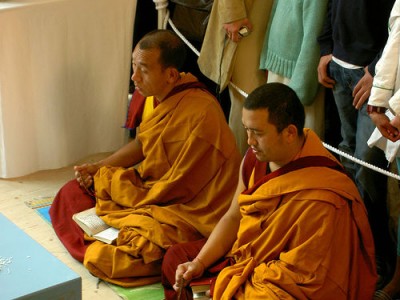
Obligatory meditation image. (Johan Stigwall)
Focused Attention
As would be expected, focused attention meditation increases activation in the brain areas implicated in the control and regulation of attention, such as the prefrontal cortex. The activation is higher in meditators with more experience, up to a point of about 19,000 hours practice. After 44,000 practice, there is an initial increase in activation, followed by a return to baseline. This means that after extensive training, it takes little effort for the attention to be controlled.
There are also differences in another brain area – the amygdala. This is an older part of the brain involved in emotion. Expert meditators have less amygdala activation than novices in response to emotional sounds. While sat in the MRI, novice and expert meditators were bombarded with distracting, emotionally provoking noises, such as a baby crying. Novices react to it, but while experts do hear the sound, they don’t react to it. They are less emotionally reactive to external events, and can hold their concentration in situations where in anyone else, the amygdala would be firing up so strongly that they would be powerless to resist its goal of redirecting their attention.
Open Monitoring
The overall effect of open monitoring is that the meditator is able to attend to all the stimuli coming at them, without getting ‘stuck’ on anything. They can just sit back and watch it all, or engage and disengage their attention as they please.
When under an EEG scan, the meditators were able to increase the gamma-band oscillations in their brain; these are usually quite weak, and difficult to detect. Gamma bands are important in attention and perception, but also in the transmission and integration of information across the brain. It is thought that this type of activity helps to integrate distributed neural processes into more ordered functions. There was also a change in the gamma bands when the monks weren’t meditating; showing that the ‘default’ setting had been altered.
Compassion Meditation
This type of meditation involves deliberately generating a state of unconditional compassion and kindness towards all beings, that saturates the whole mind. This is said to create more spontaneous acts of altruism in the meditator.
This was studied through fMRI scans. After thousands of hours of compassion meditation, the expert meditators were able to increase their empathic response to other peoples’ social signals. The brain area involved (the insula) is thicker in expert meditators than novices, and there was also greater activation in the areas associated with reading others’ mental states. In other words, by systematically creating a concern for others, the meditators are better able to process the emotions of others.
These have been quite revolutionary findings in neuroscience, showing that things like attention can be trained and develop, where previously they had been thought to be relatively fixed.
Recommended Reading:
Comments
30 responses to “The Buddhist Brain”
Interesting. That’s the first time I’ve heard of compassion meditation. I think I’ll look into it. Although I’ve only recently started meditation I’ve noticed that my mental focus has improved quite noticeably. Awareness of my own emotions and the emotions of others, however, hasn’t seemed to have changed much.
Hey Kenji,
How long do you meditate for on each session? I’ve found that if I do 15 minutes of meditation, I can do it fine for 2-3 days, but after that it becomes really difficult to stay focused during meditation.
I was speaking to a guy on my course who was part of a 3 month study (8 hours per day) of meditation, he likens it to exercise, you’ve got to keep doing it and keep practising to keep the results.
Warren
I’ve been doing 30 minutes daily. I’ve noticed that the longer you do it, the more quiet your thoughts get. Several times I had songs stuck in my head when I started meditating. I just concentrated on my breathing and stopped worrying about the music in the background. Eventually the music dissipated.
It seems like the more time you give less attention to your thoughts, and more on your breathing, your thoughts seem to slow down and grow more quiet. At least that’s my own anecdotal experience.
Sometimes it takes 20 minutes for my thoughts to finally quiet down and sometimes it takes less. It depends on how emotionally agitated I am that day.
I found this meditation guide very helpful, by the way:
http://www.freebuddhistaudio.com/talks/details?num=M10A
Thanks for posting that. I had heard about these Buddhist dudes being able to show no sign of reaction under the most provocative of conditions and wondered if any of this had been independently and scientifically validated.
Glad to hear its not all just some kind of supernatural nonsense. Though I still have reservations about some of Buddhists more far-fetched claims.
Kenji,
Alright, I’ll give 30 minutes a day a try for a while, see how it works out. Yes I’ve had that ‘song in the head’ phenomenon too. Thanks for the link, looks very useful. I’ve tried an mp3 from http://www.mentalworkout.com/, it seems ok so far but I’m going to give it a longer test before could say for sure.
I did wonder if using a ‘guide’ during mindfulness is a bit counter-productive? Kind of like doing weights, but having a spotter take most of the weight. You’re not getting a proper workout. I might email them and see what their opinion on that is.
Mohinder,
Yes it does seem validated. Would be a great trait to have, I feel. Yes I agree that other claims seem far-fetched…things like reincarnations…I don’t have a clue how that could even be tested either.
Warren
Warren: Look up (even through Wikipedia) a researcher called Ian Stevenson. Fascinating.
Had a quick look – interesting, I shall look into this in more depth.
Cheers,
Warren
[…] Thinking: What is the brain impact of different types of meditation (focused, open monitoring, […]
[…] Thinking: What is the brain impact of different types of meditation (focused, open monitoring, […]
There has been great interest in studying a budhhist monk’s brain in recent years. And rightly so. We are all fascinated by what meditation can do. I personally believe in meditation’s ability to make us a happier person.
In fact, I’ve read of a study where to conducted a similar study such as the one this article described and the leading neurologist commented how the monk must have been the happiest person alive – based on his observation of the fMRI.
.-= Andre “Brain Fitness Coach” Auerbach´s last blog ..Brain Killing Food: What You Eat Can Deteriorate Brain Function =-.
I think that might be Matteui Ricard, there are videos of him on You Tube.
I have been sitting for 10 years and an average of 2 hours a day for the last five. It is true you become keenly aware of your emothions and the emotions of others. Even to the point of you are aware when someone has thier attention on you even if they are out of sight and silent. Also I can go so deep that that all perception stops. No sight sound taste, touch, phenomina thoughts or anything. When I come out of this state I am blissed out and radiate energy. According to my family and others I radiate energy all the time and they can feel it. there are other experiences that would not be helpful to discuss here or with anyone who was not a dedicated and experienced practitioner. Consistancy and patient will yield amazing results after years of practice. Sitting my be the best thing you can do for yourself and those around you.
Wow! Thanks for stopping to leave a comment, it’s good to hear from someone who has a large amount of experience with meditation. What form/s of meditation do you practice?
Now you’ve just got me curious about those other experiences, sure you don’t want to go into a little more detail there? Even by email if you don’t want to discuss publicly?
Thanks,
Warren
Impressive post – maybe I should try it out to mediated but 19.000-44.0000 is not something what you make at an weekend 😉
.-= Buddha amulet´s last blog ..Buddha Statue =-.
Just finished reading Rick Hanson’s “Buddha’s Brain”– fascinating stuff; he and Dan Siegel’s work. As a long-time meditator, I find all of this quite intriguing. Dr. Hanson is offering some online events coming up later in the month where he’ll be presenting some of his latest findings, etc. Looks pretty cool… http://tiny.cc/64m8p
take care,
matt
Now I know what do these monks are doing in their chapels.
Interesting findings. I’ve been getting into Buddhism and meditating the past few weeks, and so far I’ve noticed a gradual change in my mental functions. Before I might think an obsessive/negative thought and would keep on tracing thinking it over and over.. I’d trace it to another thought, and that’d lead to yet another thought.. After meditating, I would still think those negative thoughts but it would just float in my mind and would dissipate.
I haven’t received any formal training in meditation though. For me, I’m just sitting alone in silence, not in any particular stance, and just letting things be. Sometimes I focus on my breath but most of the time I try and be as still as possible.
.-= Henway´s last blog ..My Colon Cleanse Journal =-.
Awesome post! I always like to see scientific evidence of what I’m experiencing. It just bridges the gap for those not willing to start because of not being sure if it’ll work.
Heard a lot about things noticed in the arterior cingulate and prefrontal cortex. Both associated with emotional stability and ability to take control of ones actions, and be effective; overcome addictions/ mental illness. So much science, but too little practice, I think some of us just need to get down and do it.
🙂
I love that graphic at the top of the post of the theta brainwaves before and after synchronisation. Having been in some really deep theta states through hypnosis I can confirm that it feels as great as it looks.
Thanks for a great post.. 😀
Alex
.-= Alex´s last blog ..Overcoming Fear of Flying Is All About Understanding Your Brain =-.
Meditation is something that I’ve discovered more recently – I practice 2-3 times a week and combine it with Sauna. That said, 44,000 hours in focused meditation still sounds kinda crazy 😀
.-= Jane´s last blog ..Suffering From Candida Try Garlic =-.
[…] study employing brains scans suggests that people who practice Buddhist meditation on regular basis process information about […]
I was dabbling with meditation for some years and it felt good but when I went to a 10 day silent meditation retreat and did meditation for 10 hours a day every day it really changed something in my brain.
I gained the ability to more easily remove myself from situations. To take a step back and just observe what’s going on inside of me. When I realized this it was a pretty life changing experience and I hope more people can learn this. It’s awesome! 🙂
Jay,
That’s awesome! I’ve been thinking of taking a 10-day retreat for a long time, and I know I will eventually.
How long ago did you do it?
Hi Warren,
that was about 1,5 years ago. Since then I went to similar retreats on a regular basis and my ability to just observe got better and better.
I meditate just about 10-20 minutes every day to keep myself “trained” and I use the retreats to really make progress (of course without being attached to the idea of making progress!) I’m just there and do and do and be and be 🙂
It is also funny how the perception of time changes when you are longer in the state of being. If people complain that time goes by faster when they get older… meditation changes that!
I have some recommendations for retreats in Europe and Thailand if you are interested. I prefer the Thai (Vipassana) retreats though because they are a bit rougher but the results are greater too.
Best,
Jay
Yes definitely let me know about the retreats in Europe and Thailand… I appreciate that. Europe preferably, as long as they speak English at the retreat of course.
What other changes have you noticed as a result of meditation? How has it affected you emotionally, and in your dealings with other people?
Thanks!
In Europe try http://www.plumvillage.org (France) and in Thailand http://www.watkowtahm.org/
In dealing with people or in general with feelings I’m simply calmer, more positive and understanding (with others and myself).
I don’t jump to conclusions that quickly because I have a bit more time in which I see my thoughts arise and that helps me to be a better listener.
I realized how often I had already made up my mind and stopped listening in the past. The constant observing of thoughts while practicing meditation helps to learn to not jump to conclusions too quickly.
This plus on control over my thoughts and feelings also increases my overall level of happiness. I haven’t been flourishing like I do right now since I was a kid. (I’m 30 now so this has been a few years!)
Get into meditation Warren! You’ll love it!
Thanks Jay! I’ve been meditating on and off for a year or two now, I’ve done maybe a few hundred hours total. A retreat has been on my to-do list for a while, and I think I have a chance to do one soon, maybe later this year.
I really like your site by the way!!
Sounds good! I’m sure chances are a retreat can “push you over the edge” like it did for me.
Glad you like my site. I just finish up the final lessons of the course and will then launch the site in a few weeks.
Let me know if you make it to Thailand, I might be around and we can go for a few drinks or so. (We have a house over there, so I visit frequently)
OK cool, thanks! I doubt I’ll make it to Thailand. I’ll maybe move there for a few months next year since my income is location-independent and therefore cheap foreign countries are very appealing! I’ll let you know if I make any plans. Where are you otherwise, Germany?
Yes let me know when your site is launched and I’ll make a post about it.
I will move back to Germany (from Thailand) by the end of the year. Location independent income is awesome, glad you have this freedom. Thanks for the support!